
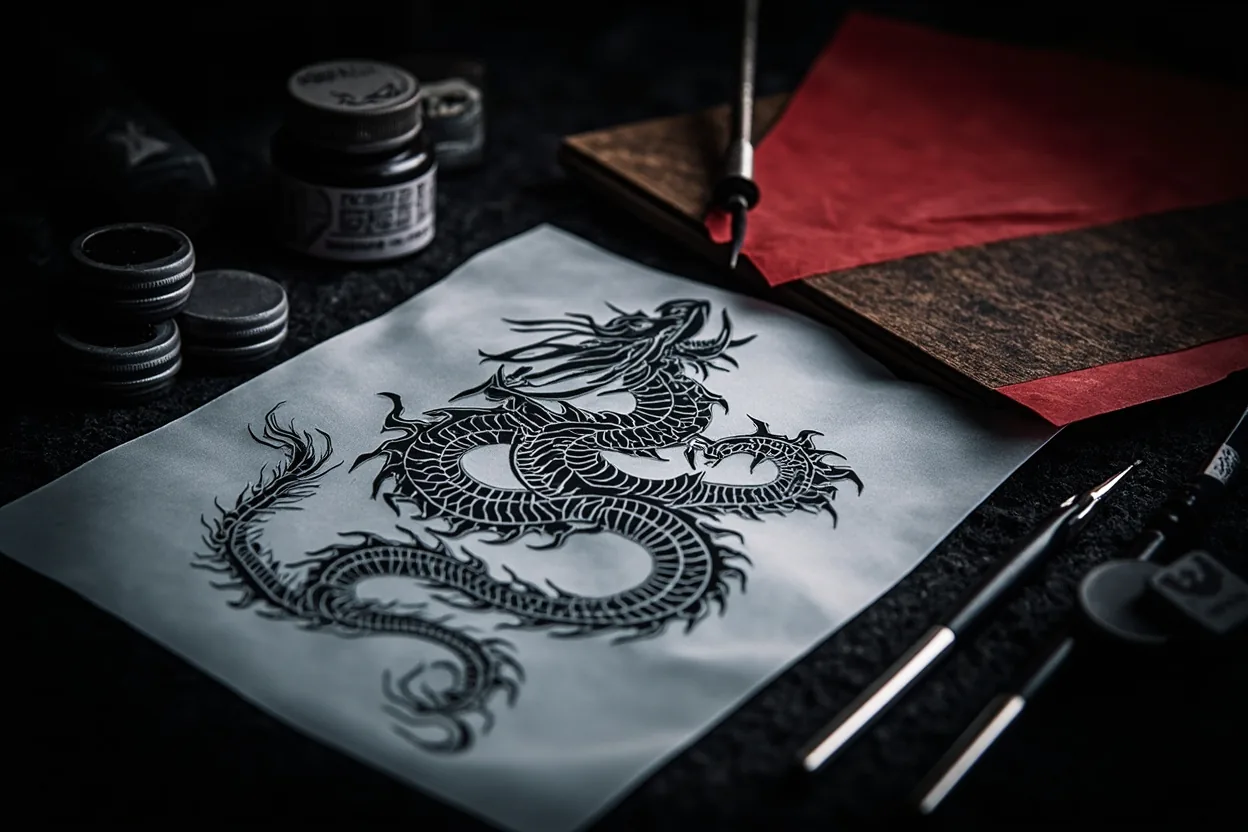
Dragon tattoo meaning changes dramatically by style. A Japanese dragon, Chinese dragon, Western dragon, blackwork dragon, and fantasy dragon do not carry the same mood.
Quick answer: Dragon tattoos can mean power, protection, wisdom, luck, strength, chaos, guardianship, transformation, or danger. Japanese and Chinese dragons often lean toward wisdom and protection, while Western dragons often lean toward force, treasure, and threat.
Dragon meanings by style
Before choosing a dragon tattoo, choose the tradition or visual language you are referencing.
| Idea | Best use | Watch-out |
|---|---|---|
| Japanese dragon | Protection, wisdom, water, strength | Research motif rules |
| Chinese dragon | Luck, power, imperial force | Cultural context matters |
| Western dragon | Danger, fire, treasure, force | Can look fantasy-heavy |
| Blackwork dragon | Power and graphic impact | Needs strong silhouette |
| Fine line dragon | Subtle mythic symbol | Detail can collapse |
Japanese Irezumi dragons carry specific weight: a three-clawed dragon means earth, five-clawed means imperial power, and a dragon coiling upward signals good fortune while one diving downward signals protection. Chinese dragons in traditional American or neo-trad styles read differently, usually bold outlines and saturated fills, built to last 20-plus years without muddying. Celtic knotwork dragons are tighter compositions, all interlocking linework, and they demand a precise hand or the geometry collapses on healing.
Black and grey dragons pull meaning from shadow placement. A heavily shaded underbelly with lighter scales on top reads as strength and depth, not just style preference. Watercolor dragon treatments look striking fresh but the soft edges and unsaturated pigment fade faster, especially on high-wear zones like the inner wrist or hand. Fine line dragon work is popular right now, but those delicate lines can blow out on skin that runs oily, so placement and artist selection matter more than the style alone.
Dragon tattoos need scale
The culture you pick changes everything, same dragon, completely different message.
Dragons are long, detailed, and movement-heavy. They usually work better as medium or large tattoos than tiny symbols.
Back, thigh, upper arm, chest, shoulder, and sleeve layouts give the dragon enough room to move. If you want a small dragon, simplify the silhouette aggressively.
A dragon crammed into a 3-inch box loses everything. The serpentine body, the claw detail, the face, none of it reads from across the room. The design needs room to breathe, which means thigh, back panel, sleeve, or full ribcage are your real options for anything with serious detail. A quarter sleeve technically fits a dragon but you’re choosing between decent body coverage and a face that actually has expression.
Scaling also affects line weight. On a back piece, your artist can run bold outlines, maybe 5 to 7 needle groupings on the main contours, and those lines hold sharp for decades. Compress that same design onto a forearm and those thick lines compete instead of guide the eye. Flash-style dragons on smaller placements work when the artist simplifies aggressively, drops secondary detail, and commits to black and grey or a tight two-color palette. Ask to see healed photos, not just fresh ones.
Choose the right artist
Dragon tattoos expose whether an artist understands anatomy and style rules.
- Ask for dragon or large-scale animal examples.
- Ask how the body will curve through the placement.
- Ask what cultural references are being used.
- Ask whether the size is large enough for claws, face, and scales.
Dragon work has a real specialization split. Someone who does incredible fine-line botanicals is not automatically your person for a traditional Japanese dragon with scales, flow, and a full background. Look at their portfolio specifically for elongated compositions, scale texture, and how their clouds or water elements integrate with the figure. If their portfolio has zero dragons, ask why before you book, not after you’re in the chair.
Consultation matters more for dragons than almost any other subject. A good artist will tell you if your placement idea kills the design, if your reference is too complex for the size you want, or if a particular style won’t heal well on your skin tone. Expect to pay a deposit, usually $100 to $200, and expect multiple sessions for anything full-sleeve or back-panel. Rushing a dragon into one long session to save on return visits usually means rushed shading and corners cut on detail.
Dragon tattoo mistakes
Do not copy a dragon from a fantasy image and expect it to tattoo well. Skin needs cleaner shapes and stronger contrast.
Do not mix Japanese, Chinese, and Western dragon cues without understanding what each one signals. The result can look confused instead of custom.
The most common mistake is mismatched scale and complexity. Clients bring in a full A3 reference print and want it on a calf, then wonder why the healed version looks muddy. Dense scale patterns need space or they merge into gray blobs after the first heal cycle. Your artist should be telling you this at consultation. If they’re not, that’s a red flag worth acting on.
Second big mistake is ignoring placement pain when booking. Ribcage, ditch of the elbow, and back of the knee are spicy spots, and a long dragon composition often crosses multiple zones in one session. Factor that in honestly. Numbing cream helps but it can affect how skin takes ink in some cases, so talk to your artist before you show up with a tube of Emla. Also, dragons on hands and necks are high-wear, which means fading within two to three years and potential blowout on fine detail, especially around the claws and face.









