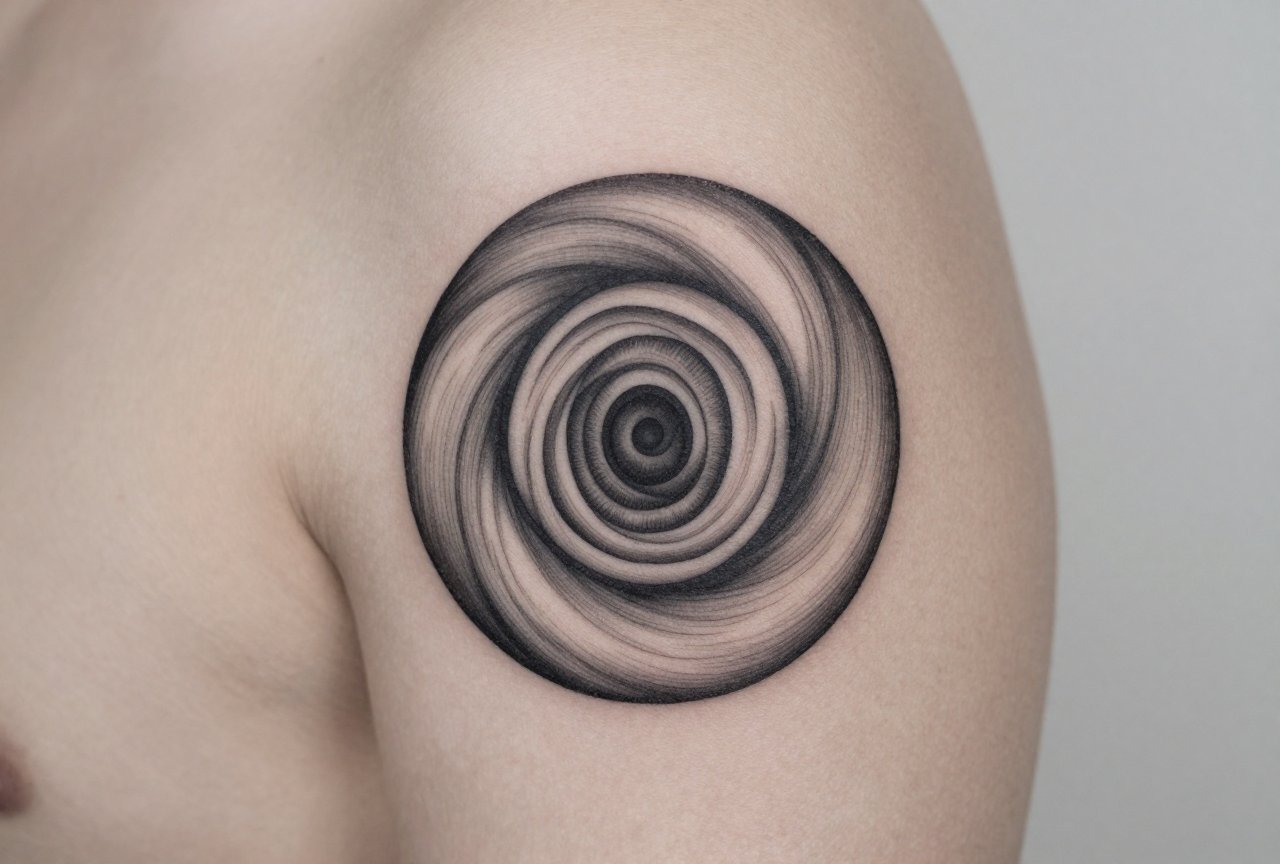
The enso is a hand-drawn circle, usually done in one or two uninhibited brushstrokes, and it carries the weight of centuries of Zen Buddhist practice. this tattoo represents enlightenment, the beauty of imperfection, and the acceptance of life’s incompleteness. I’ve tattooed dozens of these over the years, and what strikes me every time is how much personal story gets packed into such a deceptively simple shape.
Symbolism & History
Where the Enso Comes From
This isn’t some trendy symbol cooked up for Instagram. The enso has roots in Japanese Zen Buddhism going back to at least the 1600s, though the practice of creating it is older. Monks would paint these circles with sumi ink on rice paper as a form of meditation, a single breath and single movement capturing a moment of complete presence. The circle might be open or closed, thick or thin, perfectly round or wobbling off-kilter. Each variation held meaning about the artist’s state of mind.
What I tell clients who sit in my chair asking for this: the enso isn’t about getting it right. It’s about the attempt. The wobble in your circle? That’s the point. The gap where the brush didn’t quite meet? That opening represents the idea that the path to enlightenment is never fully closed, never finished.
Core Meanings Today
- Enlightenment & awakening: The moment of creation mirrors the flash of insight
- Imperfection (wabi-sabi): Finding beauty in flaws, asymmetry, and the incomplete
- Strength in simplicity: One motion, one breath, no overthinking
- Cycle & continuity: The circle as life’s ongoing nature, birth to death to rebirth
- Acceptance: Letting go of control, embracing what emerges
I’ve had people tear up explaining why they want this. A woman who survived cancer wanted the open circle because her life felt unfinished, still unfolding. A guy leaving a strict religious background got it as permission to be imperfect. The enso holds whatever you bring to it.
Common Variations & Styles
Open vs. Closed Circles
This distinction matters more than most people realize when they first walk in. A closed enso can suggest completion, wholeness, the cyclical nature of existence. An open circle, where the brushstroke begins and ends without meeting, speaks to impermanence, the idea that nothing is ever fully finished, that there’s always room for growth. In my experience, about sixty percent of clients choose the open version. It feels more honest, less final.
Stylistic Approaches
- Brushstroke realism: We build up texture with varying needle groupings to mimic real sumi ink bleeding into paper, soft edges, darker pools where the brush lingered, the occasional splatter
- Bold blackwork: Solid, saturated black with crisp edges; reads better from distance and ages harder on the skin
- Fine line: Delicate, single-needle work that looks ethereal fresh but requires touch-ups sooner
- With kanji: Often paired with characters for “mu” (emptiness), “shin” (heart/mind), or “zen” itself
- Color accents: Red seals (in the style of traditional hanko stamps), or watercolor splashes behind the circle, purists hate this, but it can work if the client connects with it
The brushstroke style is hardest to execute well. I’ve spent hours studying how sumi ink actually behaves on absorbent paper so I can replicate that organic bleed in skin. The best ones look like they were done in a single confident motion, even though tattooing demands we build that effect carefully, pass by pass.
Best Placements
Where you put an enso changes how it reads. This is a tattoo that needs breathing room; cram it into a busy spot and it loses its power.
- Forearm: Most common. Visible, flat canvas, the circle sits clean. Inner forearm feels more personal; outer reads bolder
- Upper arm/shoulder: Good for larger pieces, especially if you want the brushstroke texture to really show
- Ribcage: Painful, but the curve of the body can echo the circle in interesting ways. I’ve done a few here for yoga teachers who want it hidden but meaningful
- Back of neck: Small, subtle, almost like a secret. The hairline can frame it
- Chest: Over the heart, literally. Works well for larger, more expressive brushstrokes
- Ankle or wrist: Tiny ensos are trendy but tricky. Too small and the detail blurs within a few years; I usually talk clients up a half-inch larger than they initially want
Skin movement matters. The forearm twists, the ribcage expands. A circle on a bicep will distort when the muscle flexes. I always have clients move through their range of motion before we settle on placement. The enso should hold its integrity if you’re still or in motion.
Who Chooses This Tattoo / Personal Meanings
Patterns I’ve Noticed
After years in shops, you start seeing who gravitates toward what. The enso draws a specific crowd: people in recovery from something, creatives who’ve hit walls and broken through, spiritual seekers who’ve left organized religion but still want symbols, and surprisingly often, people in high-control professions, lawyers, surgeons, engineers, who are learning to let go.
A client I’ll never forget: a firefighter who’d developed severe OCD after a bad call. He got the open enso on his forearm where he could see it during rituals he was trying to resist. The gap in the circle became a visual reminder that control is an illusion, that the messy stroke is enough. He told me six months later it was the most effective “therapy tool” he’d found, though I always make clear I’m not making medical claims, just reporting what he experienced.
Why Simplicity Scares People
There’s a funny paradox with this tattoo. People want it because it’s simple, then worry it’s too simple. They ask about adding mandalas inside, or lotus flowers, or geometric patterns. Sometimes that works. More often, I talk them back to the raw circle. The courage to wear something minimal, to let it stand without decoration, that’s often the exact lesson the enso is trying to teach. The tattoo becomes practice.
Similar Symbols
Clients sometimes come in confused between the enso and related imagery. Here’s how we sort it out in consultation:
- Ouroboros: Snake eating its tail, Western symbol of eternal cycle. More narrative, more dark. The enso is quieter, more about the moment of creation
- Mandala: Intricate, balanced, geometric. The enso is the opposite: spontaneous, asymmetrical, done in seconds versus hours
- Infinity symbol: Mathematical, romantic, endless repetition. The enso acknowledges that things end; the gap is built in
- Celtic knot circles: Interwoven, complex, cultural. The enso is deliberately unadorned, almost aggressively simple
- Sun disc (Japanese hinomaru): Perfect red circle, national symbol, polished. The enso is personal, imperfect, black ink
I’ve had people switch from ouroboros to enso mid-consultation once they grasp the difference. The enso asks less of the viewer. It doesn’t explain itself. That restraint is its strength.
Final Thoughts
The enso tattoo works because it refuses to overwork. In a culture of endless optimization and curated perfection, wearing a circle that celebrates the wobble, the gap, the single breath, that’s quietly radical. I’ve watched this small mark change how people move through their day, catching their own eye in a mirror, remembering.
If you’re considering one, spend time with actual enso paintings before you come to a shop. Look at how different monks’ circles feel, some aggressive, some tentative, some almost laughing. Know which energy you want. Then find an artist who understands that this isn’t just a circle. It’s a captured moment, frozen in your skin, imperfect and complete exactly as it is.
Frequently Asked Questions
Does an open or closed enso have a specific meaning I should choose?
There’s no wrong choice, but traditionally an open circle suggests impermanence and ongoing growth, while a closed one can mean completion or wholeness. I usually ask clients which feeling resonates with their current life, not where they hope to end up. The honest answer is usually the right one.
How well does brushstroke texture hold up over years?
Fine, feathery edges will soften and blur faster than bold lines. I build texture with deliberate dark pools and clear value shifts rather than relying on superfine detail that won’t last. Expect a touch-up in 5-8 years if you want it crisp, which is normal for this style.
Can non-Buddhists respectfully get an enso tattoo?
Most artists and practitioners I’ve encountered welcome sincere appreciation, but approach it with education, not aesthetic shopping. Learn the history, sit with the meaning, and avoid pairing it with unrelated imagery that contradicts its spirit. Respect matters more than lineage.
What’s the typical price range for a quality enso tattoo?
Simple circles run smaller in time but you’re paying for precision and understanding of the form. In most US shops, expect $150-400 depending on size, location, and artist experience. Don’t bargain hunt; a bad circle is obvious forever, and this piece lives or dies on confident execution.
Related Tattoo Meanings
- Lemon Tattoo Meaning: Symbolism, Styles Placement Guide
- Let Them Tattoo Meaning: Release, Freedom Boundaries
- Spiritual Symbols Tattoo Meaning: Sacred Ink Across Cultures
- Explore more