Let’s cut straight to it: you can’t “delete” a tattoo like hitting backspace on a keyboard. But you can remove, fade, or replace it through several methods that range from expensive and painful to creative and strategic. I’ve watched hundreds of clients walk this road, some thrilled, some nervous, almost all wishing they’d known more before their first session. Here’s what actually works, what hurts, what costs, and what artists whisper about when the client leaves the room.
Laser Removal: The Real Deal
Laser tattoo removal is the only method that actually breaks down ink particles so your body can flush them out. It works, but it’s not the magic eraser people imagine. I’ve sent clients to reputable removal specialists for years, and the ones who do best are the ones who understand the grind.
How It Actually Works
A Q-switched or picosecond laser fires incredibly fast pulses at specific wavelengths. Black ink absorbs all laser colors, so it fades fastest. Colors are pickier, reds respond to certain wavelengths, blues and greens to others. White and flesh-tone inks? They can turn dark or oxidize weirdly, which surprises people who got that “invisible tattoo” trend.
Each session shatters ink deeper into particles small enough for your lymphatic system to carry away. Your body does the real work over weeks, which is why sessions are spaced 6-8 weeks apart minimum. Rushing it doesn’t speed anything up; it just irritates skin that’s already been through trauma.
Pain, Cost, and Timeline Reality
- Pain: Most clients say it hurts worse than getting tattooed, like hot rubber bands snapping, or bacon grease hitting bare skin. Numbing cream helps some; others say it barely touches the sensation. The laser feels different than a needle, more “shocking” than “grinding.”
- Cost: Small tattoos might run $200-500 per session. Full sleeves or large back pieces? You’re looking at thousands per session, multiplied by 8-15 sessions for complete removal. Insurance won’t touch it unless there’s a documented medical necessity.
- Sessions needed: Amateur tattoos with less dense ink might clear in 4-6 sessions. Professional work with saturated color and heavy black? 10-15 sessions aren’t unusual. Some shadows never fully disappear.
After each session, you’ll blister, scab, and peel. The area looks brutal for two weeks. Keeping it clean, out of sun, and un-picked is non-negotiable. I’ve seen people get infections because they treated it like a fresh tattoo they could show off, don’t.
Cover-Up Tattoos: The Artist’s Solution
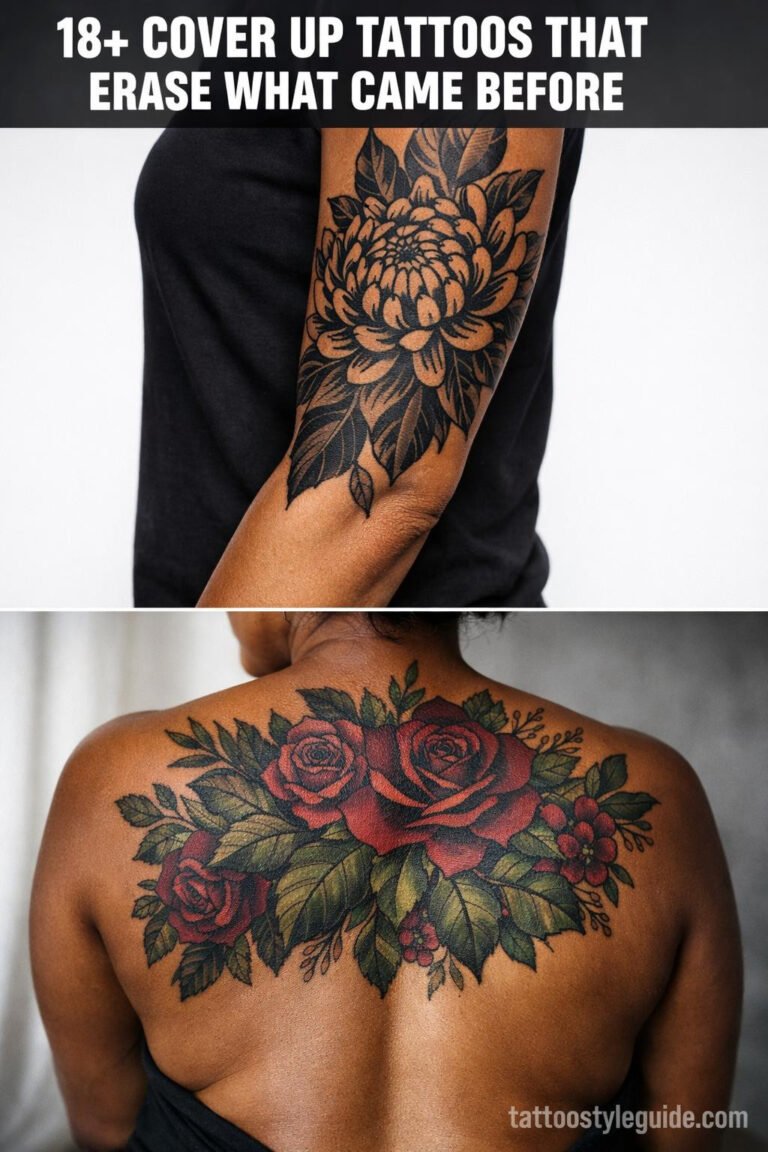
Most tattoo artists prefer this route. We’re builders, not destroyers. A good cover-up transforms something you regret into something you want to keep, and the process is genuinely creative rather than clinical.
What Makes a Cover-Up Work
Darkness covers darkness. We can’t tattoo lighter ink over darker ink and expect it to disappear, that’s not how skin works. Strategic design uses the existing tattoo’s shape, flows new lines through old ones, and leverages black and deep saturation where the old ink sits heaviest.
Flowers, mandalas, Japanese backgrounds, and neo-traditional designs cover best because they’re busy, organic, and forgiving. Straight lines and minimalism? Nearly impossible over existing work unless the original was very light and small.
Sometimes we “blast over”, tattoo directly with heavy saturation. Other times we fade the original first with 1-3 laser sessions to knock it back, then cover. That hybrid approach costs more but opens design options dramatically.
Choosing Your Cover-Up Artist
Not every tattooer does cover-ups well. Look for portfolios with healed photos, not just fresh ones. Ask specifically how many cover-ups they’ve done in the last year. A good artist will be honest about what’s possible, push back on unrealistic ideas, and probably charge more than their standard rate because cover-ups take more time, more ink, and more problem-solving.
Be prepared to give up some control. The best cover-ups happen when you trust the artist’s vision for what will actually work over your specific old tattoo, not when you force a design that doesn’t fit the canvas.
Fading and Lightening Methods
Between full removal and full cover-up, there’s a middle ground: fading the original enough that new options open up. Some methods work better than others, and some are outright scams.
Saline Tattooing and Glycolic Acid
Saline removal involves tattooing a salt solution into the skin to draw ink out. It works somewhat for cosmetic tattoos (eyebrows, eyeliner) and very superficial body art, but it’s inconsistent for professional tattoos with ink sitting deep in the dermis. I’ve seen it lighten small pieces, but “remove” is too strong a word.
Glycolic acid and other “tattoo removal creams” are largely ineffective. If they could actually penetrate to the dermis and break down ink without scarring, we’d be using them in shops. The FDA doesn’t regulate these products meaningfully, and the before/after photos are often edited or show natural fading over time, not cream results.
Natural Fading Over Time
All tattoos fade. Sun exposure accelerates it dramatically, that crisp black line work softens to gray, colors mute and shift. Some clients deliberately sun their regrettable tattoos to speed natural fading before laser or cover-up. It’s not efficient, but it’s free. The trade-off is skin damage that can complicate future work.
Older tattoos with less dense ink and simpler designs are easier to remove or cover than fresh, bold pieces. Time is a factor most people don’t consider when they’re panicking about a week-old tattoo they hate.
What About Surgical Options?
Dermabrasion, excision, and skin grafts exist but are rarely chosen for aesthetic tattoo removal anymore. Dermabrasion sands away layers of skin, painful, imprecise, often leaves scarring worse than the tattoo. Excision cuts the tattooed skin out and stitches the edges; only works for very small pieces, leaves a surgical scar.
I’ve seen these discussed more in prison tattoo contexts or emergency situations than in professional studios. Modern laser technology has made them largely obsolete for people who can access proper removal services.
Emotional and Practical Preparation
The tattoo industry has shifted. What was permanent and stigmatized is now more fluid. Artists don’t judge removal or cover-up clients the way some imagine, we’ve all got pieces we’d change, and we understand that skin evolves with the person wearing it.
Still, the process tests patience. If you’re lasering monthly for two years or sitting through a 15-hour cover-up sleeve, you’re committing to discomfort, expense, and uncertainty. The clients who handle it best treat it as a project, not an emergency. They research practitioners, save properly, follow aftercare religiously, and adjust expectations when progress surprises them.
One honest aside: I’ve watched people remove partner names, gang affiliations, impulsive vacation tattoos, and genuinely beautiful art that just no longer fit their lives. The reason matters less than the resolution. Good removal specialists and cover-up artists have heard everything, so honesty about your goals gets you better results than embarrassment.
Key Takeaways
- Laser removal is effective but expensive, multi-session, and genuinely painful, plan for 8-15 sessions over 1-2 years for complete removal.
- Cover-up tattoos offer creative transformation but require experienced artists and often darker, busier designs than you might initially want.
- Partial fading through limited laser sessions opens up cover-up possibilities that pure tattooing cannot achieve.
- Saline and acid methods have limited effectiveness; creams are largely ineffective for professional tattoos.
- All methods require proper aftercare: keep clean, avoid sun, don’t pick scabs, and follow your practitioner’s specific guidance.
- Consult with both removal specialists and tattoo artists before deciding your path, many cases benefit from hybrid approaches.
- Time, money, and patience are your real tools; anyone promising quick, cheap, painless removal is selling something that doesn’t exist.
Your tattoo doesn’t have to be forever in exactly the form it is now. Options exist, they’re imperfect but improving, and the right approach depends on your specific ink, skin, budget, and what you want the end result to be. Talk to professionals who’ll show you healed results and give you straight answers, not sales pitches. The skin you’re working with has to last your whole life, treat the process with that same long view.
Related Tattoo Guides
- How to Use Tattoo Transfer Paper: A Complete Guide
- How Much Does Tattoo Removal Cost in 2024?
- How Much Do Tattoo Artists Make in 2024
- Explore more
Frequently Asked Questions
How long does it actually take to fully remove a tattoo with laser treatments?
Most tattoos require 6 to 12 laser sessions spaced 6 to 8 weeks apart, so the full process typically takes 1 to 3 years depending on ink colors, depth, and your immune system.
Can I completely remove a tattoo at home with creams or salt scrubs?
No, topical creams and DIY methods cannot reach the dermis where tattoo ink resides; they only damage the skin surface and may cause scarring without fading the actual tattoo.
Does tattoo removal hurt more than getting the tattoo?
Many people describe laser removal as more painful than tattooing because it feels like hot rubber bands snapping against the skin, though numbing creams and cooling devices help manage the discomfort.
Will my skin look normal after the tattoo is fully removed?
Complete clearance is possible but not guaranteed; some patients have slight skin texture changes, ghosting, or hypopigmentation, especially with older laser technologies or darker skin tones.