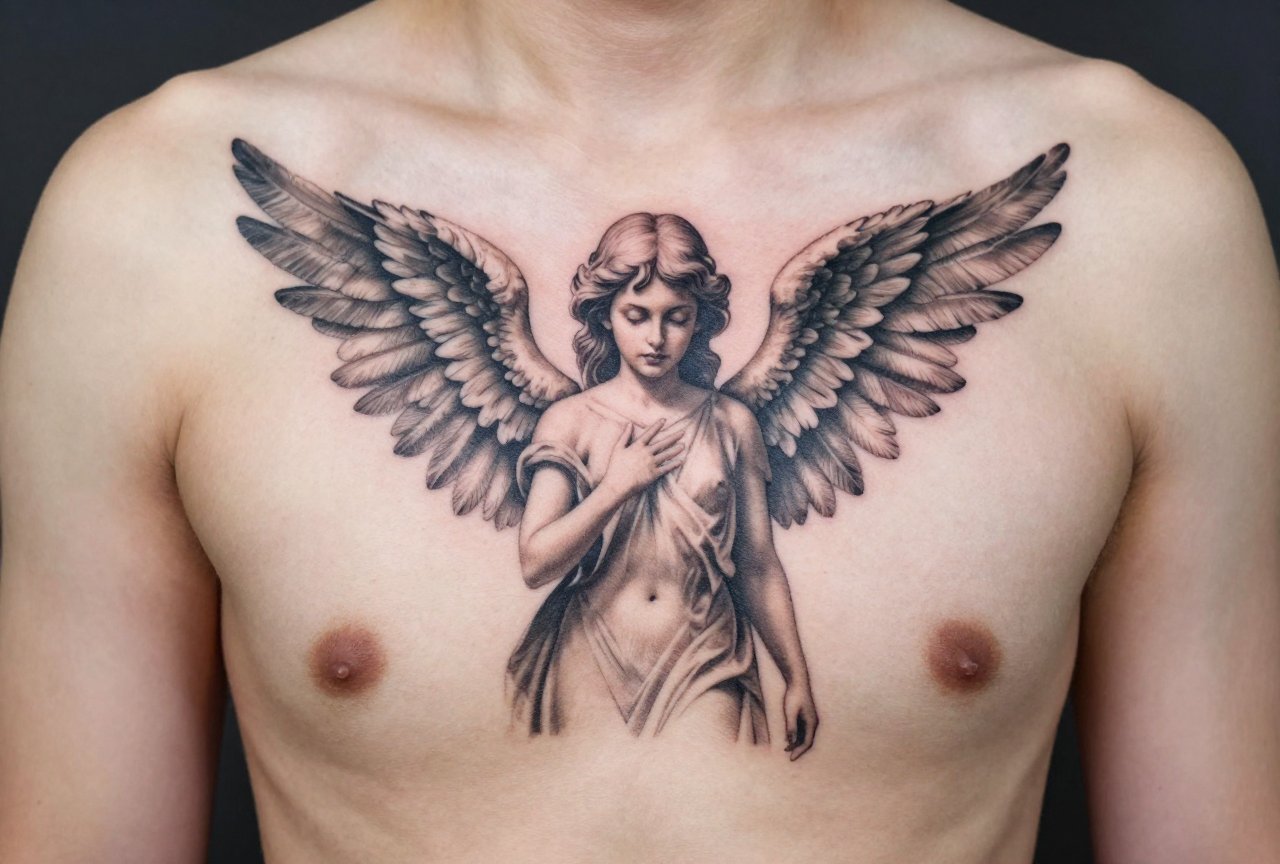
A realistic angel tattoo isn’t some soft, glowing figure with a halo slapped on. Done right, it’s a portrait of something divine rendered in human skin, every feather, every fold of fabric, every catch of light on a cheekbone built from needlework and patience. I’ve tattooed angels that took twelve hours and angels that took thirty. The difference between a powerful piece and a wall-hanger sticker comes down to understanding what realism actually means when you’re translating it onto a body that moves, ages, and lives.
Origins & History
From Church Walls to Skin
Realism in tattooing borrows directly from Renaissance and Baroque religious painting. Those masters, Caravaggio, Bernini, the guys who spent years on a single ceiling, were obsessed with making the divine look physically present. Angels weren’t cute. They were messengers, warriors, mourners. When realism hit tattooing in the late 80s and 90s through artists like Paul Booth and later Nikko Hurtado, that same gravity came with it. We started seeing skin rendered like oil paint, and angels became a natural test of skill.
In my chair, clients bring me reference from Italian churches, from pre-Raphaelite paintings, from their grandmother’s funeral cards. The good references have weight. The bad ones look like Hallmark ornaments. I tell clients: pick something that scares you a little. That’s usually the image with enough substance to carry realism.
How the Style Matured
Early realistic tattooing struggled with contrast. Skin isn’t canvas; it blurs, it scars, it changes. The breakthrough came when artists stopped trying to copy photographs and started building images that would settle into skin gracefully. Angel tattoos were perfect for this evolution because they demand both softness and structure, exactly what skin rewards when you understand it.
Key Characteristics & Motifs
What separates a realistic angel from illustrative or neo-traditional versions? Here’s what I look for in a design that’ll actually work:
- Facial structure grounded in anatomy: Even idealized faces need bone beneath them. I map cheekbones, orbital sockets, the tension in a jaw. Without this, you get a doll, not a being.
- Feathers with individual weight: Each feather catches light differently. I build them from the shaft outward, barbs that fray, that overlap, that cast tiny shadows on the feather beneath. This is where days disappear.
- Fabric that moves: Drapery in realism isn’t decoration. It describes the body under it, the wind, the moment. I study how cloth pools, stretches, goes translucent at edges.
- Light source consistency: Nothing kills realism faster than light coming from three directions. I pick one source and commit. Everything bends to it.
- Emotional register in the eyes: The best angel tattoos I’ve done, the ones that still hit me years later, have eyes that hold something specific, grief, vigilance, terrible mercy.
We see this a lot: clients want an angel that’s “peaceful” but bring reference of faces with no tension, no story. I push back. Realism without narrative is just technique. Technique without soul is wallpaper.
Color vs Black and Grey
Black and Grey: The Classic Move
This is where I spend most of my time. Black and grey realism on angels lets you push depth without fighting skin’s limitations. I build faces from dark umber washes, pulling highlights with negative space and skin tone. The result ages beautifully, ten years out, a well-executed black and grey angel still reads as dimensional because the contrast structure was sound from day one.
Skin undertones matter here. On cooler skin, I warm my grey mixes slightly. On olive or deeper skin, I go heavier on the blacks to maintain punch as the grey settles. This is shop-floor knowledge, not theory. I’ve watched pieces I loved at six months go muddy at five years because I didn’t account for how that particular client’s skin holds pigment.
Color: Higher Risk, Higher Reward
Color realism on angels is stunning when it works. Flesh tones, gold light, the impossible blue of certain skies. But color fades differentially, reds hold, yellows vanish, skin tones can go ashy. I only recommend full color for angels if the client understands touch-ups are part of the deal, not a failure. And I avoid color on high-movement areas for large pieces; the stretching distorts those subtle transitions that make realism work.
Best Placements
Realistic angels need real estate. This isn’t a style that works at two inches. Here’s where I’ve seen them succeed and fail:
- Full back: The classic. Wingspan across the shoulder blades, figure descending or ascending the spine. Gives you the full wings, the drapery, the narrative space. I’ve done backs that took forty hours over a year. Worth it.
- Upper arm to half sleeve: Portrait focus, single wing wrapping the deltoid. The curve of the muscle becomes the curve of the wing. This is where I place guardian-type angels, watching, protective, contained.
- Thigh: Underrated. Flat when sitting, the thigh lets you build a seated or kneeling figure with fabric pooling. Painful, but the canvas is generous.
- Chest: Risky. The sternum moves, the skin stretches with breath. I do chest angels smaller, more focused on face and hands, letting the chest’s center line become a compositional element rather than fighting it.
- Forearm: Only for smaller portrait studies. Full wings here look cramped in five years. I talk clients down from this regularly.
Healing reality: backs and thighs are easier to keep clean and protected during that first two weeks. Chest and arms get bumped, sun-hit, slept on wrong. I always factor placement into my aftercare talk.
Who It Suits
Not everyone should get a realistic angel. I say this as someone who makes money doing them. You need patience for the session count, the healing, the touch-ups. You need skin that cooperates, heavily tanned or damaged skin loses the subtle greys that make realism breathe. And you need a reason beyond “angels are pretty.”
The clients I love working with bring personal loss, specific protection, a moment they want held. The tattoo becomes a memorial or a ward, not decoration. That intention shows in how they sit, how they heal, how they carry the piece years later. I’ve tattooed angels over surgical scars, over burns, over hearts that needed something watching. Those are the ones that matter.
Modern Variations
Fallen and Broken
Current shop culture leans into damaged angels, torn wings, bloodied faces, the divine interrupted. I get it. There’s more visual drama, more emotional immediatey. But I caution clients: broken without context becomes edgy wallpaper. If you want fallen, tell me what they fell from. That story becomes the design.
Hyper-Realistic Hybrids
Some artists are blending photorealistic faces with more stylized wings or backgrounds. I do this sometimes, anchor the face in absolute realism, let the wings go slightly illustrative for readability at distance. It solves the aging problem: the face stays, the wings read as wings even as they soften.
Choosing an Artist
This is where I get blunt. Not every realism artist can do angels. Portraits of people, sure. Cars, animals, fine. But angels require understanding idealized anatomy, the specific physics of wings, the emotional weight of religious or spiritual imagery. I’ve fixed too many angel tattoos where the artist was technically skilled but culturally clueless, wings attached backward, faces that were just pretty women with no presence.
- Look for healed photos, not fresh: Fresh realism looks like a photograph. Healed realism shows whether the artist understands skin. Ask for five-year photos. If they don’t have them, you’re the experiment.
- Check their religious or spiritual portfolio: Even if you’re not religious, this shows they’ve thought about the iconography. I have clients who are atheists who want angels as pure art. Fine. But I learned my craft partly through understanding what these images meant to believers.
- Ask about their reference process: Do they composite from multiple sources? Do they understand why Bernini’s angels work structurally? The good ones light up talking about this. The bad ones say “yeah, I can do that.”
- Budget honestly: A full back realistic angel from someone who knows what they’re doing is thousands, plural. Over multiple sessions. Anyone quoting you a single day and under a grand is either doing something small and simple or something that’ll need heavy fixing.
I tell clients: this is a collaboration that takes longer than some relationships. Choose someone you can sit across from for thirty hours without wanting to strangle them.
Final Thoughts
Realistic angel tattoos sit at the intersection of technical demand and emotional weight. They’re not the easiest style to wear, not the fastest to execute, not the most forgiving as they age. But when they’re right, when the light hits a healed shoulder blade and the wing still lifts, still watches, still holds whatever you needed held, they’re among the most powerful images we can put on skin. I’ve been doing this long enough to know the difference between a tattoo that impresses at the shop and one that lives with you. Aim for the second. The first is easy. The second is why we keep working.
Frequently Asked Questions
How long does a realistic angel sleeve typically take?
A half sleeve with realistic angel work usually runs 15-25 hours depending on detail level. Full sleeves with extensive wing work can push 40-50 hours. I always break this into sessions of 4-6 hours max, skin and client stamina both have limits.
Will an angel tattoo with lots of grey shading look blurry in ten years?
Not if the contrast structure is built correctly. I use darker anchors around grey areas so even as the mid-tones soften, the form holds. The enemy of aging isn’t grey, it’s grey without black beneath it.
Can you cover an old tribal tattoo with a realistic angel?
Sometimes, but it depends on the black density and placement. Heavy tribal on a back can become the dark background an angel emerges from, I’ve done this. But tribal on a forearm or anywhere the new image needs light skin? That’s usually laser territory first.
Do I need to be religious to get an angel tattoo?
Absolutely not. I’ve tattooed angels on atheists, Buddhists, people who just lost someone and needed a watcher. The image carries weight regardless of your belief system. What matters is that you carry it with intention, not emptiness.
Related Style Guides
- Realistic Owl Tattoos: A Working Artist s Guide
- Realistic Tiger Tattoos: Complete Style Guide
- Realistic Heart Tattoos: Complete Style Guide
- Explore more