
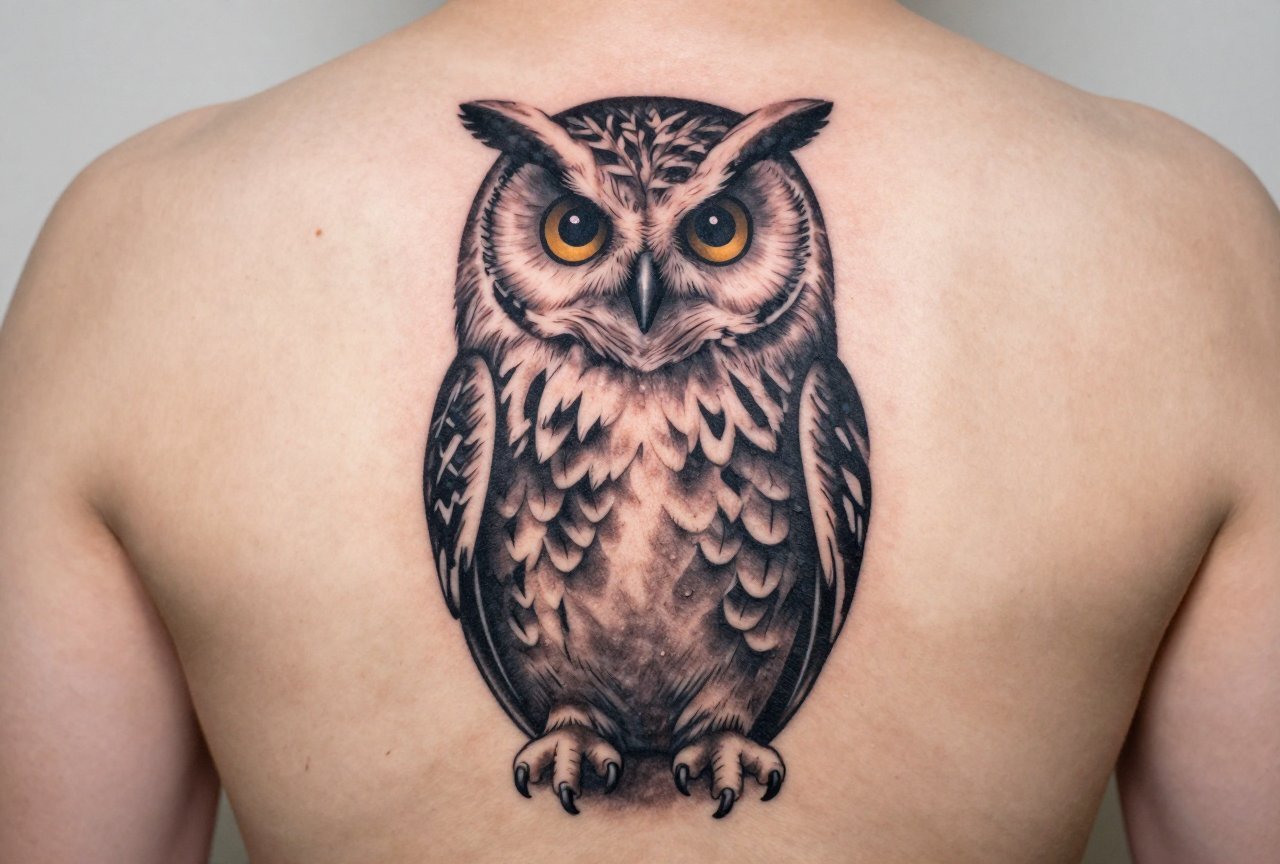
Realistic owl tattoos sit in that sweet spot between wildlife art and portrait work. I’ve tattooed dozens of them over the years, and they never get old. There’s something about translating all that feather texture, those huge forward-facing eyes, and the flat face disc into skin that pushes you as an artist. Done right, a realistic owl can look like it’s about to blink off someone’s arm. Done poorly, it turns into a muddy blob that the client covers up in three years. This guide comes from actual shop hours, not Pinterest boards.
Origins & History
From Scientific Illustration to Skin
The realistic style owes a huge debt to 19th-century naturalist painters like Audubon. Those plates weren’t just art; they were documentation. That obsession with accuracy carried into tattooing through the 1970s and 80s when artists like Don Ed Hardy started pulling from fine art references instead of flash sheets. Owls specifically gained traction as wildlife tattooing exploded in the 90s. I remember older artists in my first shop rolling their eyes at “another goddamn barn owl,” but the clients kept coming. There’s a reason. Owls carry weight across about every culture, and people come in with stories already attached.
Why Owls Specifically
Unlike eagles or wolves, owls have that alien quality. The asymmetrical ear openings, the neck rotation, the silent flight. All of it translates visually to interesting tattoo work. I’ve had clients cry in my chair talking about a grandmother who collected owl figurines. I’ve had others who just think they look cool as hell. Both are valid starting points. The realistic style lets you honor either motivation without slipping into cartoon territory.
Key Characteristics & Motifs
Realistic owl tattoos aren’t just detailed. They’re strategically detailed. Here’s what separates the good ones from the Instagram traps:
- Eye work: The eyes are everything. In a realistic piece, they need depth, reflection, and that wet glass quality. I spend more time on the eyes than the rest of the head combined sometimes. Two concentric circles of color, a catchlight, subtle shadow in the iris. Get it wrong and the whole bird looks dead.
- Feather grouping: Real feathers don’t read as individual strands. I group them in layers, using negative space and varying line weight to suggest texture without drawing every barb. The facial disc feathers are softer, more diffuse. The wing feathers are harder, more defined.
- Beak treatment: That hooked beak needs to read as keratin, not plastic. I use warm greys, subtle yellows, always a highlight where light catches the curve.
- Ear tufts vs. round heads: Great horned owls give you those dramatic tufts to frame the face. Snowy owls are rounder, more minimalist. Each species demands different technical approaches.
Common Companion Elements
Clients often want moon phases, pine branches, or geometric frames. I don’t fight it if the composition makes sense. But I do push back when someone wants a full forest scene behind a 3-inch owl on their wrist. Scale matters. The owl should dominate. Everything else is atmosphere.
Color vs Black and Grey
This is the conversation I have most often in consultations. Here’s the real breakdown from someone who’s done both hundreds of times.
Black and grey ages cleaner, period. The contrast between soft grey feather tones and deep black shadows holds up for decades. I can push saturation in the eyes, deep blacks in the pupils, and let the rest breathe. For barn owls, great horned owls, any species with strong contrast patterns, black and grey is my default recommendation.
Color works for specific species and specific clients. Snowy owls need that warm cream, the faint barring. Great grey owls have those concentric facial rings that color makes sing. But color realism on owls is unforgiving. The feather textures already compete for visual space; adding saturated color can tip into chaos. I use muted palettes, earthy tones, and I always warn clients: color realism needs touch-ups. The yellows and soft oranges in beaks and eyes fade first. Plan for it.
The Hybrid Approach
More artists are doing black and grey bodies with selective color pops in the eyes. It’s a smart compromise. The bird stays readable long-term, but you get that arresting stare. I’ve been doing more of these lately, especially on clients who want impact without the maintenance burden of full color.
Best Placements
Realistic owl tattoos need room. The facial structure, the eye detail, the feather layering. All of it collapses under a certain size. My hard minimum is about 4 inches for the head alone. Full body with wings? 8 inches or don’t bother.
- Upper arm/shoulder: Classic. The rounded cap of the shoulder mirrors the owl’s head shape naturally. I’ve done probably thirty here. Healing is straightforward, the client can see it, and it flows into chest or back pieces if they want to expand later.
- Thigh: Underrated. Big canvas, stable skin, less sun exposure than arms. The muscle structure can complement a perched pose. Women especially seem to gravitate here for larger pieces.
- Forearm: Risky but doable. The flat plane shows the face well, but you’re limited on size. I see a lot of forearm owls that started ambitious and got compressed. The face squishes. The eyes get too close together. Be careful.
- Back: For the serious collectors. Full wingspan, maybe a pair. I’ve done one back piece with two great greys facing each other across the spine, moon between them. Took twelve hours. The client sat like a stone.
- Chest: Heart placement can work for a single head, but the sternum bone makes smooth shading tricky. We see this a lot in the shop, and it always takes extra passes to get even.
Placement to Avoid
Hands and feet. The detail required for a realistic owl doesn’t survive the wear and fading in those spots. I’ve done them as a favor to stubborn clients, and I’ve watched them blur within two years. Save your money.
Who It Suits
Not everyone should get a realistic owl. The style demands commitment to the aesthetic. If your other tattoos are all traditional Americana, a photo-realistic owl will look like it belongs to someone else. I tell clients this directly. The tattoo has to live on your body, not just look good in a photo.
That said, realistic owls cross demographics in ways that surprise me. I’ve done them on 22-year-old software engineers and 60-year-old retired teachers. The through-line is usually some personal symbolism: wisdom, transition, night intuition, protection. Or just genuine love for the animal. The best clients come in knowing the species they want. “A great horned owl, not a barred owl.” That specificity tells me they’re ready.
Modern Variations
The style keeps shifting. Here’s what’s actually happening in shops right now, not just on tattoo convention banners.
- Double exposure: Owl silhouette filled with forest or galaxy imagery. Technically challenging. The interior image has to read at distance while the exterior shape holds. I’ve done maybe five that I’m truly proud of.
- Neo-realism with graphic elements: Realistic head, geometric framing or shattered glass effects. Popular with younger clients. The contrast keeps it interesting, but the graphic elements age differently than the realism. Plan for mismatch.
- Motion blur: Wings in flight, feathers trailing. Hard as hell to execute. The blur has to be intentional, not just sloppy. I practice this on synthetic skin before committing to a client.
- Micro-realism: Tiny, hyper-detailed owls, usually single needle. Trendy, finicky, often blown out within five years. I do them small, but I warn every client. It’s a trade-off.
Choosing an Artist
This matters more than any other decision. Realistic owl tattoos are not beginner work. The eye structure alone requires understanding of spherical form, reflected light, and how skin holds saturation in tight spaces.
What to Look For
Ask to see healed photos, not just fresh work. Everyone’s fresh tattoos look decent under ring lights. I keep a folder of my owls at one year, three years, five years. The real test is how the feather grouping reads after the initial swelling subsides and the skin settles. Look for smooth grey transitions, not peppery or blotty shading. Check that the eyes have depth in healed work, not just black holes.
Ask about their reference process. I shoot my own reference photos at wildlife centers when I can. I study slow-motion flight videos. An artist who works from a single Google image is cutting corners. The best owl tattooers I know are basically amateur ornithologists.
Red Flags
Flash portfolios with identical owl poses. Claims of doing a full realistic owl in under two hours. No discussion of aftercare specifics for detailed work. In my chair, we talk about healing for three weeks minimum, keeping it out of sun for months, the whole reality. Anyone rushing you through consultation is rushing your tattoo.
Final Thoughts
Realistic owl tattoos are a test of patience for everyone involved. The client sits longer. The artist plans more. The healing demands discipline. But when it works, there’s nothing like it. That moment when the plastic comes off, the blood wipes away, and the bird actually looks back at you. I’ve been tattooing fifteen years, and I still feel it.
Come in with your story, your species, your placement idea. But stay open to the artist’s eye. We see how skin actually takes ink, how bodies move, how time treats detail. The best realistic owl tattoos happen when the client’s vision meets the artist’s hard-won knowledge of what lasts. That’s the collaboration. That’s the whole point.
Frequently Asked Questions
How long does a realistic owl tattoo typically take?
A detailed head alone runs 3-4 hours. Full body with environment can be 8-12 hours, often split across multiple sessions. I never rush feather work; the layering takes time to build properly.
Do realistic owl tattoos hurt more than other styles?
The pain level depends on placement, not style. However, realistic work often requires longer sessions, which wears on you. The eye area on thin skin can be sharp, but the shoulder cap where many owls go is manageable.
How do I keep the feather detail from fading?
Stay out of sun, moisturize during healing, and plan a touch-up at 2-3 years. The fine grey lines in feather texture are the first to soften. I build them slightly heavier than they appear fresh, anticipating that settling.
Can you mix realistic owl style with other tattoo styles I already have?
It’s tricky but possible. I often suggest a transitional piece that bridges styles, or placing the owl where it stands alone as a statement piece. Traditional work nearby can actually frame realism nicely if planned carefully.
Related Style Guides
- Realistic Tiger Tattoos: Complete Style Guide
- Realistic Heart Tattoos: Complete Style Guide
- Traditional Ship Tattoos: A Complete Guide
- Explore more









