
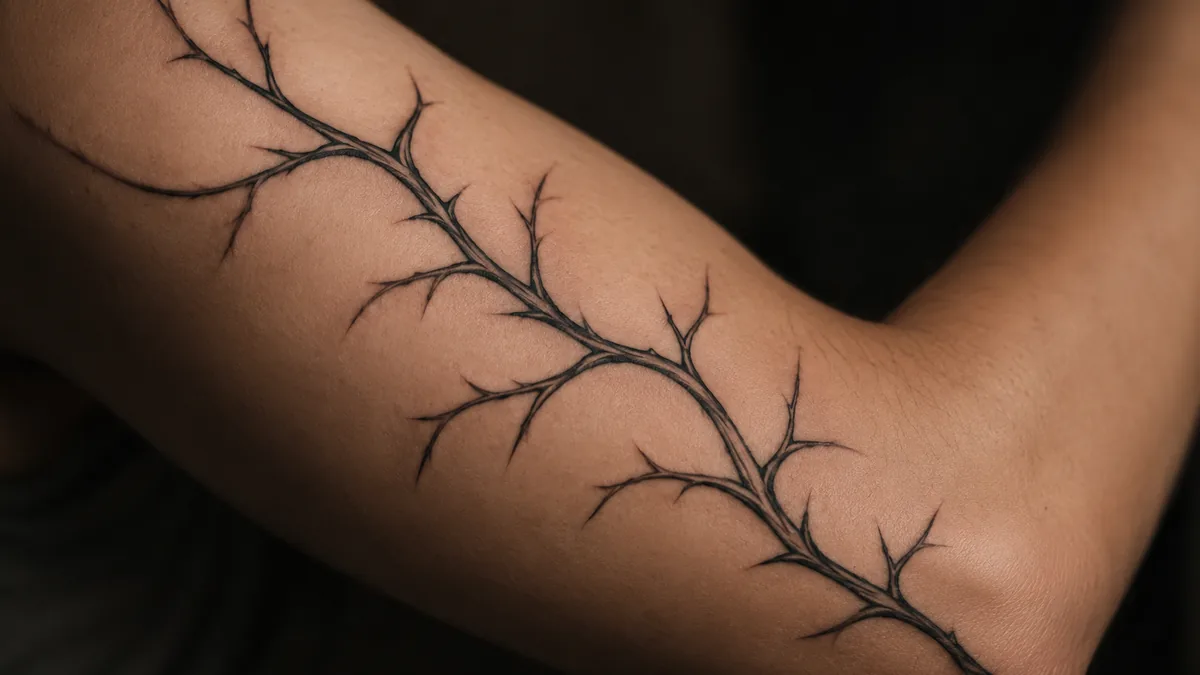
Thorns don’t exist to hurt you. They exist to protect. That’s the core of what a thorn tattoo communicates, and it’s why this design keeps showing up in studios across every style and region. It’s honest ink. No pretense, no softness.
If you’re getting a single thorned stem, a full crown of thorns, or roses wrapped in sharp points, the symbolism runs deep. Pain coexisting with beauty. Defense as a way of life. Survival without apology. This is one of those tattoos that says a lot with very little.
Core Meaning: Pain, Protection, and Resilience
Thorns are nature’s defense system, and that translates directly to the skin. The primary reading is protection, something sharp that keeps threats at a distance. A lot of people getting this tattoo have been through something that forced them to build walls or develop a tougher exterior. The thorn represents that armor.
The second big meaning is the duality of pain and beauty. Thorns almost always appear alongside roses or other blooms, which flips the energy. You can’t have something beautiful without the risk of getting cut. That balance resonates with people who’ve experienced loss, love, grief, or growth in the same breath.
Religious and Historical Context
The rose gets the glory. The thorn does the work.
The most loaded thorn symbol in Western culture is the crown of thorns placed on Christ before the crucifixion. For religious clients, a crown of thorns tattoo represents suffering, sacrifice, and faith. It’s one of the oldest Christian tattoo motifs and still gets done constantly in traditional American and neo-traditional shops.
Outside Christianity, thorns appear in Norse, Celtic, and Greek symbolism tied to protection and warding off evil. In some folk traditions, thorned plants were hung over doorways to block harmful spirits. That protective quality is cross-cultural and ancient. You’re not reaching when you call a thorn tattoo a shield.
Popular Design Variations
The thorned rose is the most common variation and for good reason. It reads immediately, the contrast between soft petals and sharp points is visually strong, and it works in every tattoo style from traditional to fine line. A standalone thorned vine or bramble is another clean option, especially for wrapping around limbs or ribcage. It can fill a space organically without needing a focal bloom.
Crown of thorns designs are typically rendered as a circular band, placed on the upper arm, forearm, or head. Some clients go dark and heavy with thick black thorns and no flowers at all, which strips the design down to pure edge. That version tends to carry a harder, more guarded energy and reads as intentional minimalism rather than unfinished.
Black and Grey vs. Color
Black and grey is the dominant choice for thorn tattoos. It suits the subject matter. Thorns are jagged, textural, and dark by nature, and whip shading in grey ink brings out depth in the barbs without softening the overall feel. A skilled artist can make thorned vines look almost three-dimensional in solid black and grey, especially on a curved surface like the forearm or calf.
Color opens up the design considerably. A deep red rose with saturated green stems and crisp black thorns is a classic American traditional setup that holds up for decades. Bold will hold, and traditional color packs are still the most durable long-term choice. Fine line color thorn work looks stunning fresh but requires a lower-wear placement and regular touch-ups to keep that crispness. Discuss longevity honestly with your artist.
Placement and How It Ages
Thorned vines are natural wraps, which makes the bicep, forearm, calf, and thigh ideal zones. They follow muscle contours and stay legible even as the skin moves and ages. The lines on thorns need to stay crispy to read well, so placement matters. High-wear areas like the inner wrist, fingers, and hands will fade faster and soften edges sooner, which blurs fine points into mush.
Thorns have fine, sharp tips, and those tips are the first thing to blur on skin that gets a lot of friction or sun. Placing a thorn tattoo on the upper arm, outer forearm, or upper thigh keeps it in a lower-wear zone where it heals nicer and holds detail longer. Avoid placing delicate thorn work in the ditch of the elbow or behind the knee unless you’re okay with significant touch-up over time.
Pain Factor by Placement
Thorns are a symbol of pain, so it tracks that some placements for this tattoo are genuinely spicy. Ribs are brutal, no way around it. The sternum, inner bicep, back of the knee, and shin bone are all rough spots. A thorn crown on the head is an intense experience. Your artist will tell you to breathe through it, but there’s no trick to making a bony area comfortable.
The better news is that most popular thorn placements, the outer arm, thigh, calf, and shoulder, are moderate on the pain scale. Fleshy areas with muscle underneath tend to be much more manageable. If this is your first tattoo and you want a thorn design, start on the outer forearm or upper arm. You’ll be able to sit for the session without it turning into a survival exercise.
Who Gets Thorn Tattoos and How to Make It Personal
People who’ve been hurt and kept going. People who protect something or someone fiercely. Survivors of abuse, illness, or loss. People who identify with the rose-and-thorn dynamic in a relationship or in their own personality. Military and first responder clients sometimes gravitate toward the protective symbolism. Religious clients get the crown. The thorn tattoo casts a wide net because the symbolism is simple and universal.
To make it personal, focus on what the thorn means to you specifically and build the design around that story. A date hidden in the thorns. A name woven into the vine. A specific flower paired with the thorns that carries its own meaning, lavender for calm, lily for remembrance, peony for strength. Talk to your artist about negative space and composition. A thoughtful thorn design will say more about you than a generic one ever could.









