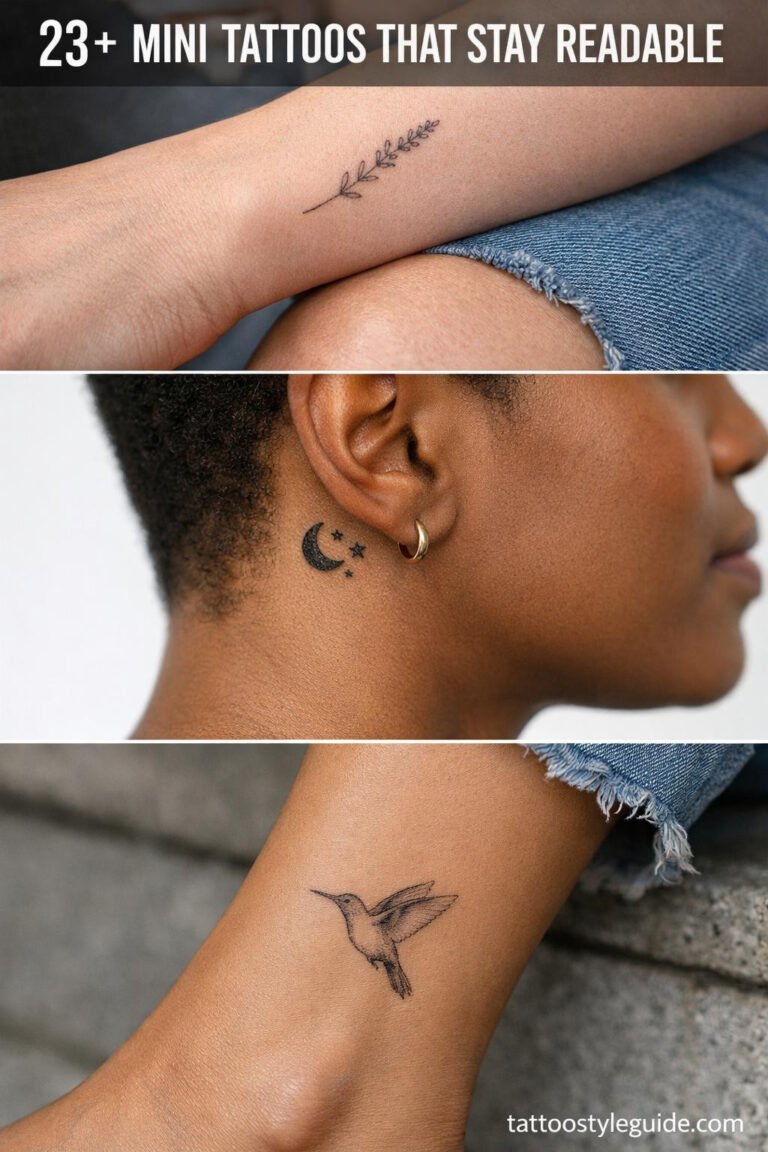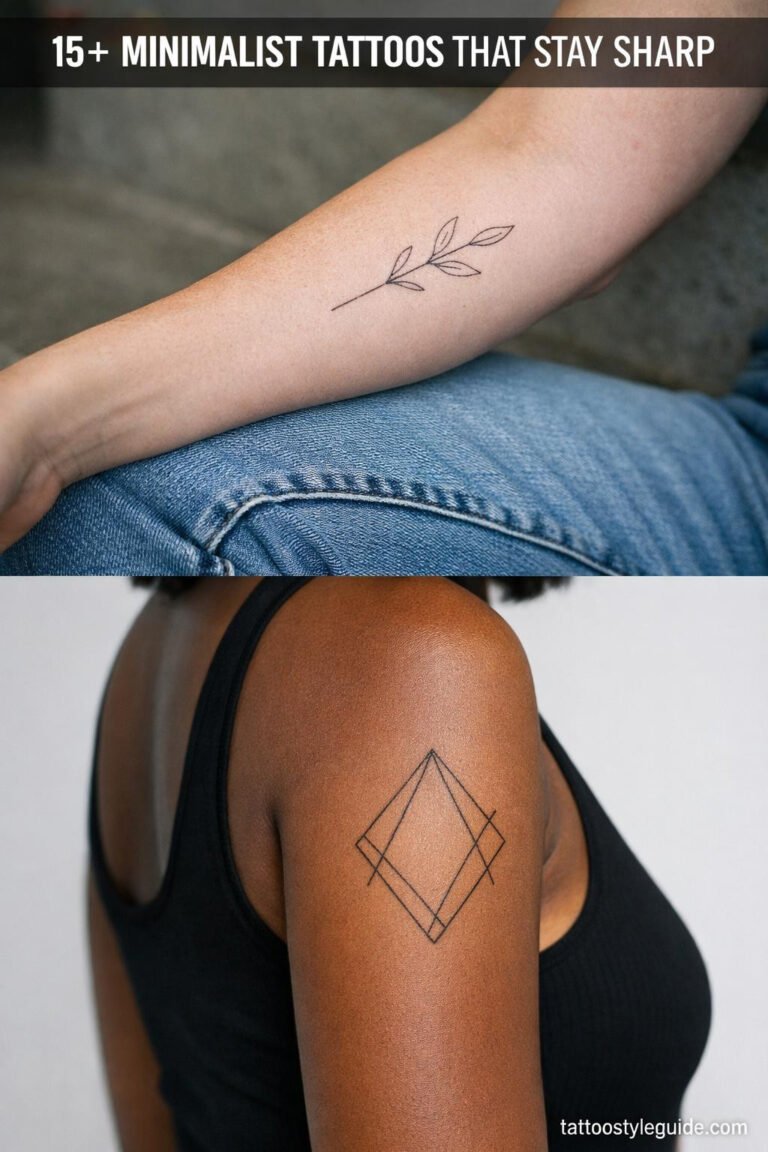
Minimalist flower tattoos are popular because they can feel soft, personal, and easy to place. They fail when every petal gets squeezed into a stamp-sized design.
Quick answer: Good minimalist flower tattoos include single-stem roses, birth flowers, tiny wildflowers, lotus outlines, peonies, lavender, daisies, and small ornamental florals with simplified petals and enough spacing.
Minimalist flower ideas by flower
Choose the flower for shape first, meaning second. Some flowers simplify better than others.
| Idea | Best use | Watch-out |
|---|---|---|
| Lavender stem | Rib, forearm, ankle | Thin leaves can disappear |
| Single rose | Wrist, arm, shoulder | Keep petal count low |
| Lotus outline | Spine, sternum, forearm | Symmetry must be clean |
| Birth flower | Personal month or family | Use one bloom, not a bouquet |
| Tiny daisy | Ankle, wrist, collarbone | Center detail can blur |
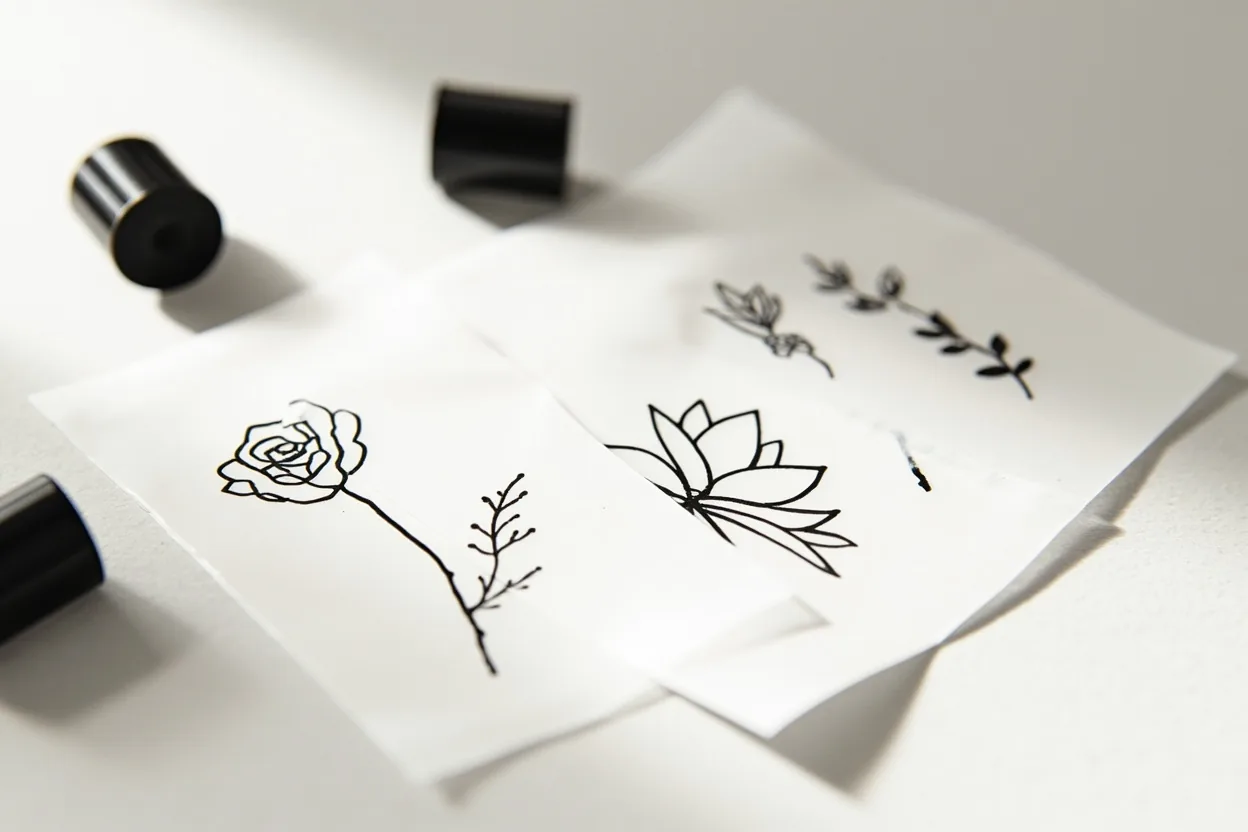
Single-stem roses are the most requested, and for good reason. They hold up well in black and grey, and a tight bud reads better than an open bloom at small scales because you’re dealing with fewer petals to cram in. Lavender sprigs work great on the wrist or behind the ear. One clean stalk, a few buds staggered up the side, done. Peonies look incredible but they’re dense, so size them up or the center turns into a blob within two years.
Lotus flowers are popular for ankle and sternum placements. The symmetry makes them forgiving to line. Wildflowers like cosmos or anemones suit fine-line artists who can control their needle depth, since those thin petals need light, precise passes, not heavy saturation. Cherry blossoms work best as a cluster of three to five, not a full branch, if you’re keeping it minimalist and small.
Flowers need breathing room
A single clean petal outlasts a dozen crowded roses.
The problem with tiny florals is not the flower. It is the amount of interior detail. Petals, stems, leaves, and little dots all need space after the ink settles.
If the flower is meaningful, resist the urge to add a date, name, butterfly, moon, and quote around it. One flower can carry a person or memory on its own.
Negative space is doing half the work in a minimalist flower tattoo. If your artist packs petals too close together with no air between them, the lines bleed into each other as the skin heals and spreads the ink slightly. A good rule: if two lines are closer than 2mm on a small piece, they will likely merge within three to five years. That’s not a scare tactic, that’s just how skin moves.
Placement matters too. Flat zones like the outer forearm or the shoulder blade give your artist a stable canvas. Curved zones like the inner wrist or the ankle bone compress the design as skin wraps. Your artist needs to account for that distortion when they draw the stencil. A circle on flat skin becomes an oval on a wrist. Ask them to confirm the stencil looks right from your normal resting position, not stretched out on the table.
What to ask your artist
Floral tattoos look simple until the linework exposes every shortcut.
- Ask which petals should be removed for size.
- Ask whether the stem should follow the body line.
- Ask for healed fine line floral examples.
- Ask if the design needs bolder contrast.
Ask your artist directly what their minimum line weight is for fine line work. Some artists cap out at a certain gauge needle and cannot realistically execute hair-thin strokes without blowout risk on certain skin types. Ask to see healed examples of their fine line pieces, not fresh photos. Fresh tattoos always look sharp. Healed work shows you the truth about line retention and whether the grey wash stays light or muddies up.
Also ask about touch-up policy. Fine line minimalist tattoos often need a pass at six to eight weeks once the skin has fully settled. Some shops include one free touch-up, others charge a flat rate. Know that going in. And ask where they’d recommend placing it for longevity. A good artist will steer you away from high-wear zones like the palm side of fingers or the inner elbow crease without you even having to ask.
The bouquet problem
Tiny bouquets often age worse than one clean flower. Every extra stem creates another line that can merge with the next one.
If you want several flowers, make the tattoo larger or split the flowers into separate placements.
Bouquets fail at small scale because clients want every flower represented and the artist doesn’t want to disappoint. You end up with five different blooms crammed into a two-inch space, and the whole thing turns into a dark smear in two years. The strongest minimalist bouquets pick two flowers max, let one dominate, and use simple line work for stems rather than trying to render leaves in detail.
If you want variety, consider a scattered arrangement instead of a tight bunch. Three or four small single flowers placed with space between them read as a cohesive set without forcing the congestion. This also gives you room to add a piece later without the whole area looking overcrowded. That kind of planned negative space is what separates a clean tattoo that still looks crisp at ten years from one that turns into a patch job.