
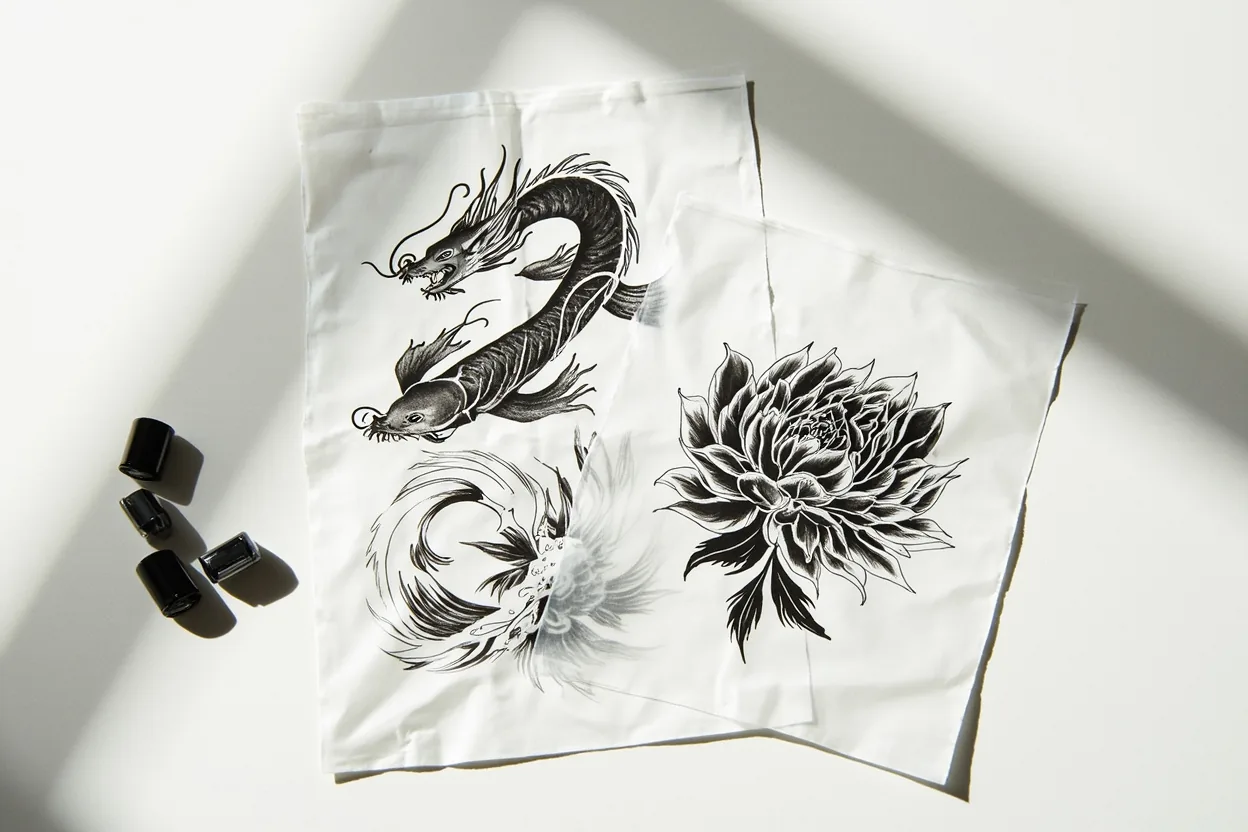
Japanese tattoo ideas carry more structure than a single motif. Irezumi is built around flow, background, season, and symbolism, and the strongest designs read as one story that moves across the body instead of a cluster of separate images.
Quick answer: Strong Japanese tattoo ideas include dragons, koi, tigers, snakes, hannya masks, oni, foo dogs, peonies, chrysanthemums, cherry blossoms, and lotus, tied together by a background of waves, wind bars, and clouds. The motif sets the meaning, the background carries the movement, and large placements such as sleeves, back pieces, chest panels, and bodysuits let the whole composition breathe.
If you are gathering Japanese tattoo ideas, start with the meaning you want the piece to carry, then let an experienced artist build the layout around it. Traditional irezumi follows a visual grammar that has been refined for centuries, so the motifs below are not interchangeable decorations. Each one points to a specific idea, and the way you pair and place them changes the message.
Japanese tattoo motif ideas and their meanings
Choose the motif with context. A Japanese tattoo is rarely an isolated sticker, and most motifs were designed to sit inside a larger scene of water, wind, and flowers.
| Motif | Core meaning | Composition note |
|---|---|---|
| Dragon (ryu) | Wisdom, benevolent power, protection, mastery of water and weather | Pairs with clouds and waves, usually ascending for growth |
| Koi fish | Perseverance and ambition, the struggle that turns a fish into a dragon | Upstream means active struggle, downstream means reward earned |
| Tiger | Courage and raw power, wards off evil, the earthly counterpart to the dragon | Often placed low in a scene, dragon higher, as earth and sky |
| Snake (hebi) | Protection, healing, and transformation through shedding the skin | The body curve should lead the design, pairs strongly with hannya |
| Hannya mask | Jealousy and grief turned into wisdom, a talisman against negativity | Not casual decoration, the angle shifts it from demonic to sorrowful |
| Oni | Fearsome guardian who punishes evil, mastery over inner demons | Red oni reads as active, blue oni as the calmer protector |
| Foo dog | Temple guardian, vigilance, protection from evil spirits | Traditionally a pair, one mouth open and one closed |
| Peony (botan) | Wealth, honor, bold beauty, the idea that big rewards need big risks | Softens ferocious animals like lions and dragons |
| Chrysanthemum (kiku) | Imperial authority, perfection, longevity | An autumn flower, sits well with maple leaves and stormy water |
| Cherry blossom (sakura) | Impermanence, fleeting beauty, the warrior accepting a short life | Softens powerful motifs and reminds that strength is temporary |
| Lotus | Purity and enlightenment rising from muddy water | Suits spiritual, Buddhist-leaning scenes with calm figures |
How the background carries the design
In irezumi, the negative space is doing as much work as the ink.
Background elements are not afterthoughts in irezumi. Waves, wind bars, finger waves, clouds, and rocks are the connective tissue that ties separate motifs into one continuous scene, so there is almost no empty skin gap left floating.
Water is the most common background. Waves and finger waves wrap around limbs to create movement, and the direction of the water can echo the story, with a koi cutting against the current or a dragon slicing through a storm. Wind bars add stylized streaks of motion behind figures and leaves. Clouds lift dragons, phoenixes, and oni into a sky or spiritual realm, and rocks add weight that anchors the lower part of a piece. When an artist talks about flow and background before the main animal, that is a good sign you are in skilled hands.
Seasonal and narrative pairings
Japanese tattooing borrows the seasonal logic of classical Japanese art, so motifs tend to be chosen as themed sets rather than random collections.
- Spring. Cherry blossoms and peonies for youth, love, and impermanence.
- Summer. Bold foliage, dragons, and snakes in stormy compositions for intensity and testing of strength.
- Autumn. Chrysanthemum, maple leaves, and tigers in stormy water for maturity and facing mortality with courage.
- Winter. Pines, snow, and stoic figures enduring hardship.
Some narrative pairings are classics for a reason. Dragon and tiger sets up heaven against earth, wisdom against raw power. Koi and dragon together tell the same legend at two stages, from struggle to transcendence. Hannya and snake reads as emotional pain transformed into resilience. Oni or foo dogs framed by waves and clouds act as guardians standing at the boundary between worlds.
Scale and placement
Japanese tattoos often need more room than minimalist references suggest, because the body becomes part of the composition. The classic large formats each have their own logic.
- Full sleeve. One main subject plus secondary motifs and a consistent background that wraps the arm. Lines guide the eye from shoulder to wrist, and the main face is oriented to look outward when the arm rests.
- Back piece. The back is the canvas for the main story, with one central figure on the spine axis and a heavy background that wraps over the ribs and into thigh work.
- Chest panel. Often a symmetrical pair of motifs or a guardian that frames the upper body and connects into a sleeve.
- Bodysuit. A single massive composition from shoulders to knees, held together by one theme and a background that transitions smoothly, often water on the lower body and clouds above.
If you want a smaller Japanese-inspired tattoo, that is fine, but simplify carefully and be honest about which cultural reference you are using. A single koi with a sliver of wave can work. A tiny isolated hannya with no context usually loses what made the motif meaningful.
Color and style choices
Traditional irezumi leans on a recognizable palette. Deep black outlines and grey shading carry the structure, while bold reds, blues, greens, and yellows fill the motifs. Black and grey alone produces a quieter, more graphic look that still respects the composition rules. Some artists work in a more illustrative or neo-Japanese style that keeps the motifs and flow but loosens the rendering. Whichever direction you choose, the background and line work should still tie the piece together, because that flow is what separates real Japanese work from a scattered collection of Japanese symbols.
Choosing a Japanese tattoo artist
This is not the place to pick a random generalist from one good photo. Traditional Japanese composition is a specialty, and the right artist will steer your idea toward a layout that actually works.
- Ask for healed Japanese-style work not just fresh photos, so you can see how the lines and background settle.
- Ask how the background elements support the motif and how water or wind will connect the scene.
- Ask whether the motif pairing makes sense since some combinations contradict each other.
- Ask how the design could grow across future sessions if you may extend it into a sleeve or back piece.
Respect and cultural context
The common mistake is treating every Japanese motif as generic decoration. Many of these symbols carry religious, theatrical, seasonal, or folklore weight. The hannya comes from Noh theatre, the lotus sits in Buddhist imagery, and the chrysanthemum is tied to the imperial family. A respectful approach is to decide the core narrative first, for example turning pain into wisdom through koi, dragon, hannya, and cherry blossom, then let the artist design the flow.
It is also worth knowing that large irezumi has a long association with outcasts and later with yakuza, and full-body work can still be read as taboo in parts of Japan, where some onsen and gyms refuse visibly tattooed guests regardless of meaning. None of that should stop you from getting work you understand and value, but it is context worth carrying with the design.
What do Japanese tattoos symbolize?
Each motif carries its own meaning. Dragons mean wisdom and protection, koi mean perseverance, tigers mean courage, hannya masks mean emotion mastered, and flowers like peony, chrysanthemum, and cherry blossom carry wealth, longevity, and impermanence. The background of waves and clouds ties them into one story.
Are Japanese tattoos disrespectful for non-Japanese people?
Getting irezumi is widely accepted when you understand the motifs and work with an artist experienced in traditional composition. The disrespect comes from random mashups that ignore the meaning, not from appreciating the art form with care.
How big does a Japanese tattoo need to be?
Bigger placements suit the style because the background and flow need room. Sleeves, back pieces, and bodysuits are classic, but a simplified single motif with a touch of water can still work at a smaller scale.
What is the most popular Japanese tattoo?
Dragons and koi are the most requested, often paired because they tell two halves of the same legend, from upstream struggle to transformation.









