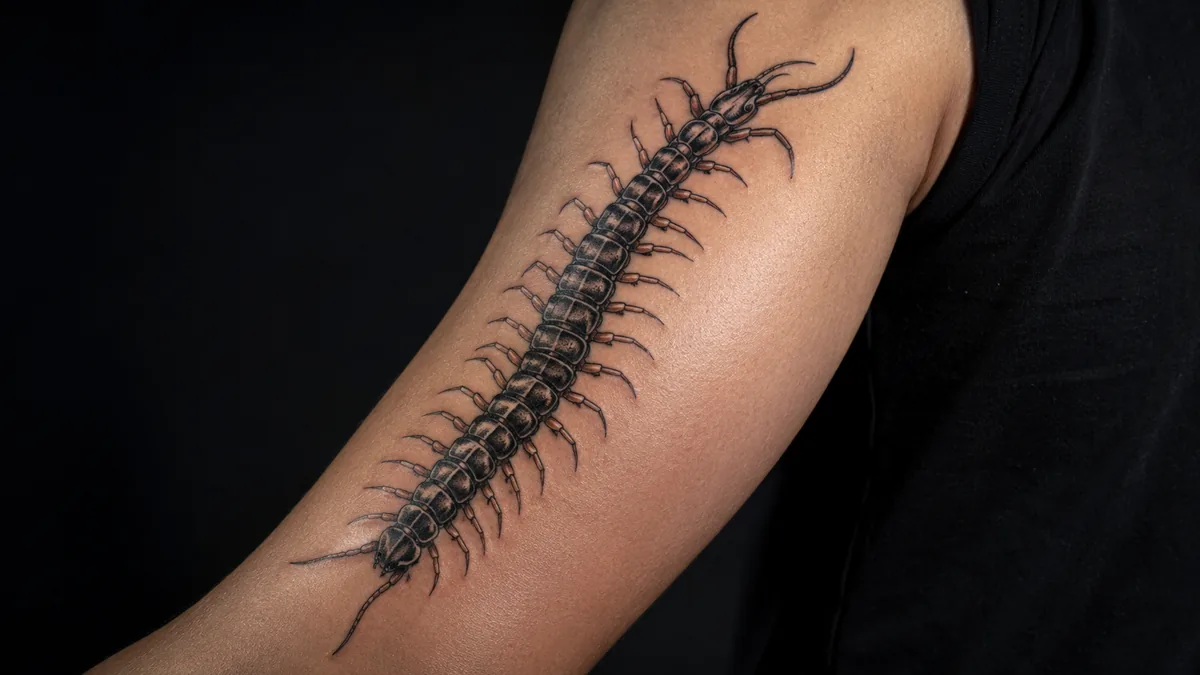
The centipede isn’t a cuddly animal, and that’s exactly why people tattoo it. It represents raw, unshakeable survival. A creature that thrives in the dark, adapts to almost any environment, and keeps moving no matter what gets thrown at it. That reads loud on skin.
Across East Asian traditions and Western alternative tattoo culture alike, the centipede carries layered meanings: protection, warrior energy, speed, and the willingness to go where others won’t. If you’re drawn to this bug, you probably already know something about yourself.
Core Symbolism of the Centipede Tattoo
The centipede is primarily associated with resilience, power, and adaptability. It survives in nearly every climate on earth, moves fast, and defends itself with venom. As a tattoo, that energy translates to someone who has faced hard conditions and come out the other side. It’s a personal statement about toughness that doesn’t need to shout.
Beyond survival, the centipede also symbolizes protection and guardianship. Many people who get this piece see it as a ward against harm, a shield worn on the body. It also carries associations with speed, agility, and decisive action. Not brute force, but precise, calculated movement. People who lead with strategy over brawn tend to connect with that reading.
Cultural and Historical Background
The centipede never backs up, and neither do you.
In Japanese folklore, the centipede, called mukade, is a creature of real power. Samurai clans used it as a symbol on armor and banners, particularly for its association with fearlessness in battle and steady forward momentum. The centipede only moves forward, it cannot walk backward, and that quality made it a natural emblem for warriors who committed fully to the fight.
In Chinese tradition, the centipede appears in the group known as the Five Poisons alongside the snake, scorpion, spider, and toad. In that context it represents both danger and protective power. Imagery of the Five Poisons was worn or displayed to ward off evil and disease. The centipede specifically was tied to courage and the ability to neutralize threats before they land.
Popular Design Variations
Japanese-influenced centipede tattoos tend to be detailed and dramatic. Lots of leg articulation, strong body curves, and bold outlines. These work well as a sleeve filler or standalone forearm piece. They hold up over time because the line weights are solid and the forms read clearly even after years of settling.
Illustrative and neo-traditional versions push the color and texture. You’ll see exaggerated mandibles, stylized segments, maybe floral elements woven around the body. Fine-line centipedes have gotten popular for people who want something more subtle, though fair warning: all those tiny legs and segment details are going to need a skilled hand and good aftercare or they’ll blur together in a few years.
Black and Grey vs. Color
Black and grey is the stronger long-term choice for a centipede. The creature’s natural form is already dramatic, all those repeating segments and legs create pattern and movement without needing color to carry the piece. A good whip shade on the body sections adds depth. Saturated black makes the outline crispy. Heals cleaner, ages better, and still reads from across the room.
Color opens up options, especially for Japanese-style work where rich reds and golds tie into traditional aesthetics. A red centipede against a black background hits hard. Watercolor-style centipedes exist but they’re a risky pick for the long game. Color fades faster on high-movement areas and that style doesn’t hold its detail as well. If you’re going color, go bold and saturated, not soft.
Placement and How It Ages
The centipede’s long, segmented body makes it a natural fit for placements that follow the body’s lines. Forearm, shin, spine, ribcage, and thigh all work well. The shape flows naturally along a limb and doesn’t fight the anatomy. A spine placement is dramatic and personal. A forearm centipede is visible and confrontational in the best way.
Placement also affects aging. Inner arm, ribs, and thighs are lower-wear zones and will hold detail longer. Hands, fingers, and feet are high-wear, high-friction areas where fine-line work will spread and blur over time. Bold outlines handle those zones better if you’re set on placement there. Knees, elbows, and the top of the foot are spicy spots. Know what you’re signing up for.
Who Gets Centipede Tattoos
People who get centipede tattoos tend to share a common thread: they’ve been through something. This isn’t a first tattoo for most people. It attracts those who identify with the darker, more grounded side of nature and aren’t interested in softening that. Veterans, fighters, survivors of serious illness or hardship, and people who have rebuilt their lives all gravitate toward this imagery.
It also pulls in collectors who are drawn to Japanese traditional or neo-traditional work and want something with real cultural weight behind it. And then there’s a strong contingent in the horror and alternative scene who just genuinely love insects and unsettling imagery. All of those are valid entry points. The meaning you bring to the piece is the one that sticks.
Making It Personal
The centipede gives you a lot of room to personalize without losing the core symbolism. You can incorporate it into a larger Japanese sleeve alongside koi, waves, or florals and it fits naturally. You can add elements that represent what you survived, a date, a phrase, a complementary creature. Let the design work with your body shape and your story.
Talk to your artist about what aspect of the centipede resonates most with you. Warrior energy, protective symbolism, survival, speed, the Five Poisons tradition. A good artist will build the composition around that focus rather than just copying a flash sheet. Bring reference, be specific about the feeling you want the piece to project, and give them room to execute. That’s how you get something that actually means something.