
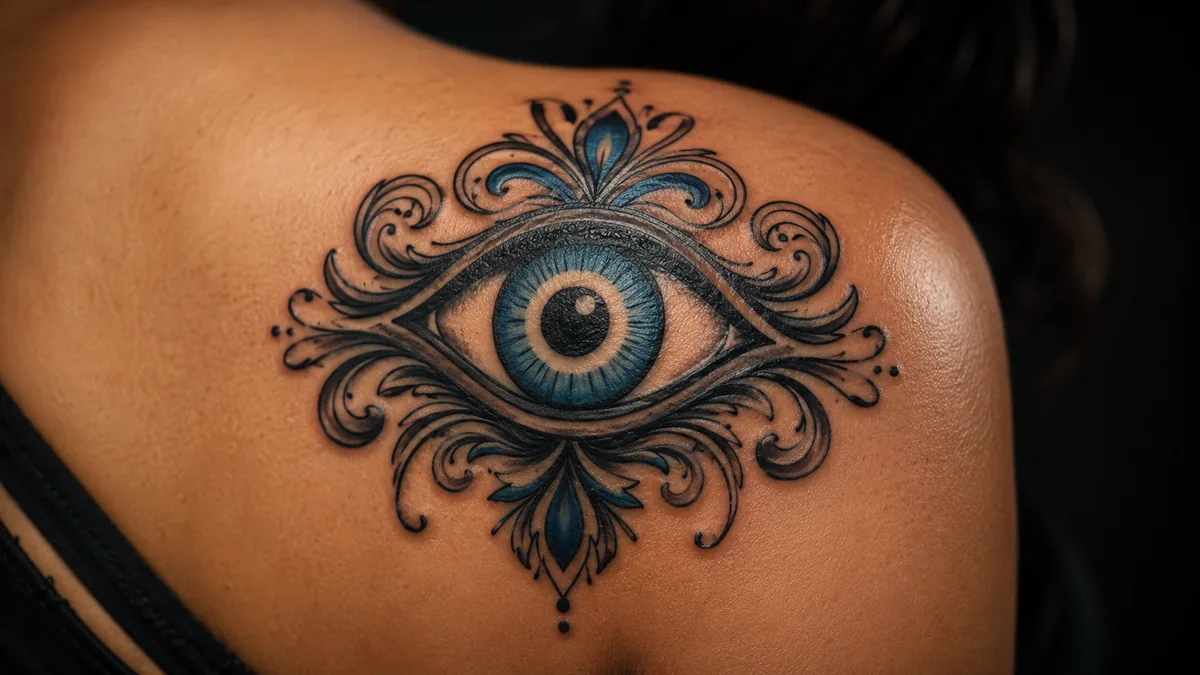
The greek eye tattoo, more precisely called the evil eye or “mati” in Greek, is one of those symbols that’s been around so long it’s basically bulletproof. People wear it for one core reason: protection. The belief is that a person can receive negative energy, bad luck, or harm just by being looked at with envy or malice. The evil eye amulet deflects that back.
It’s not trend bait. The symbol shows up across Greek, Turkish, Middle Eastern, and Mediterranean cultures going back thousands of years. When someone gets it tattooed, they’re making that protection permanent. It lives on their skin 24/7. That’s a serious commitment to a symbol, and most people who get it understand exactly what they’re signing up for.
What the Greek Eye Actually Means
The mati, or evil eye, is fundamentally a protective talisman. The idea is rooted in the concept that intense envy or admiration from another person can transmit negative energy to the target. The eye symbol acts as a ward, catching that harmful gaze and neutralizing it before it can cause damage. It’s not superstition to everyone who wears it. For many, it’s cultural identity.
Some people read additional layers into it: awareness, clarity, spiritual sight, intuition. Others keep it strictly traditional, protection and nothing else. Neither reading is wrong. The symbol is old enough that it carries multiple valid meanings depending on who’s wearing it and where they come from. When a client sits in your chair for this piece, always ask what it means to them personally.
Real Historical and Cultural Background
It does not decorate you, it guards you.
The evil eye concept appears in ancient Greek texts, in Roman records, in the Hebrew Bible, and across North Africa and South Asia. In Greece specifically, the mati has been a household and personal protective symbol for centuries. Blue glass eye beads called “nazar boncugu” in Turkish are close cousins, and the two traditions overlap heavily in iconography. The circular eye design with a dark pupil surrounded by blue or teal is the most widely recognized form.
Greeks traditionally pass down mati jewelry and amulets to children at birth. Wearing the symbol is not considered occult or fringe. It’s mainstream protective folk belief that coexists easily with Christianity and other faiths in Mediterranean communities. That broad cultural acceptance is part of why the tattoo version has spread globally without much resistance. It reads as both spiritual and aesthetic.
Popular Design Variations
The classic design is a single eye inside a teardrop or oval shape, concentric circles of blue, white, and black, sometimes with a dark blue outer ring. That version reads clean and bold from across the room, which is exactly what you want in a tattoo. Simplified geometric interpretations, especially in fine line, have become hugely popular over the last decade. Mandala-style versions add ornamental detail around the eye itself.
Realistic eye renders inside the evil eye frame are a strong move, especially in black and grey, letting the artist show off their portraiture skills while keeping the symbolism intact. Floral wraps, hamsa hand combinations, and sun or moon framing are all common requests. Some clients want a minimalist outline only, single needle, almost ghostlike on the skin. Others want the full saturated color version with bold outlines that holds for years. Both are valid, just different commitments.
Color vs. Black and Grey
Traditional evil eye blue is significant for a reason. In Mediterranean belief, blue specifically, particularly a cobalt or royal blue, carries the protective power. Some clients insist on the blue for that reason. Saturated color work in this design can look stunning when done right, but color fades faster than black ink, especially in high-wear zones. If you’re going bold color, use quality pigments and plan for a touch-up in two to three years.
Black and grey versions age more predictably and stay readable longer. A skilled whip shade on the iris and pupil area gives the eye depth without needing color at all. Fine line black and grey evil eyes are particularly popular right now, clean geometry, minimal shading, sophisticated look. The downside is that very fine lines in high-movement areas can spread slightly over time. Your artist should factor in placement before committing to hairline-thin work.
Best Placements and How They Age
The forearm is the most common spot, inner or outer, and it works well because the design is meant to be seen. The evil eye facing outward on the forearm actively faces the world, which aligns with the protective intent. The back of the neck is another strong choice for the same reason, it faces behind you where you can’t see. Chest placements are popular for people who want it closer to the body’s core, more personal, less display.
For longevity, avoid the fingers, palms, and sides of feet. These areas blow out fast, and fine detail in the iris will smear within a year or two from friction and sun exposure. Inner wrist is moderate risk, slightly spicy to tattoo, heals reasonably well if kept moisturized and out of the sun. Forearm and upper arm placements on most skin tones hold the best over a decade-plus. Upper thigh is a solid low-wear option if you want something you can cover.
Style Pairings That Work
The evil eye integrates naturally into several tattoo styles. Neo-traditional suits it perfectly because of the bold lines, saturated fields of color, and decorative framing that the style favors. Blackwork and geometric styles lock in nicely too, using negative space and sharp shapes to build the concentric eye form without shading at all. That version is stark and strong and reads clearly even at small sizes.
Fine line is the biggest trend right now for this symbol. Tiny single-needle evil eyes on the wrist, ankle, or collarbone are everywhere. They look beautiful fresh but require an artist who is honest with you about longevity. A solid, slightly heavier fine line version will outlast a hairline version by years. If you’re going small, go with an artist who specializes in small-scale work. A good artist will tell you exactly what detail they can guarantee will hold.
Who Gets This Tattoo and How to Make It Personal
Greek and Mediterranean diaspora communities get this tattoo for straightforward cultural reasons, it’s part of their heritage and they want to carry it permanently. But the evil eye has genuinely gone global. People with no Greek or Turkish background get it for the universal protective meaning, because the concept of deflecting negative energy and envy resonates across cultures and belief systems. It’s one of the few symbols that needs almost no explanation anywhere in the world.
To make it more personal, consider incorporating a birth month flower, a specific color with personal meaning, or a name or date worked subtly into the ornamental framing. Some clients add an eye that references a specific person they lost, turning the protection symbol into a memorial piece. That layering of meaning is exactly what makes a tattoo feel earned rather than just decorative. Talk it through with your artist before you finalize the design. The best pieces come from a real conversation.









