
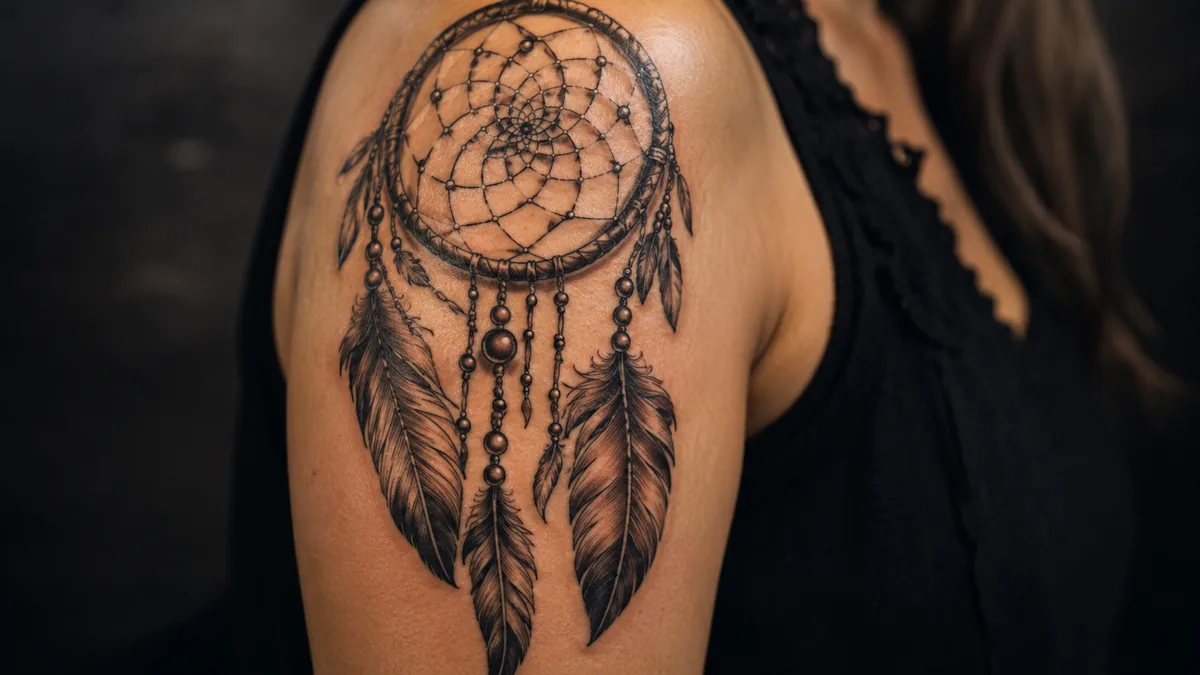
A dream catcher tattoo is one of the most requested pieces in any shop. It pulls from genuine Ojibwe tradition, and most people who sit for it want something that feels protective, spiritual, or tied to a specific loss they’re carrying. The meaning is real, the design has layers, and it reads beautifully in almost every style.
The core idea is simple: the web catches bad dreams, filters them out, and lets the good ones slip through the feathers down to the sleeper below. On skin, that translates to protection, hope, and the idea that not everything that comes at you has to stick.
What a Dream Catcher Tattoo Actually Means
The dream catcher is a protective symbol. The woven web at the center acts as a filter, trapping nightmares and negative energy before they reach you. Good dreams slip through the center hole and travel down the hanging feathers to find the sleeper. That directional flow matters. It is not a passive symbol. It is active, intentional, working.
On skin, people carry it for protection against bad energy, grief, anxiety, or trauma. Some wear it as a tribute to someone lost. Others connect it to a personal struggle with sleep, mental health, or a period of life where everything felt threatening. The tattoo says: I made it through. I still have something filtering the bad out.
The Real Cultural Background
A dream catcher tattoo is a filter, not a decoration, know what you are asking it to hold.
Dream catchers originate with the Ojibwe people, also called the Anishinaabe, Indigenous to the Great Lakes region of North America. In their tradition, spiderwebs were seen as protective. The Ojibwe legend of Asibikaashi, the Spider Woman, is central here. She protected her people by spinning webs over cradles and sleeping spaces. As the nation spread geographically, the handheld dream catcher emerged as a practical way to carry that protection.
In the 1960s and 70s, the symbol spread across pan-Indian movements and was adopted broadly by other Native nations. By the 80s and 90s it entered mainstream American culture. That adoption is a real point of conversation. Many Native artists and communities have spoken clearly about cultural appropriation concerns. If this symbol matters to you, do your research, be honest about your connection to it, and consider supporting Indigenous artists when you can.
Common Design Variations
The standard build is a circular hoop with a woven web inside, a center hole, and feathers hanging below, sometimes with beads threaded on the strings. That is the baseline. From there, artists push it in every direction. Floral dream catchers weave flowers, roses, or wildflowers into the hoop and down the feathers. Animal skulls, moons, and wolves get worked into the web. Geometric versions replace organic curves with sharp linework and sacred geometry patterns.
Mandala-style dream catchers blend traditional structure with dotwork centers and fine radiating lines. Some clients want a minimalist single-needle version, almost wireframe-looking. Others want a full traditional piece heavy with detail and bold outlines. The feathers are where most artists get expressive. Long flowing plumes, short stiff feathers, bird-specific feathers like eagle or owl, all carry their own added layer of meaning depending on the client’s intent.
Black and Grey vs Color: What Works on Skin
Black and grey is the dominant choice for dream catchers, and for good reason. The fine linework in the web, the delicate feathers, the texture in the beads, all of that reads clean and detailed in greywash. A skilled artist can build real depth with whip shading through the feathers and subtle fill in the hoop. It heals nice, ages gracefully, and the contrast stays readable for years without going muddy.
Color versions are popular too. Watercolor washes behind the hoop, saturated feathers in turquoise, purple, or sunset tones, these can look striking fresh out of the shop. The honest caveat: watercolor and soft pastel tones fade faster than bold saturated color or black ink. High-wear zones like the wrist or shoulder will show that aging sooner. If you want color, go bold and saturated over soft and gradient. Bold will hold. Soft will fade.
Placement and How It Ages
Dream catchers work naturally in vertical placements because of the hanging feathers. The spine, ribcage, sternum, thigh, and upper arm are all strong choices. The spine is the most dramatic, letting the piece run long with the feathers trailing down. Thigh placements give you a large, low-wear canvas that holds detail beautifully over time. The ribs are spicy on the pain scale, but the shape fits perfectly against the body’s curve.
The web’s fine linework is the main aging concern. Intricate webs with very thin lines, especially in fine-line or single-needle style, can blur slightly over five to ten years. Experienced artists build web lines with just enough weight to last without losing the delicate look. Avoid finger, hand, or foot placements for highly detailed pieces. Those are high-wear zones and will blowout faster, breaking up the web pattern and softening crispy lines you paid good money for.
Who Gets Dream Catcher Tattoos and Why
The client breakdown is wide. A lot of people sit for this piece after loss, a loved one gone, a hard chapter closed, a mental health battle survived. The protective meaning connects with anxiety, PTSD, and grief in a direct, tangible way that a lot of abstract symbols do not. Others come in because of Indigenous heritage, wanting to mark an ancestral connection on their body in a meaningful way.
Younger clients often choose it as a first tattoo because the imagery feels personal without being aggressive. It is recognizable but still carries real weight. The best versions are the ones tied to a specific story, a grandmother’s saying, a specific feather type tied to family memory, a date woven into the beads. The piece earns its place when there is something behind it beyond just liking how it looks.
Making the Design Personal
The smartest move is bringing reference and then letting your artist push it. Show them the elements that matter: hoop shape, web density, feather style, any additions like flowers or animals or names. A good artist will take that input and draw something original rather than pulling flash. Dream catchers done as custom pieces read completely differently from traced flash, cleaner proportions, better flow on the body.
Personal additions make it land harder. Birthstones worked into bead placements, specific birth flowers threaded through the hoop, a feather tied to someone’s memory. Some clients add a name or a date into the design, worked into the woven web or along the hoop band. That specificity is what separates a tattoo that means something from one that just fills space. Get the details right before you sit down.









