
Aztec tattoos carry serious weight. These designs pull from one of the most sophisticated civilizations the Americas ever produced, and every symbol in the visual vocabulary means something specific. You’re not just getting a cool pattern. You’re wearing a glyph that once marked warriors, priests, and gods.
People get Aztec pieces for a lot of reasons. Pride in Mexican or Indigenous heritage. A connection to strength, cycles, and the cosmos. Sometimes it’s pure aesthetic, and that’s valid too, but knowing the real meaning behind what you’re putting on your skin makes the whole thing hit different.
The Core Symbolism of Aztec Tattoos
Aztec iconography centers on a few big ideas: duality, sacrifice, cosmic order, and the eternal cycle of life and death. Nothing in the Aztec worldview was purely good or purely bad. Creation required destruction. The sun needed blood to rise. That tension is baked into every god, every glyph, every calendar stone. When you tattoo any of these symbols, you’re tapping into that same framework.
Common meanings people go for include strength, protection, warrior spirit, and connection to ancestry. The symbols aren’t decorative filler in the original context. They’re functional, sacred markers. A skull glyph meant transformation, not Halloween. An eagle meant the sun and the warrior class. Understanding that shifts how you wear the piece.
The Aztec Sun Stone: Most Popular Design
Every Aztec glyph is a sentence — know what yours says before it's permanent.
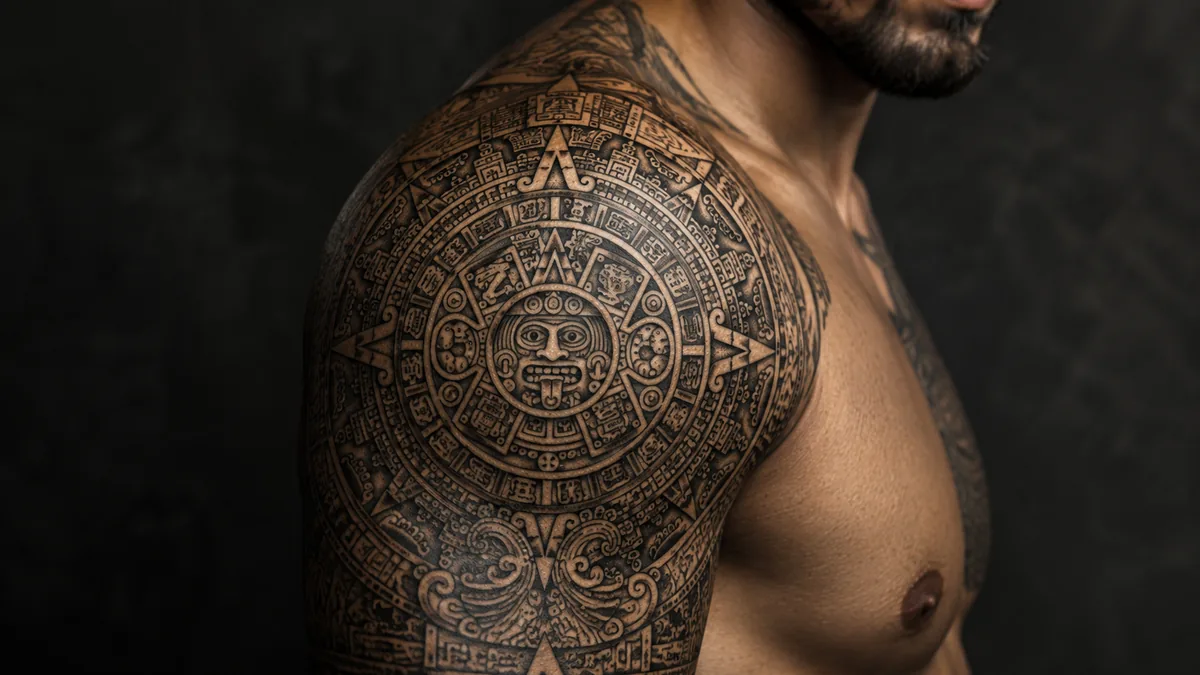
The Sun Stone, often called the Aztec calendar, is the single most tattooed Aztec image in any shop. It’s a circular stone carving featuring Tonatiuh, the sun god, at the center, surrounded by rings that represent cosmic cycles, cardinal directions, and the five world eras the Aztecs believed had existed. It’s a map of the universe, not an appointment book.
As a tattoo, it represents the passage of time, cosmic balance, and the idea that everything moves in cycles. It reads beautifully in black and grey with heavy contrast, or as a bold traditional piece with saturated color. The detail is dense, so it needs room. Chest, back, upper arm, or thigh give it the space to breathe and stay legible as it ages.
Gods and Their Tattoo Meanings
Each Aztec deity carries specific symbolism. Quetzalcoatl, the feathered serpent, represents wisdom, wind, learning, and the boundary between earth and sky. He’s a protector figure and a god of creation. Huitzilopochtli is the sun and war god, the one who required blood offerings to keep the sun rising. He’s raw power and warrior energy. Tlaloc is the rain god, tied to fertility, agriculture, and life-giving water.
Xipe Totec, god of seasons and renewal, wears a flayed skin, representing rebirth and the shedding of the old. Dark imagery, heavy meaning. Mictlantecuhtli is the god of the dead, ruler of the underworld. People going through major life changes, grief, or a rebirth narrative often choose him. Pick the god whose domain aligns with your story. That’s where the tattoo becomes personal rather than generic.
Warrior and Eagle Symbolism
The eagle warrior was one of the elite military orders of the Aztec empire. Eagle warriors represented the sun, since the eagle was believed to carry the sun across the sky. A tattooed eagle head in full Aztec regalia means courage, honor, discipline, and a willingness to sacrifice for something greater than yourself. It’s not a casual symbol. It’s heavy on purpose.
Jaguar warriors were the other elite order, connected to the night, the underworld, and Tezcatlipoca, the god of darkness and conflict. Jaguar symbolism covers stealth, power, and the darker forces of the cosmos. Many people combine both, the eagle and jaguar, to represent balance between light and dark. Done right in black and grey with strong linework, that piece reads from across the room.
Style Variations: Bold Traditional vs. Fine Line
Traditional Aztec stonework doesn’t have gradients. It’s flat, geometric, and carved. That translates beautifully into bold black tattoos with clean, crispy lines and solid fills. This approach ages the best. Bold will hold. The geometry stays sharp for decades in the right placement, and the lack of fine detail means you’re not watching the piece blur into a grey smear ten years out.
Fine line interpretations exist and can look stunning fresh, but be realistic about longevity. Aztec glyphs with hairline detail in high-wear zones like the hand, wrist, or inner elbow are going to require touchups. Black and grey with some whip shading gives you depth without sacrificing readability. Full color pieces work well on larger formats, especially chest and back, where the saturated tones can really anchor the contrast.
Placement and How Aztec Tattoos Age
Best placements for Aztec work are the upper arm, chest, back, thigh, and calf. These are low-wear, relatively stable zones where the skin holds ink consistently and doesn’t stretch dramatically. The Sun Stone specifically needs a large, flat surface. A back piece is the gold standard for that design. Forearms work well for medium pieces with strong lines, but expect some fading on the inner forearm over time.
Avoid putting dense Aztec geometry in spicy zones unless you’re ready for multiple sessions and touchups. The ribs, spine, and ditch are beautiful but punishing both during the session and for ink retention. High-friction areas like the inner elbow, behind the knee, and the hands will break down faster. Whatever zone you choose, proper aftercare and sunscreen long-term are non-negotiable for keeping those lines looking solid.
Who Gets Aztec Tattoos and How to Make It Yours
A big portion of Aztec tattoo clients have Mexican, Central American, or Mesoamerican heritage and are reclaiming connection to an ancestry that gets flattened or erased in mainstream culture. That’s a powerful reason to get tattooed, and it usually produces the most thoughtful, personal pieces. Others connect to the philosophical framework, the cycles, the duality, the warrior ethos, without having direct lineage.
Either way, do your homework before you sit. Talk to your artist about which symbol actually carries the meaning you want. Don’t just pull a random image off Pinterest and call it Aztec. Research the deity, the glyph, the specific calendar symbol. The more specific you get, the more the tattoo becomes yours. A Quetzalcoatl wrapping a forearm because you connect to wisdom and transformation hits completely different than a generic geometric pattern with no intention behind it.
Skull Symbolism in Aztec Tattoos
The skull in Aztec culture is not a morbid symbol. It’s a symbol of transformation and the cyclical nature of life. The Aztecs celebrated Mictlan, the underworld, as a real destination and a necessary part of existence. Skulls appeared on Tzompantli, the skull racks used to display sacrificial remains, and in the iconography of Mictlantecuhtli. Death was not the end. It was a phase.
The skull merged with Day of the Dead imagery over centuries of cultural blending, but the original Aztec meaning is specifically about transition, rebirth, and honoring those who came before. As a tattoo, it sits in that same space. People get Aztec skull work after major losses, survivals, or life changes. Pair it with marigolds, jade, or the death god imagery and you’re working with a full visual language, not just a cool skull.









