
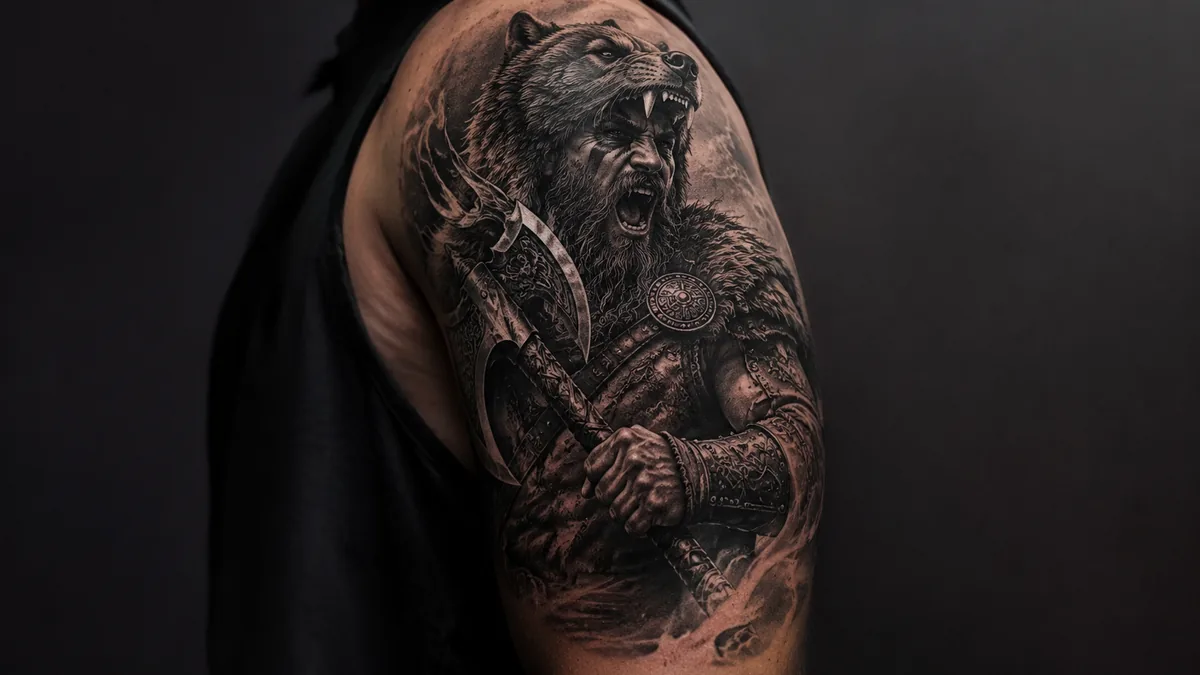
The berserker tattoo is built around one core idea: a warrior who charges into battle without fear, without hesitation, and without stopping. These were real Norse fighters, and people get this ink because that energy resonates hard. It’s not about mindless violence. It’s about tapping into something primal and unstoppable.
If you’re drawn to the mythology, the history, or just the raw symbolism of a man who cannot be broken, a berserker piece carries serious weight. Here’s what it actually means, how people are wearing it, and what you need to know before you sit in the chair.
Core Meaning of the Berserker Tattoo
A berserker tattoo stands for fearlessness, raw strength, and a willingness to face whatever comes at you head-on. The word berserker literally traces back to Old Norse, most likely meaning ‘bear-shirt’ or ‘bare-shirt,’ describing warriors who fought in a trance-like fury. People get this tattoo to represent that same spirit: zero hesitation, total commitment.
It also carries meanings of transformation and altered states. Berserkers were said to channel something beyond normal human consciousness in battle. So the tattoo can symbolize pushing past your limits, surviving what should have broken you, and coming out the other side changed. A lot of people who’ve been through serious hardship connect with that reading deeply.
Real Norse History Behind the Symbol
The berserker did not fight to survive, he fought past the point where survival mattered.
Berserkers were documented by medieval Norse and Icelandic sources, including the sagas and Snorri Sturluson’s writings. They were associated with Odin, the god of war and wisdom, and were believed to fight in a battle-rage called ‘berserkergang.’ Historical accounts describe them as nearly oblivious to pain or injury during combat. That’s not myth padding. That’s in the actual texts.
They weren’t lone wolves either. Some berserkers served as elite bodyguards for Norse kings. The bear and wolf were their totemic animals, symbols of raw power and pack loyalty. This is why so many berserker tattoos incorporate animal imagery, especially bears, wolves, or hybrid warrior-beast figures. The connection is historically grounded, not invented.
Popular Design Variations
The most popular berserker designs show a Norse warrior mid-charge, sometimes helmeted, sometimes bare-headed, with a weapon raised and an expression of pure controlled fury. Bear-warrior hybrids, where the fighter wears or transforms into a bear pelt, are extremely common and look incredible in a full sleeve or back piece. Wolves woven into the figure add another layer of Norse symbolism.
You’ll also see berserkers paired with Norse runes, especially Tiwaz for victory and Algiz for protection. Valknut symbols, Yggdrasil branches, and ravens are natural companions. Some clients want a more abstract approach: a bear skull with a Viking helm, or a wolf mid-howl with warrior elements blended in. All of these read clean and carry the same core energy when the composition is tight.
Black and Grey vs. Color
Black and grey is the dominant choice for berserker tattoos, and it fits the subject perfectly. The drama of deep blacks against faded greys gives warrior pieces that cinematic, battle-worn feel. A solid black and grey berserker with heavy contrast reads from across the room and ages beautifully. Whip shading on fur textures and armor details gives the piece real depth without needing a drop of color.
That said, color has its place. Muted, desaturated palettes, think aged bronze, stormy blues, and muted greens, look stunning on a larger piece. Some artists go full traditional with bold, saturated colors and a thick black outline, which keeps it crispy long-term and heals nice. Avoid super fine color gradients in high-wear zones because they’ll muddy out. Bold will hold. Always.
Best Placement and How It Ages
The upper arm, forearm, chest, and thigh are the strongest placements for a berserker piece. These are relatively low-wear zones with stable skin that holds detail well over time. A full chest or back piece lets you go big enough to do justice to the composition, especially if you want a mid-action warrior with environmental elements like storm clouds or a battlefield behind him.
Avoid the wrist, fingers, and inner elbow for anything with fine detail. High-wear zones blow out faster and the subtlety fades into a muddy mess within a few years. Knee ditch and ribs are spicy but give you a large flat canvas if you can handle the sit. Wherever you place it, give the artist enough real estate to work with. Squeezing a complex warrior into a four-inch space kills the piece before the needle even touches.
Who Gets a Berserker Tattoo
The people sitting in the chair for a berserker piece come from all walks. Veterans, first responders, athletes, and people in recovery are all common clients because the symbolism maps directly onto their experience. Overcoming something that should have stopped you, fighting through when your body and mind are screaming to quit, that’s berserker territory. It’s not just about aggression. It’s about endurance.
Norse heritage plays into it for some clients, but honestly, most people just connect with the archetype regardless of ancestry. The berserker is a universal symbol of the human capacity to push through fear. If you want to make it personal, add a rune with specific meaning to you, incorporate your birth year in runic numerals, or work with your artist to blend a meaningful animal into the warrior figure.
Making It Your Own
The best berserker tattoos have a specific emotional truth behind them. Before you book the consultation, know your angle. Are you coming out of a rough stretch and want something that marks that survival? Are you drawn to the Norse mythology side and want a historically grounded piece? Are you more about the animal transformation symbolism? The clearer you are, the better your artist can build something that actually means something instead of just looking cool.
Talk to your artist about scale and negative space. A berserker crammed with detail everywhere gets visually loud and ages into a muddy blob. Strategic negative space makes the subject pop and keeps it readable as the skin matures. Bring reference images, but give your artist room to interpret. A piece with their hand in it will always look better than a copy of something you found online.









