Native American tattoos carry some of the heaviest symbolism in the game. We’re talking strength, spiritual protection, ancestral connection, and respect for the natural world. These aren’t just cool patterns lifted off a wall. They represent living traditions from hundreds of distinct nations, each with their own visual language and meaning.
Most people come in wanting a headdress, a dreamcatcher, a feather, or a powerful animal. All of those motifs have real, documented meanings. Know what yours means before you sit in the chair. That’s how you wear it with confidence instead of wearing it like a costume.
What Native American Tattoos Actually Mean
The core of Native American tattoo symbolism comes down to a few big themes: strength, spiritual protection, connection to nature, and identity. These were never just decorative choices. Traditional tattoos across many nations marked who you were, what you had done, and what forces protected you. A warrior’s chest design told his whole story without a word spoken.
Today, people get these tattoos to carry those same values: resilience, loyalty to family, courage, and deep respect for the natural world. A bear means raw power and healing. An eagle feather means honor and spiritual elevation. A wolf means loyalty and instinct. None of that is invented. It is rooted in oral tradition and ceremony going back thousands of years.
Historical Roots: Real Indigenous Tattooing
Every feather, every line belongs to a people, know which one before you ink it.
Tattooing in Indigenous North America is at least 2,000 years old, likely much older. Different nations used bone needles, cactus spines, or pigment-soaked thread sewn through the skin. Charcoal and soot were common inks. These tattoos marked rank, rites of passage, clan lineage, and spiritual medicine. Plains nations tattooed warriors’ arms and chests to record acts of bravery. Southwestern women received chin and face tattoos at puberty, marking adulthood and social standing.
European missionaries worked hard to suppress these practices in the 19th century. Many traditions went underground or were lost entirely. Since the late 1900s, Indigenous artists and communities have been reviving them as acts of cultural sovereignty. Today, Native tattoo artists from Inuit, Lakota, Ojibwe, and Navajo communities are actively reclaiming the craft. That history matters when you choose a design.
The Headdress: The Most Loaded Motif in the Shop
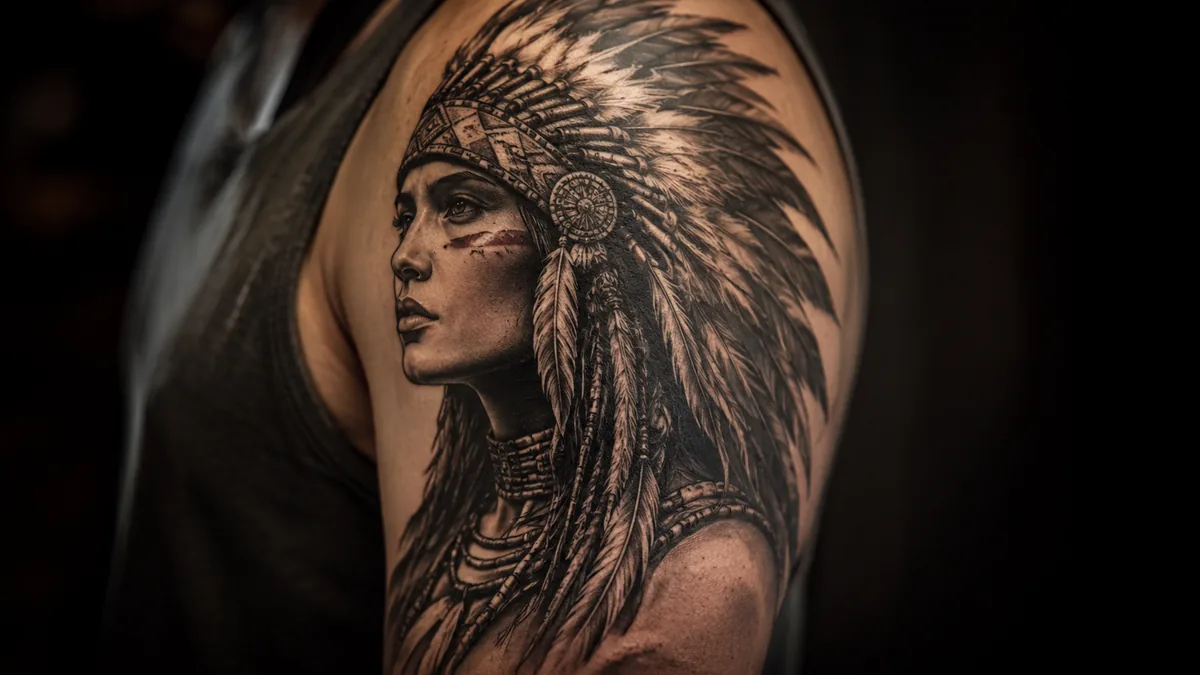
The feather warbonnet is the most requested Native American tattoo design. It is also the most weighted. In Plains nations like Lakota and Cheyenne, a full headdress was earned one feather at a time through acts of bravery and community service. Wearing one meant you had done the work. It was the equivalent of a military medal display, not decoration, not a vibe.
As a tattoo, people mean courage, leadership, and warrior spirit. That reads clean when you understand the weight behind it. The design tattoos beautifully in both black and grey and color. Full headdresses need a large canvas: thigh, back, chest, or upper arm. Bold linework holds long-term on all those zones. Know what you are putting on your body and be ready to speak to it.
Feathers, Dreamcatchers, and Animal Spirits
Eagle feathers are probably the single most universal symbol across Indigenous nations. They represent honor, spiritual connection, and the link between the human world and the spirit world. A single feather reads as freedom, elevation, and respect. Fine line feathers look crispy in black and grey. Dreamcatchers come from Ojibwe tradition. The web catches bad energy and bad dreams while letting good pass through. As a tattoo, people wear them for protection and filtering negativity out of their lives.
Animal spirits carry distinct, documented meanings across multiple nations. Wolf means loyalty, pack instinct, and guidance. Bear means raw strength, protection, and healing, tied to the bear’s ability to go inward and return stronger. Eagle means vision, freedom, and spiritual power. These are not invented associations. They show up consistently across oral tradition, ceremony, and recorded ethnography from many different Indigenous cultures.
Styles: Black and Grey, Color, and Geometric
Black and grey is the dominant approach for Native American work. Realism-style animal portraits, detailed headdresses, and dreamcatchers all thrive with deep whip shading. Feather texture and animal fur come alive with that technique. These pieces age well in the right placement and at the right size. Go too small on complex detail and it muds up within a couple of years.
Color work hits hard in earth tones: turquoise, ochre, burnt red. Those colors reference the actual beadwork and regalia of many nations, so they feel grounded. Geometric and linear blackwork is another solid path, inspired by traditional weaving, basketry, and carving patterns. A clean geometric armband in this style reads well from across the room, ages better than fine-line realism in the same zone, and sidesteps the more sacred ceremonial imagery.
Placement and How These Tattoos Age
Large compositions, full headdresses, animal portraits, and dreamcatcher sleeves belong on the thigh, back, chest, or upper arm. These are lower-wear zones that hold detail long-term. Your artist can go bold, layer deep shading, and add intricate feather work without worrying about blowout. Ribs and spine are spicy for pain but hold well and give you a solid surface for vertical compositions.
Forearms and calves work for medium-complexity pieces. They see sun and friction, so lines need to be a bit thicker than you would run on a sheltered spot. Hands, fingers, and feet are high-wear zones. A small feather or geometric mark can work there but expect fading and a touch-up within a few years. Inner wrists are solid for a single feather or simple symbol, but keep the design clean and you will get solid longevity out of it.
Cultural Respect and Choosing Your Design Right
Native American imagery covers hundreds of distinct nations with different traditions and visual systems. A Navajo geometric pattern is not a Plains headdress. An Ojibwe dreamcatcher is not a Lakota war bonnet. Collapsing all of that into a generic design erases real, specific cultures into a single stereotype. If you have Indigenous ancestry, lean into your specific lineage. Find out which nation and study that nation’s actual visual tradition before you book your appointment.
If you have no Native ancestry but feel deeply connected to these values, the more grounded path is to express those themes through animal spirits and nature imagery rather than directly copying sacred regalia like ceremonial warbonnets. Better still, find a Native tattoo artist if you want to go deeper. They can guide you toward something real. That is how you end up with a piece that holds meaning instead of one you have to defend every time someone asks about it.
Who Gets These Tattoos and How to Make Yours Personal
Native American tattoos attract a broad range of clients: people with Indigenous heritage honoring their roots, veterans who connect hard with the warrior symbolism, outdoors people bonded to wolves, bears, and eagles, and people who have survived something difficult and want to mark that with real weight. The symbolism is deep enough to hold all of those stories honestly.
The best versions of these pieces are specific. They come in with a clear meaning, a real animal or symbol the client connects to, and a style choice that fits their body. An animal spirit portrait in black and grey on the upper arm hits different from a generic headdress lifted off a flash sheet. Talk to your artist. Tell them what the tattoo needs to mean to you. Native American symbolism gives you more than enough to build something genuinely personal.