
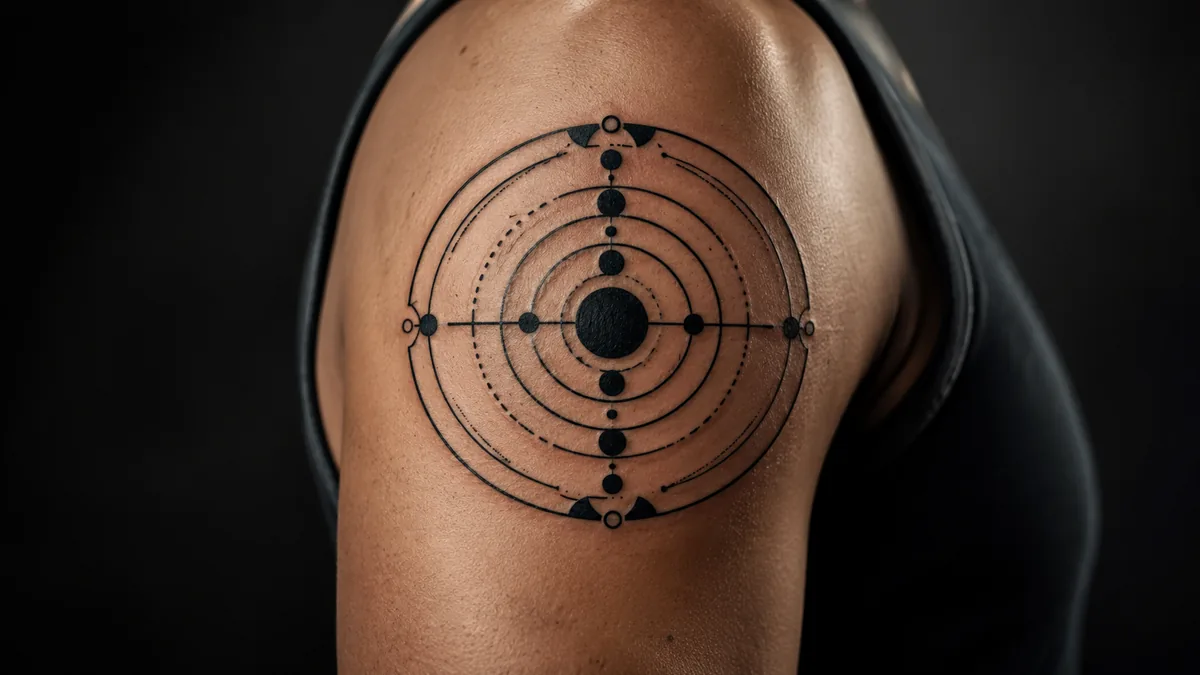
The circle is one of the oldest symbols humans ever drew. No beginning, no end. It shows up in every culture on earth, and people have been pressing it into skin for a long time. There’s a reason it stays popular.
Circle tattoos can be bold geometric statements, delicate fine-line pieces, or loaded with personal meaning. Before you book your appointment, it helps to know what you’re actually putting on your body permanently.
Core Meaning: What a Circle Tattoo Actually Represents
At its most basic, the circle means wholeness and completion. No start, no finish. It represents the idea that life moves in cycles, that what ends eventually comes back around. People get circle tattoos to mark a chapter closing, a transformation finishing, or just to carry that sense of continuity with them. It’s a quiet symbol that reads loud when you look at it long enough.
Unity is another big one. The circle holds things together, contains them. It can represent a relationship, a family, a community. A lot of clients tell me they want something that says ‘everything connects.’ The circle does that without spelling it out. Simple, direct, no explanation needed.
Cultural and Historical Roots Worth Knowing
A circle never starts and never ends, that is the whole point.
In Japanese culture, the Enso is a hand-brushed circle, often incomplete, drawn in a single stroke. It represents enlightenment, the moment the mind is free. Zen Buddhist monks have been painting it for centuries. Tattoo versions of the Enso are popular for exactly that reason. The rough brushstroke quality is part of the meaning. A crisp geometric circle and an Enso are spiritually different things, so know which one you want.
Celtic tradition uses circular knotwork and ring symbols to represent eternity and the interconnection of all living things. The Ouroboros, a snake eating its own tail to form a circle, comes from ancient Egypt and Greek alchemy. It means cyclical renewal and the infinite. Norse, Hindu, and Native American traditions all carry their own circle symbolism. If you’re borrowing from a specific culture, do a little research first so the piece is grounded.
Popular Design Variations You’ll Actually See in Studios
The single circle, clean and unbroken, is the purest version. Bold line, solid execution, nothing extra. Some people add a meaningful date, coordinates, or a word inside it. The Enso style uses a brushstroke finish, intentionally imperfect. Sacred geometry circles incorporate overlapping rings, mandala elements, or the Flower of Life pattern. These carry their own layered meanings and look stunning large-scale on the back, chest, or thigh.
Minimalist fine-line circles are everywhere right now, usually placed on the wrist, inner arm, or behind the ear. Double or triple concentric circles can represent focus, priority, or layers of meaning. The Ouroboros version adds a snake or dragon. Some clients pair the circle with phases of the moon. Others do a simple open circle, slightly incomplete, to represent the idea that nothing is ever fully finished. Each variation says something slightly different.
Black and Grey vs. Color: How Style Affects the Meaning
Black and grey circle tattoos age the best, full stop. A solid black circle with crisp linework will still read clean fifteen years from now. Fine-line circles in black are delicate but need a skilled artist. On thin skin or high-wear zones, fine lines can blow out or fade faster than you’d expect. Bold will hold. If you’re going minimalist fine-line, understand the long-term trade-off and pick a low-wear placement.
Color opens up the symbolism. A red circle can reference the Japanese flag or carry urgency. A white ink circle over pale skin is subtle but fades fast. Watercolor-style circles with soft washes of blue or purple look beautiful fresh but shift significantly over time. If you want the piece to hold its meaning and its look, black with clean linework is the most reliable foundation. Color accents can work, but they need touch-ups.
Best Placements and How the Tattoo Ages
The inner wrist, forearm, and upper arm are the most popular spots for circle tattoos because they’re easy to see and relatively low-wear. The back, chest, and thigh are great for larger mandala or sacred geometry versions. These areas hold ink well and give an artist room to work detail into the design. Behind the ear and ankle are spicy for pain and high-wear, meaning the ink gets more sun, more friction, more fading over time.
Placement also affects how the shape reads. A circle on a flat area like the forearm or upper back stays geometrically true. On curved areas like the shoulder cap or knee ditch, a perfect circle can distort as you move. A good artist will account for this. Knee and elbow ditches are notoriously rough to heal, and circles there tend to need touch-ups. Inner bicep and ribs are spicy. If you want crisp, clean linework forever, choose placement wisely.
Who Gets Circle Tattoos and Why
Honestly, all kinds of people. It’s one of those symbols that crosses demographics. People going through major transitions get it as a marker, a visual reminder that cycles end and begin. Spiritual and mindfulness-oriented clients gravitate toward it for the Zen or unity angle. Couples and close friends sometimes get matching circles. Mathematicians and scientists have come in wanting a symbol of perfection and infinite precision.
Athletes get circles to represent focus, the target, the goal. Grief tattoos sometimes use a circle to symbolize continuity, a person who is gone but still part of the loop. Some clients just want something visually clean and architecturally satisfying with zero narrative attached. That’s a completely valid reason. The circle works because it carries as much or as little meaning as you bring to it. You don’t owe anyone an explanation for your own tattoo.









