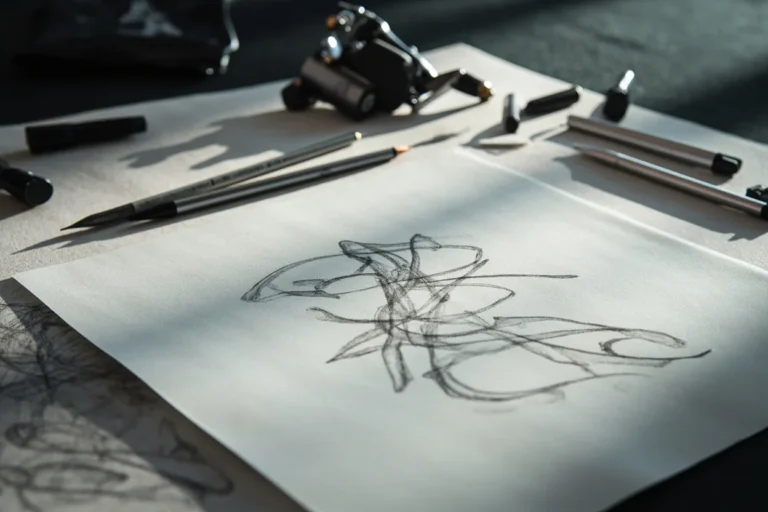
Hold the tattoo gun like a thick pencil, resting the back of your hand against the skin for stability, with the needle tube angled between 45 and 90 degrees depending on what you’re doing. That’s the short answer. But in my chair, I’ve watched apprentices grip too tight, wobble at depth, and blow out lines because nobody broke down what “hold it right” actually means in human terms. This guide is what I tell them after the machine stops buzzing.
The Basic Grip: Finding Your Foundation
Most machines run between 80 and 150 grams. That’s heavier than a Sharpie, lighter than a hammer. I tell clients who ask about learning that you don’t grip it, you let it sit in your hand. Your thumb, index, and middle finger do the work. Ring and pinky? They drift down to brace against the stretch.
Hand Position and the “Three-Point Contact”
Think of it like shooting pool. You need three points of contact for stability:
- Your grip on the tube itself
- The heel of your hand or pinky side resting on the skin nearby
- The stretch from your other hand pulling the skin taut
That third point is where beginners fall apart. They’ll grip the machine like they’re strangling it and forget to stretch. The skin bounces. The needle skips. I’ve tattooed palms, ribs, throats, places where there’s no flat surface to rest on, and you learn real fast that your stretch hand is half your stability.
How Tight Is Too Tight
White-knuckling kills your lines. Your hand cramps within twenty minutes. The machine vibrates against a tense grip and transfers that shakiness straight into the skin. I learned this the hard way doing a 4-hour tribal back piece when I was green. By hour two my hand was a claw. The lines went from crisp to wobbly. My mentor looked at it, said “death grip,” and made me stretch for an hour before he’d let me touch skin again.
Hold firm enough that the machine doesn’t rotate in your hand, loose enough that someone could pull it away with moderate resistance. That’s your zone.
Needle Angle: Why 45 vs 90 Degrees Matters
This is where shop talk gets confusing. You’ll hear “ride the tube” and “hang the needle” and a bunch of other phrases that mean specific things. Here’s what actually happens at skin level.
Lining: Steeper Angle, Deeper Saturation
For lining, you’re generally between 60 and 90 degrees to the skin surface. The needle grouping enters more vertically, deposits ink in the dermis where it stays, and you pull the line in one confident motion. Hesitate, and you get that telltale dot-dash effect. We see this a lot in walk-ins who tried DIY work. The line looks like Morse code because they stopped and started.
The tube tip should barely kiss the skin. You’re not drilling. The needle does the work; you’re just steering. I run my liners around 7.5 to 8.5 volts, and the hand speed matches the machine’s rhythm. Too fast, the line breaks. Too slow, you stack ink and it blobs.
Shading and Color Packing: Flatter Angle, Softer Entry
Shading drops to 30 to 45 degrees. The needle sweeps across, not punches in. This is how you get those soft gradients and smooth fills. With a mag shader or curved mag, you’re essentially painting with the edge of the needle group. The flatter angle means less trauma per pass, which matters for solid saturation without chewing the skin.
Color packing, blasting solid fields of red or black, sits in between. You’re more vertical than shading but not as steep as lining. Circular motions, small ovals. I’ve watched apprentices try to shade like they line, and the skin looks like hamburger. Different job, different angle.
Machine Types Change Everything
Coil machines, rotaries, and pen-style machines all feel different in your hand. I started on coils in 2009. They’re heavy, they buzz hard, they have that mechanical kick that tells you when the needle’s moving. You hold them further back on the tube to absorb vibration.
Rotary machines are lighter, smoother, quieter. The vibration is different, more hum, less rattle. You can grip closer to the tip for precision. Pens are basically rotaries in a different shape, and they grip exactly like a marker. That’s great for detail work, but the lightness means you have to generate your own stability. No machine weight helping you out.
Each one changes your fatigue pattern. After a long session, coil guys feel it in the forearm. Pen users feel it in the fingertips. I switch between a rotary liner and a pen shader depending on the piece, and my grip shifts accordingly.
Depth, Pressure, and the “Give” of Skin
Here’s what nobody puts in the textbooks: skin is not paper. It moves, it stretches, it resists. The needle hangs out of the tube tip by about 1.5 to 2 millimeters for most work. That’s your working depth. You don’t push the tube into the skin. The needle extends, touches, retracts. Your hand stays relatively still in space while the skin moves underneath.
Pressure is feel, not force. On the ribs or stomach, there’s more give. You need less downward pressure because the skin yields. On bone, knees, collarbones, shins, the skin is tight. Same needle depth feels deeper because there’s nowhere for the tissue to go. I’ve seen apprentices blow out lines on ankle bones because they used the same pressure as on a thigh.
The “dip” matters too. After the needle enters, you feel a slight release, that’s the dermis. Push past it and you’re in subcutaneous fat. The ink spreads, the line blurs, and your client has a permanent gray cloud. We call it a blowout. It’s almost always a depth or angle problem, not a machine problem.
Stretching: Your Other Hand Is Half the Job
I can’t overstate this. The hand not holding the machine is doing active work. You’re creating a flat, stable surface. On a curved arm, you stretch across the curve. On loose skin, you pull opposite to the needle’s direction. Two fingers of your stretch hand, thumb of the same hand, or sometimes both hands working together.
The stretch changes as you move. You reposition constantly. A 3-inch line might need three stretch adjustments. I tell clients to watch a good artist’s stretch hand, it’s never still. Beginners focus all their attention on the machine hand and wonder why their lines wander.
There’s also the matter of skin texture. Older skin, scarred skin, sun-damaged skin, all stretch differently. You learn to read it. Some skin needs a lighter stretch or it blanches white and the needle skips. Some needs more tension or it bounces like a trampoline.
What Your Body Position Does to Your Grip
How you sit or stand changes your hand stability more than people think. I tattoo from a stool, leaning forward, elbows on my knees or the armrest. My forearms form a triangle with my hands at the center. That triangle is your shock absorber.
Standing for back pieces? Your whole body sways. You compensate with a tighter stretch, a slightly higher angle, and shorter passes. I’ve done marathon sessions where my lower back screamed, and my lines suffered because my base was unstable. Good artists manage their bodies first, then their hands.
Lighting matters too. Shadows make you overcorrect. I use a headlamp and a ring light, and I still reposition to eliminate shadow on the working area. You can’t hold a machine steady if you’re guessing where the needle actually is.
Practice Without Skin
Before anyone touches a person, they should spend hours on fruit, practice skin, and rubber pads. Not for the artistic result, for the grip. Your hand needs to learn the weight, the angle, the rhythm without the pressure of a human wincing beneath you.
I still practice linework on fake skin when I’m trying a new machine or needle configuration. The grip changes. The balance point shifts. Better to discover that on a $5 practice pad than on someone’s forearm.
Key Takeaways
Hold the tattoo gun like a tool, not a weapon, firm enough for control, loose enough for hours of work. Match your angle to the job: steep for lines, flatter for shading. Let the needle do the work; your hand steers. Stretch the skin constantly and actively. Adjust for machine type, body placement, and skin texture. And respect that this takes years to feel natural. I’ve been at it over a decade and I still adjust my grip mid-session when something feels off.
The best tattooers I know aren’t the ones with the most expensive machines. They’re the ones whose hands disappear into the work. You don’t see the grip anymore. You just see clean lines, smooth shading, and clients who sit still because they trust what they can’t see happening.
Frequently Asked Questions
Why does my hand cramp after only 30 minutes of tattooing?
You’re almost certainly gripping too tight. The machine’s vibration transfers through a tense hand and fatigues your muscles fast. Try resting the heel of your hand on the client’s skin for support, and consciously relax your fingers between passes. It feels less secure at first but saves your hand over a long session.
Should I hold a pen-style rotary differently than a coil machine?
Yes. Pen-style machines are lighter and balanced differently, so you can grip closer to the needle tip for detail work. Coil machines have more weight and vibration toward the back, so a slightly rearward grip helps absorb the buzz. The fundamentals stay the same, but your finger placement shifts.
How do I know if my needle angle is too shallow or too steep?
Too shallow and the needle skims the surface, leaving faint lines that fade fast or don’t deposit ink at all. Too steep and you risk going too deep, causing blowouts where ink spreads under the skin. Start at a moderate angle and watch how the skin reacts, slight redness is normal, heavy bleeding or immediate bruising suggests you need to adjust.
Is it normal to change my grip during a long tattoo session?
Absolutely. I reposition my hands constantly, switching between thumb-forward and finger-forward grips depending on the curve I’m working. Your body tells you when something’s off, listen to it. A slight grip adjustment beats powering through and producing shaky work.
Related Tattoo Guides
- How to Spell Tattoo: A Tattoo Artist s Guide
- How to Take Off a Tattoo: A Real Guide to Removal Options
- Tattoo Removal in Los Angeles: What Artists Want You to Know
- Explore more