
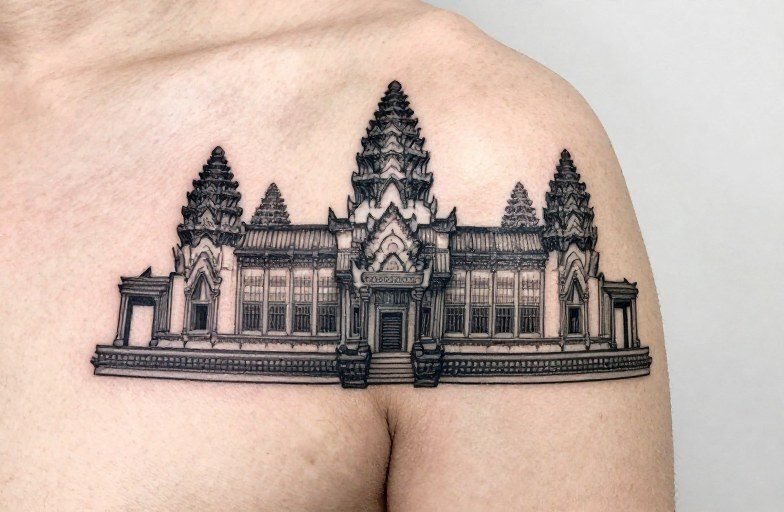
Khmer tattoo meaning centers on spiritual protection, cultural heritage, and the intersection of Hindu and Buddhist traditions that shaped Cambodia for over a thousand years. These designs range from ancient temple carvings to sacred yantra patterns once believed to shield warriors from harm. Modern wearers choose them to honor ancestry, express devotion, or connect with the mystical reputation of Khmer spiritual arts.
Symbolism & History
From Temple Stone to Skin
The visual language of Khmer tattoos descends directly from Angkor Wat and the broader Khmer Empire, which dominated Southeast Asia from the 9th to 15th centuries. Bas-reliefs depicting apsaras (celestial dancers), nagas (serpent deities), and scenes from the Ramayana and Mahabharata provide the primary visual vocabulary. Religious syncretism defines this tradition: Shiva lingams appear alongside Buddha images, and Hindu gods were worshipped as protectors long after Buddhism became dominant.
Sak yant, the sacred yantra tattooing tradition often linked to Khmer and Thai cultures, represents a distinct but overlapping practice. These geometric designs, typically rendered by monks or ajarns (spiritual masters), incorporate Pali and Khmer script in spiraling patterns meant to invoke specific blessings. Common sak yant motifs include:
- The hae taew (five lines): five horizontal lines of scripture for universal protection and good fortune
- The gao yord (nine spires): a mountain-like formation representing the peaks of Mount Meru, the cosmic axis
- The paed tidt (eight directions): eight mantras arranged geometrically for protection in all cardinal directions
- The hanuman depiction: the monkey god as strength, loyalty, and fearless service
Protective Magic and Social Function
Historically, these tattoos served practical purposes beyond aesthetics. Soldiers and fighters received sak yant for invulnerability, a belief that persisted through the Khmer Rouge era and into contemporary Cambodian boxing (kun khmer). The spiritual component required adherence to rules, abstaining from certain foods, avoiding disrespect, maintaining moral conduct, or the magic would supposedly fail. This transactional relationship between body art and spiritual discipline distinguishes Khmer tattoo culture from purely decorative traditions.
Common Variations & Styles
Religious and Mythological Imagery
Direct representations of Angkor Wat itself appear frequently, either as architectural silhouettes or detailed stone-face portraits of Avalokiteshvara (the bodhisattva of compassion, whose face adorns the Bayon temple). These demand technical precision: straight lines for the temple’s iconic towers, careful stippling for weathered stone texture, and understanding of perspective to avoid the “flat” look that cheapens architectural tattoos.
Deity portraits require equal care. Shiva, Vishnu, and Brahma appear in their Khmer-specific forms, more angular, with particular crown styles and hand gestures (mudras) that differ from Indian or Thai representations. Buddha images follow strict conventions: full-body seated positions, specific earlobe elongation, and flame-like ushnisha (cranial bump) that signals enlightenment.
Script and Abstract Pattern
Khmer script itself becomes the design, either as meaningful phrases or as decorative elements whose form matters more than literal translation. The rounded, flowing characters suit forearm bands, ribcage columns, and collarbone accents. Some trace this practice to ancient palm-leaf manuscripts, where sacred texts received elaborate illumination.
Abstracted kbach ornament, the decorative motifs found in Cambodian classical dance costumes, silverwork, and temple carvings, translate into geometric filler patterns, mandala centers, or border elements. These interlocking forms, derived from floral and vegetal shapes, provide visual rhythm without explicit religious content.
Best Placements
Placement carries traditional significance in sak yant practice, though Western adaptations often ignore these rules. The upper back and shoulders receive protective designs meant to “watch your back.” The crown of the head, rarely tattooed in modern contexts, once held the highest-status yantras. The chest and sternum suit heart-protective symbols and deity images that benefit from central, symmetrical presentation.
For non-sacred Khmer imagery, consider how detail scales:
- Upper arm/shoulder cap: Ideal for temple faces or medium deities; enough flat plane for detail, easy to display or conceal
- Forearm: Script bands and linear patterns work here; complex scenes often feel cramped below the elbow
- Back, full upper: Necessary for elaborate Angkor Wat scenes or multi-figure mythological compositions
- Ribcage: Vertical script columns or narrow figurative pieces; be aware that this area shifts with breathing and weight change
- Thigh: Increasingly popular for larger pieces; provides canvas for detail without the visibility of arms or chest
Line-dominant designs (temple architecture, script) age more predictably than heavy black shading, which can blur over time in high-movement areas. The fine details of stone texture in temple tattoos often require touch-ups after 5-7 years.
Who Chooses This Tattoo / Personal Meanings
The Cambodian diaspora, particularly in Long Beach, California; Lowell, Massachusetts; and Paris, represents the most culturally rooted demographic. Second- and third-generation Cambodian Americans frequently choose these tattoos during young adulthood, sometimes after visits to ancestral villages or following family trauma processing. The genocide under Pol Pot destroyed vast repositories of traditional knowledge, making tattoo reclamation an act of cultural recovery.
Western practitioners of martial arts, particularly Muay Thai and Brazilian jiu-jitsu practitioners training in Thailand, sometimes receive sak yant during immersive trips. This carries controversy: some Cambodian and Thai practitioners view Western adoption as appropriation, especially when spiritual rules are ignored. Others welcome sincere interest. The distinction often lies in whether the wearer understands and attempts to follow associated precepts, or treats the design purely as aesthetic.
Spiritual seekers without Southeast Asian heritage sometimes gravitate toward Khmer Buddhist imagery, drawn by the region’s reputation for intense meditation traditions. This requires particular care: Buddha tattoos are illegal or restricted in several Buddhist-majority countries, and their display on lower body parts (below the waist, especially feet) is considered deeply disrespectful across Thai, Khmer, and Lao cultures.
Similar Symbols
Thai sak yant overlaps significantly with Khmer traditions, reflecting shared history and ongoing cross-border influence. The visual language is nearly identical; distinctions emerge in script (Thai versus Khmer characters) and specific monk lineages. Lao tattoo arts, less internationally visible, share the same roots with local variations in deity representation.
Indian yantras and Tibetan thangka-derived tattoo designs offer parallel geometric-mystical traditions, though their visual language differs: Tibetan work tends toward more color, more elaborate figural backgrounds, and distinctively Himalayan deity forms. Indonesian batik-pattern tattoos and Javanese wayang shadow-puppet imagery represent another Southeast Asian traditional stream, more secular and narrative than the protective-magic focus of Khmer work.
Contemporary Cambodian tattoo artists, operating in Phnom Penh and diaspora communities, increasingly blend traditional motifs with black-and-grey realism, watercolor techniques, or graphic design approaches. This evolution sparks debate about authenticity versus living-culture adaptation, reasonable people disagree on whether sak yant requires traditional hand-poked method and monk administration, or whether machine-rendered Khmer imagery in modern styles constitutes legitimate continuation.
Final Thoughts
Khmer tattoos carry weight. The imagery connects to one of humanity’s most ambitious architectural projects, to religious traditions that have sustained people through empire, colonization, and genocide, and to living practices of spiritual protection that still command genuine belief. That gravity demands respect in execution: accurate iconography, culturally informed placement, and honest assessment of if you’re honoring a tradition or consuming its surface.
The technical demands are real. Khmer script requires fluency from your artist, misspelled or nonsense characters are common failures. Temple architecture demands geometric precision that exposes sloppy draftsmanship. Deity portraits require understanding of specific conventions, not generic “Asian” aesthetic. Find artists who have done this work repeatedly, who can explain why a particular hand position matters, who know the difference between Khmer and Thai Buddha crown styles.
Done well, these tattoos function as genuine cultural bridge: the wearer learns, the art form persists, and the skin carries something that transcends mere decoration. Done poorly, they’re expensive mistakes that disrespect the source and disappoint the bearer. The difference lies in preparation, in choosing substance over vague exotic appeal, and in recognizing that some tattoo traditions come with obligations beyond the chair.
Frequently Asked Questions
Do I need to be Cambodian to get a Khmer tattoo?
No legal or universal rule prevents it, but context matters. Religious designs like Buddha images or sak yant carry specific obligations and cultural sensitivities. Non-Cambodians should research associated spiritual rules, avoid placement below the waist, and consider whether their reasons demonstrate genuine respect rather than aesthetic tourism.
What’s the difference between sak yant and decorative Khmer tattoos?
Sak yant involves consecrated designs traditionally applied by ordained masters with specific blessings and behavioral precepts attached. Decorative Khmer tattoos use similar visual elements, temples, script, deities, without the ritual framework. Both exist on a spectrum, and contemporary practice often blurs the distinction.
How do I verify that Khmer script in a tattoo design is correct?
Consult a native reader or specialized translator, not just your tattoo artist. Many artists use reference sheets with errors that propagate across shops. For phrases versus single words, grammatical structure matters. Request a second opinion from Cambodian community members or language tutors before committing to permanent ink.
Are hand-poked traditional methods better than machine tattooing for Khmer designs?
Traditionalists argue that hand-poked (jerng) sak yant carries spiritual efficacy that machines cannot replicate. Practically, machine work offers more predictable line weight and faster healing for large pieces. The “better” method depends on your priorities: spiritual authenticity, technical precision, or a specific artist’s skill set in either approach.
Related Tattoo Meanings
- Angelina Jolie Cambodian Tattoo Meaning: Sak Yant Blessing Ink
- Thai Sak Yant Tattoo Meaning: Sacred Geometry Spiritual Protection
- Yant Tattoo Meaning
- Explore more









