
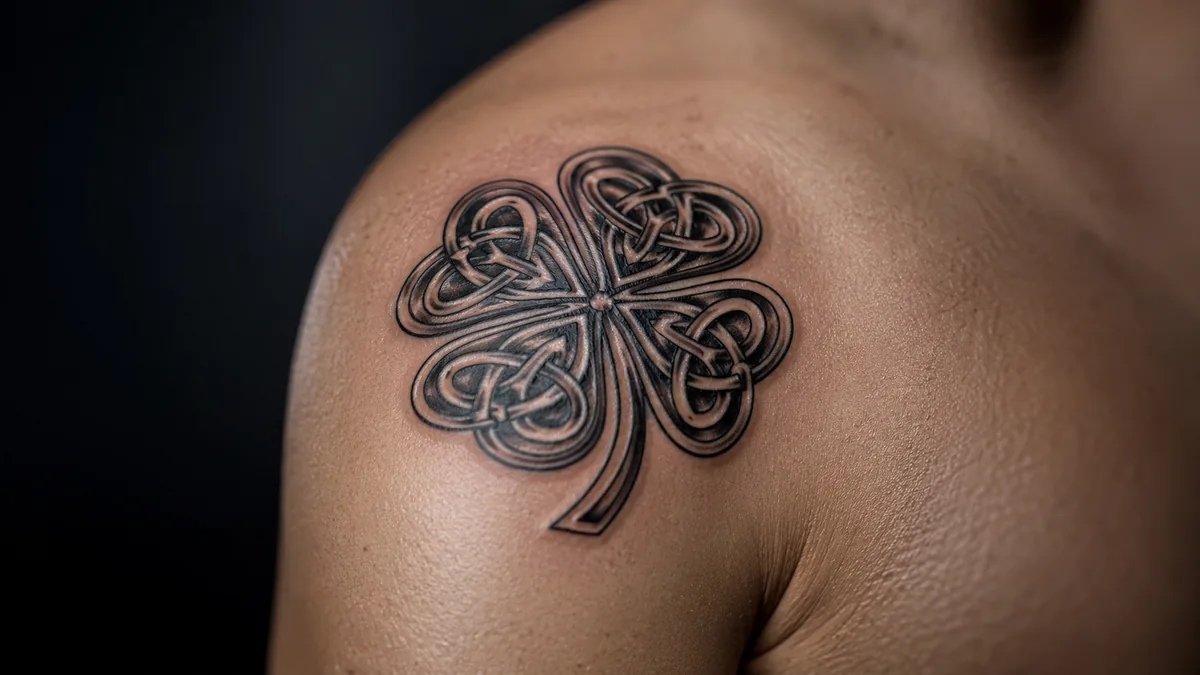
The cloverleaf tattoo is one of the oldest good-luck symbols you can put on skin. Three leaves, one stem. Simple geometry that carries a lot of weight depending on who’s wearing it and why.
Most people come in asking for a four-leaf clover, but the three-leaf clover, the actual shamrock, has its own deep symbolism that’s worth understanding before you sit in the chair. Both versions are legitimate. Both have real meaning. Here’s the breakdown.
Core Meaning: Luck, Protection, and Good Fortune
The cloverleaf tattoo is first and foremost a luck symbol. That’s the baseline, the thing almost every client who walks in asking for one already knows. The four-leaf clover specifically reads as rare luck, since true four-leaf clovers appear roughly once in every ten thousand three-leaf plants. That rarity is the whole point. People get it after surviving something hard, after a streak of fortune, or simply as a talisman they carry permanently.
The three-leaf clover carries protection and hope more than pure luck. It also signals faith, love, and friendship in older folk traditions. Some clients layer both meanings into one piece, pairing the clover with other protective symbols like horseshoes or anchors. Either way, the read is universally positive. Nobody sees a clover tattoo and thinks anything dark. That matters for placement on visible skin.
Irish and Celtic Roots
Three leaves, three promises, faith, hope, and love packed into one inch of skin.
The shamrock, Ireland’s national emblem, ties directly into this tattoo’s cultural weight. Saint Patrick used the three-leaf clover in the fifth century to explain the Christian Trinity, Father, Son, and Holy Spirit, to the Irish people. That connection stuck hard. The shamrock became inseparable from Irish identity, nationalism, and Catholic faith. If you have Irish blood, this tattoo carries ancestral pride on top of everything else.
Celtic knotwork clover designs extend that lineage further. The triquetra, a three-pointed knot that predates Christianity in Celtic culture, shares the same three-part structure and the same meaning of interconnected forces. A lot of clients blend clover leaves with Celtic knotwork to honor both the pre-Christian and Christian layers of Irish history. That’s a legitimate combo with real cultural depth, not invented symbolism.
Four-Leaf vs. Three-Leaf: What Changes in the Meaning
Three leaves mean faith, hope, and love in the traditional Irish reading. Add the fourth and it means luck. That fourth leaf is the differentiator. It’s why four-leaf clover tattoos tend to come with personal luck narratives: beating cancer, surviving an accident, finding the right person at the right time. The rarity itself is the story.
Three-leaf versions skew more toward heritage and spiritual meaning, less toward personal fortune. If someone comes in wanting a shamrock specifically, they’re usually leaning into Irish identity or the faith-hope-love trifecta. If they want a four-leaf clover, they’re usually carrying a specific lucky memory or wanting a permanent good-luck charm. Ask your clients which they mean. Some don’t know there’s a difference, and that conversation shapes the whole design.
Popular Design Styles and Variations
Traditional American style gives you bold outlines, flat color fills, and clovers that read clean from ten feet away. This is the most durable execution. Thick lines hold over decades, the green saturates well, and the design stays readable even as skin ages. Traditional clover tattoos pair well with banners, dice, horseshoes, and playing card suits for a full luck-theme sleeve or flash piece.
Fine line clover tattoos are everywhere right now, especially single-needle work with delicate leaf veining and minimal shading. These look incredible fresh but be straight with your client: fine line greens and yellows fade faster than black, and on high-movement areas like wrists and fingers you’ll see blowout and fading within a few years. Botanical realism, watercolor washes, and blackwork geometric clovers are all solid options. Blackwork holds the longest with zero color maintenance issues.
Color vs. Black and Grey
Green is the obvious choice and it works. Saturated Kelly green or forest green in traditional style holds reasonably well, especially in black-outlined pieces where the linework anchors the color. Avoid neon greens and yellow-greens in fine line work on lighter skin, they ghost out fast. On darker skin tones, rich deep greens and black and grey execute cleaner than most pastels.
Black and grey clovers are underrated. A whip-shaded black and grey shamrock with subtle highlights reads elegant and ages beautifully. It’s also more versatile for placement since it doesn’t compete visually with colored tattoos nearby. If a client wants the clover as part of a larger piece with multiple elements, black and grey keeps everything cohesive. Bold will hold in either palette, so wherever you land on color, don’t sacrifice linework weight for delicacy.
Placement, Pain, and Longevity
Outer forearm, upper arm, calf, and shoulder blade are the classic spots for clover tattoos. These areas have consistent skin texture, age predictably, and are low-wear zones where ink holds without constant fading from friction. Clovers work in small or medium scale, so they’re flexible for placements that need compact designs. The inner wrist and behind the ear are popular for delicate fine line versions, but those are high-wear and spicy spots with faster fading.
Fingers and hands are the hardest placement for any clover tattoo. The skin is thin, the movement is constant, and touch-ups are frequent. Ribs are spicy pain-wise but heal nicely and age well since they’re covered and low-friction. Upper chest and collarbone are solid for medium-scale pieces with good longevity. Whatever placement you choose, keep the design slightly larger than you think you need. A tiny clover with fine lines will turn into a green smudge on most skin types within five to eight years.
Who Gets Clover Tattoos and How to Make It Personal
Irish-Americans and people with Celtic ancestry are the core demographic, often pairing clovers with family crests, Celtic knotwork, or memorial pieces for relatives. Beyond heritage, you see them on people who’ve survived serious medical events, people who attribute a major life turn to luck, and athletes who carry lucky charms as personal ritual. Gamblers love them. Soldiers get them. People who’ve just needed a visual reminder that fortune can shift in their favor.
To make a clover tattoo personal, add a date, a name, or a number inside or around the design. Pair it with a symbol that’s specific to your story. One client’s lucky number on a banner, a parent’s birth year, a meaningful card suit. The clover works as an anchor for a mini-narrative. Or keep it clean and classic, a crispy traditional four-leaf clover in solid green with a thick black outline, no additions needed. That version never goes out of style and always reads with intention.









