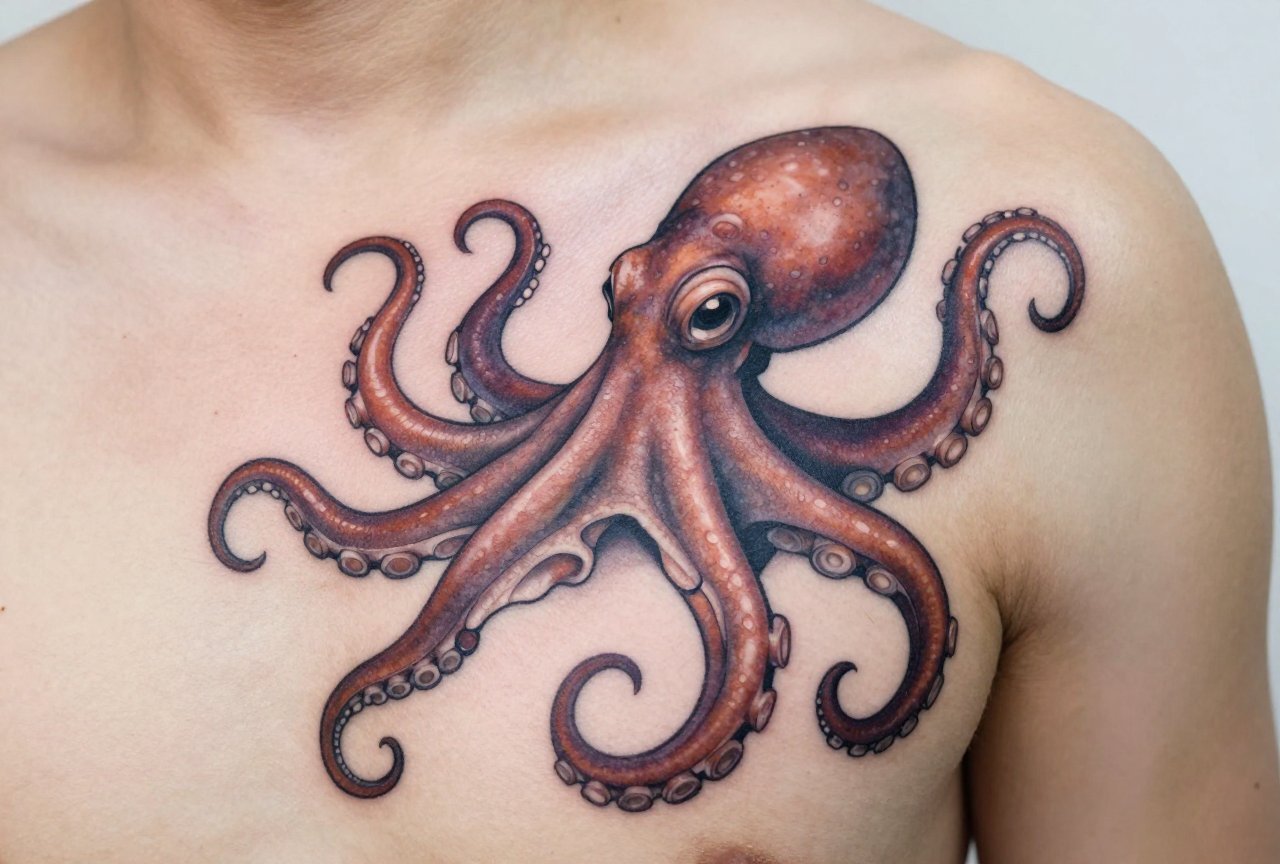
A realistic octopus tattoo is one of those designs that stops people mid-scroll. The suckers catch the light. The tentacles wrap around an arm or thigh like they own the place. Done right, it looks like the thing could slide off your skin and disappear into the nearest drain. Done wrong, it looks like a deflated balloon with eyes. This guide covers what actually matters if you’re thinking about getting one, from how the ink sits in skin over years to which artists can pull off that wet, living texture without making it look like a photograph glued to your body.
Origins & History
From Sailor Lore to Fine Art
Octopus tattoos started rough. Sailors got them as marks of survival, superstition, or just because they’d seen something wild on the water and wanted to remember it. Early flash sheets show chunky outlines, cartoon eyes, maybe a ship in the tentacles. The kraken mythology gave the image weight, danger, mystery, the unknown below.
Realism changed everything. In the 1990s and early 2000s, artists like Paul Booth and Guy Aitchison were pushing horror and bio-organic work into photoreal territory. Clients started asking for animals that looked alive, not symbolic. Octopus became a test piece. Eight limbs, hundreds of suckers, skin that shifts between translucent and opaque. If you could make that look real, you could make anything look real.
Why It Stuck Around
Unlike trending designs that burn out in five years, the realistic octopus has staying power because the subject itself is inherently dynamic. It moves. It changes color. It solves problems. People who get these tattoos usually have a reason beyond aesthetics, diving, marine biology, a love of weird intelligent creatures that shouldn’t exist but do. That personal connection keeps the style alive.
Key Characteristics & Motifs
What separates a realistic octopus from a stylized one? The details that make artists curse under their breath.
- Sucker texture: Each sucker has a ring, a hollow center, and a slight raised edge. In realism, these aren’t black dots. They’re dimensional, with shadow underneath and highlight on top. Bad work flattens them into polka dots.
- Skin transitions: Octopus skin goes from smooth mantle to wrinkled webbing between arms. Realistic pieces show this gradient through stippling, smooth shading, or needle combinations most clients never notice.
- Eye depth: The eye is large, round, with a horizontal pupil. It’s oddly human-looking, which makes it unsettling. Artists either nail the reflection and moisture or the whole piece feels dead.
- Tentacle flow: In realism, tentacles don’t just hang. They twist, foreshorten, wrap around anatomy. A good artist maps this to your body so the movement follows your muscles.
Common additions include coral, shipwreck debris, or negative space bubbles. Some clients want the octopus camouflaging against rocks, those mottled skin patterns are brutal to execute but gorgeous when they work.
Color vs Black and Grey
Color: The Living Reef Approach
Color realistic octopus tattoos hit different. The animal actually does change color, reds, browns, whites, sudden flashes of blue or purple. A color piece can capture that biological weirdness. The downside? Color saturation in octopus work fades fast if the artist doesn’t pack it properly. Those soft pinks and oranges around the eyes? They can muddy into brown within a few years if the ink wasn’t dense enough. Blues and purples hold better. Yellows and reds need touch-ups. Plan for that.
Also: color realism demands more sessions. The skin gets worked harder. You’ll be sitting longer, healing longer, and paying more.
Black and Grey: Texture Over Spectacle
Black and grey realistic octopus tattoos age like leather-bound books. The contrast between deep blacks and skin tone does the heavy lifting. Suckers read as texture without needing color variation. The mantle’s smoothness comes through white highlight and grey wash, not blue pigment. Artists often prefer black and grey for this subject because they can focus on form instead of fighting with color theory.
One honest note: black and grey can look muddy if the artist uses too much black filler. The best pieces have visible skin breaks, especially around the tentacle edges. That breathing room keeps it from becoming a dark blob at five years.
Best Placements
Octopus anatomy maps to human anatomy better than you’d expect. Those eight limbs need space to spread or wrap.
- Thigh: The classic. Flat enough for detail, muscular enough that wrapping tentacles look like they’re gripping something real. Pain is manageable. Healing is straightforward. Thigh pieces age well because the skin doesn’t stretch as dramatically as, say, a stomach.
- Upper arm/shoulder: Tentacles can spill onto the chest or down the bicep. The shoulder cap works for the mantle, the arms for the limbs. Watch out for the ditch, inside elbow, if you’re wrapping. That skin moves constantly and can blow out linework.
- Back: Full back pieces are where realism shines. Space for a giant Pacific octopus at actual size. The spine area hurts. The ribs hurt worse. But the canvas is unmatched.
- Forearm: Tricky. Smaller scale means less detail per sucker. Some artists specialize in micro-realism here; most will advise going bigger or simpler. The forearm also gets sun, which ages any tattoo faster.
- Calf: Underrated. The muscle shape lets tentacles wrap naturally. Less painful than thigh. Easy to show or hide. Downside: calf skin can be tighter, less forgiving for smooth shading.
One placement to reconsider: the side of the torso. Octopus need horizontal space. The rib cage curves vertically. Tentacles get compressed, distorted, or cut awkwardly at the waistline. I’ve seen good artists make it work, but it’s fighting the canvas.
Who It Suits
Not everyone. That’s fine.
The realistic octopus tattoo works for people who want something that reads as impressive from across a room and disturbing up close. It’s for the client who’ll sit through twelve hours without tapping out. Who understands that this isn’t a small, meaningful symbol, it’s a statement piece that demands attention.
It also suits specific body types better. The wrapping, flowing nature of tentacles works with muscle definition. On very thin arms, the tentacles can look like they’re strangling rather than embracing. On very soft areas, the detail can blur as the skin shifts. A good consultation addresses this honestly. Any artist who says “it’ll work anywhere” is either inexperienced or lying.
Personality-wise? Curious people. People who like things that are slightly uncomfortable. The octopus is alien, intelligent, boneless. There’s something unsettling about seeing one rendered perfectly on skin. If that appeals to you, this is your tattoo.
Modern Variations
Biomechanical Mashups
Some artists blend realistic octopus with mechanical elements, gears in the mantle, piston suckers, chrome instead of skin. This works best when the transition is gradual, not a hard line between organic and machine. The tentacles themselves stay flesh; the body becomes hardware. It’s been done since the 90s but keeps evolving as 3D reference and digital design tools improve.
Double Exposure and Surrealism
Octopus with ocean scenes inside the mantle, like a living aquarium. Tentacles dissolving into water, smoke, or constellations. These push past strict realism into something adjacent. The key is maintaining the creature’s believability even as the surrounding logic breaks down. Harder than it looks. Requires an artist who understands both realism and compositional storytelling.
Japanese Influences
Not traditional irezumi, but realistic octopus rendered with Japanese compositional sense, flowing movement, background water rendered with finger waves, limited color palette. This hybrid is growing in popularity, especially on the West Coast. It solves the “where does it end” problem by giving the piece a structured background.
Choosing an Artist
This is where most people stumble. Not all realism artists handle animals well. Not all animal specialists do octopus. You need both.
- Check healed work: Fresh photos lie. Ask for pieces at one year, three years, five years. Suckers that looked crisp on day one can blow out into soft circles. Good artists keep these photos.
- Look for marine life in their portfolio: If they’ve done realistic fish, eels, jellyfish, they understand wet textures and translucent surfaces. That’s half the battle.
- Ask about needle groupings: An artist who can explain why they use 7-round shaders for sucker edges versus 15-mags for black fill actually knows their craft. If they can’t explain their tools, they might be going on autopilot.
- Consultation chemistry: Realistic octopus takes multiple sessions. You’ll spend hours in proximity. If the artist is dismissive, rushed, or can’t sketch the wrap-around in a way that makes sense to your body, walk. This isn’t a flash piece you pick off a wall.
Price honestly: a quality realistic octopus starts around $800-1200 for a smaller thigh piece and climbs to $3000+ for large back work in major cities. Color adds 30-50%. Good work isn’t cheap. Cheap work isn’t good. You’ve heard it before because it’s true.
Final Thoughts
A realistic octopus tattoo is a commitment in every sense. The sessions are long. The healing is meticulous, you’ll be moisturizing those suckers for weeks, watching for scabs that could pull out detail. The result, though, is something that genuinely doesn’t look like other tattoos. It moves when you move. It catches light in ways that flat designs can’t. It ages into a softer version of itself rather than a distorted mess.
If you’re drawn to this, sit with the idea. Look at reference photos of real octopuses, not tattoo photos, the animals themselves. Notice how the skin ripples, how the eyes focus, how the tentacles curl with intention even when the creature is still. Then find an artist who sees that too. The difference between a good realistic octopus and a great one is whether the person wearing it still gets goosebumps years later, catching it unexpected in a mirror, half-forgetting it was there.
Related Style Guides
- Realistic Spider Tattoos: A Complete Style Guide
- Traditional Americana Flash Tattoos: Style Guide
- Free Tattoo Designs That Actually Work
- Explore more
Frequently Asked Questions
How long does a realistic octopus tattoo take to complete?
A realistic octopus tattoo typically takes 4 to 8 hours depending on size, placement, and detail level. Full sleeve pieces with intricate tentacles can require multiple sessions spanning 15 to 25 hours total.
What body placements work best for realistic octopus tattoos?
The thigh, upper arm, and back provide excellent canvas space for the tentacles to wrap and flow naturally. The chest and ribs are also popular choices because the octopus shape can conform well to the body’s curves.
How much does a realistic octopus tattoo usually cost?
Expect to pay between $400 and $1,500 for a quality realistic octopus tattoo from an experienced artist. Large, highly detailed pieces by renowned specialists can exceed $3,000 due to the complexity of rendering skin texture and suction cups.
What color scheme works best for realistic octopus tattoos?
Many collectors choose deep purples, rust oranges, and muted reds to mimic natural octopus coloring while adding dramatic contrast. Others prefer black and grey realism for a timeless look that emphasizes texture and form over color vibrancy.