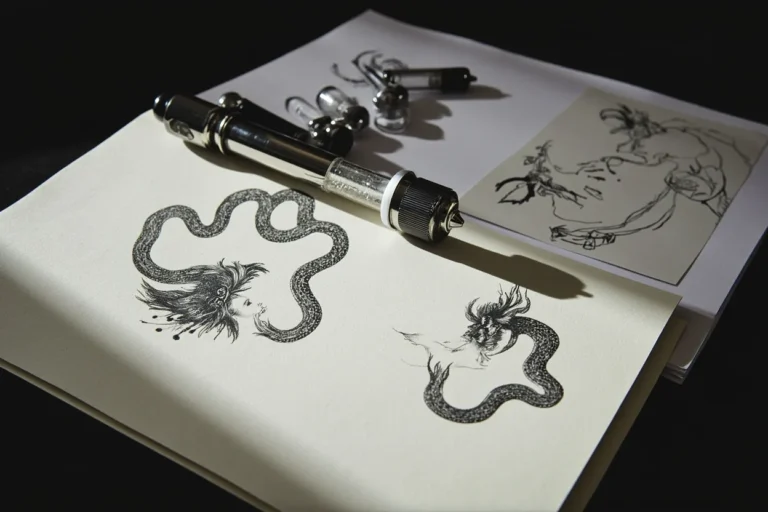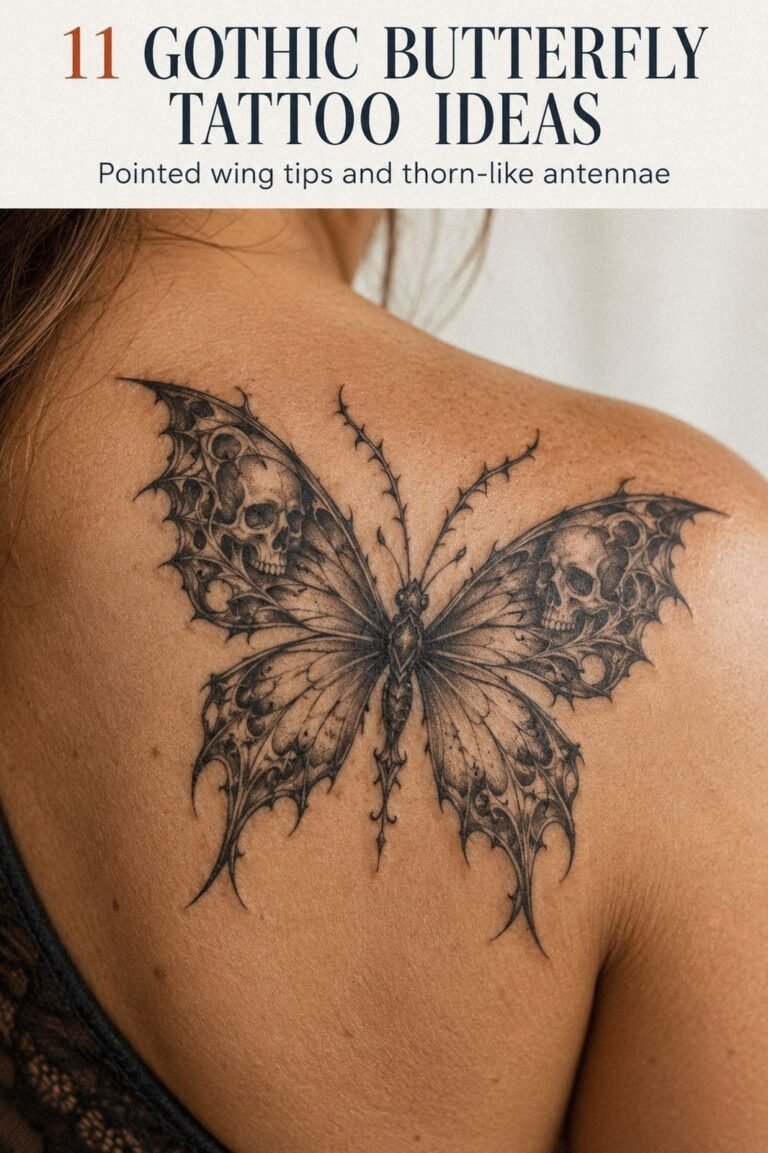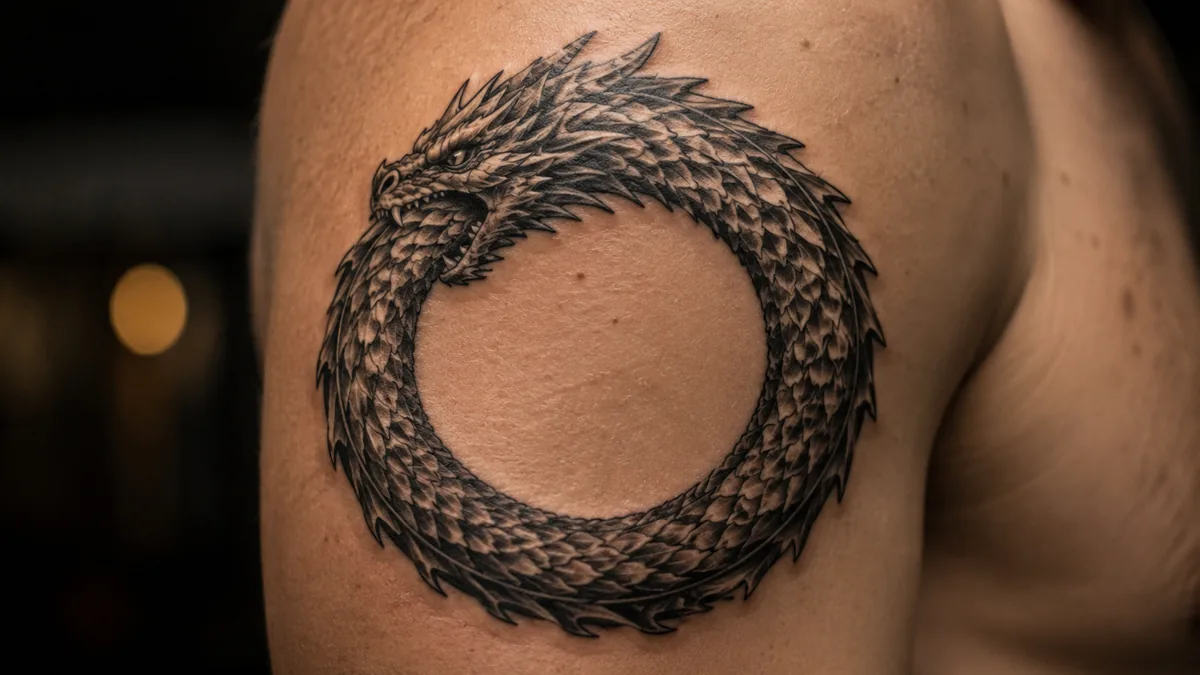
The ouroboros is a snake eating its own tail. That’s the image. The meaning behind it runs a lot deeper than the visual, which is exactly why it’s been on people’s bodies for thousands of years and it’s still landing in tattoo chairs today.
this tattoo is about cycles. Life, death, renewal. The beginning folding into the end and starting over again. It’s one of those symbols that holds weight if you’re drawn to ancient mythology, alchemy, Jungian psychology, or just want something that reads clean and timeless on your skin.
Core Meaning: Cycles, Infinity, and Self-Renewal
The ouroboros represents the eternal cycle. Something ends, something begins, and those two things are the same event. It’s not about death in the dark sense. It’s about continuity, the idea that nothing is truly lost. Life feeds into itself. That message resonates across a huge range of people, from someone coming through a rough chapter to someone who just sees existence as fundamentally circular.
It also carries a strong infinity angle, not the figure-eight infinity symbol, but a deeper read on it. The snake consumes itself to sustain itself. That’s self-sufficiency, wholeness, completeness. Many people get this tattoo to mark a period of serious self-transformation. Not just change, but the kind where the old version of you had to go so the new one could exist.
Where It Comes From: Real History, No Mythology Filler
It does not eat itself to die, it eats itself to begin again.
The ouroboros shows up in ancient Egypt, specifically in the tomb of Tutankhamun around 1300 BCE, as part of funerary text about the cyclical journey of the sun god Ra through the underworld each night and back to dawn. It was a cosmological symbol, the universe containing and renewing itself. From Egypt it moved into Greek thought, where the name ouroboros, meaning tail-devourer, was coined.
Alchemists across medieval Europe adopted it heavily. In alchemical manuscripts, the ouroboros represented the idea of prima materia, the base substance that contains everything and transforms into everything. Carl Jung later picked it up as an archetype of the unconscious, representing the integration of opposites. That’s a real documented lineage. No invented folklore here, just a symbol that kept finding new homes because it kept being true.
Design Variations: What People Actually Get
The classic version is a single snake in a circle, biting its own tail. Proportions vary a lot. Some people want a thick, coiled serpent with visible scales and a detailed head. Others go sleeker, almost minimalist, with a thin serpent that reads more like a continuous line than an animal. Both work. The thick version holds better long-term, especially at smaller sizes. Fine line ouroboros tattoos look incredible fresh but need a good artist who understands how fine lines actually heal.
Popular variations include a double ouroboros, two snakes intertwined or chasing each other, which plays up the duality angle. Dragons replace snakes in some pieces, pulling from Norse and East Asian traditions where serpentine dragons carry similar cosmic symbolism. Geometric ouroboros designs use clean linework and shapes inside the circle, popular in the blackwork scene. Some clients add alchemical symbols, celestial elements, or an eye in the center, representing consciousness within the cycle.
Color vs. Black and Grey: What Holds and What Fades
Black and grey is the dominant choice for ouroboros tattoos and for good reason. The symbol is ancient and monochromatic imagery suits that weight. A well-executed black and grey ouroboros with solid blacks and clean whip shading reads from across the room and ages with a lot of dignity. Bold will hold. The scales, the negative space inside the circle, the texture of the snake’s body, all of that pops in black ink done right.
Color opens it up for people who want something warmer or more personal. Green and gold combinations reference the alchemical tradition directly. Deep blue-black serpents with an iridescent sheen are popular in neo-traditional work. Full saturated color needs a skilled hand and solid aftercare, especially if you’re putting it somewhere that sees sun. Whatever route you go, heavy outlines are your friend for longevity. A crispy outline keeps the piece readable as the skin changes over years.
Placement: Best Spots and How It Ages by Zone
The ouroboros is a circular symbol, which makes placement decisions interesting. Wrists are the number-one spot. The circular form wraps naturally around the wrist and reads as almost jewelry-like. The inner wrist is a higher-wear zone, moderate pain, and will soften faster than the outer forearm. Ankles work the same way, same logic. The arm, thigh, and upper back give you more real estate if you want a larger, more detailed piece.
Placement affects aging a lot. Hands and fingers are spicy to tattoo and the ink breaks down fast from constant washing and friction. Not recommended for detailed ouroboros work unless you’re committed to touch-ups. The chest, ribs, and sternum are popular for larger versions but the ribcage is notoriously painful. Thighs and upper arms are low-wear, heal reliably, and give the artist room to do clean, detailed work that lasts. If longevity matters to you, go for a protected zone with less daily friction.
Duality and What the Symbol Actually Carries Personally
A lot of people come in knowing they want the ouroboros but aren’t sure how to make it theirs. The symbolism is broad enough to hold very personal meanings. Someone in recovery might read it as the cycle breaking, or as proof that they’ve come full circle back to themselves. Someone who has lost a person they love might see it as continuity beyond death. A philosopher type might be drawn to the Jungian read of unconscious wholeness. None of those readings are wrong.
The design choices you make carry meaning too. A relaxed, open-mouthed serpent feels different from a tightly coiled one. A dragon ouroboros shifts the cultural register. Adding the alchemical symbol for mercury inside the circle means something to people who know what they’re looking at. Talk to your artist about what angle you’re coming from. The best tattoos aren’t just technically clean, they’re specific to the person wearing them. The ouroboros gives you enough symbolic real estate to build something genuinely personal.
Styles That Work Best for This Design
Traditional and neo-traditional both suit the ouroboros well. Traditional gives you that bold outline, limited palette, and flat fill that holds up for decades. Neo-traditional adds more detail in the scales, more dynamic line weight, and richer color gradients while keeping that structural boldness. Either way, the serpent benefits from having a clear outline. Without a solid border, the circular shape loses its punch as the tattoo settles into the skin.
Blackwork and dotwork are strong choices for clients who want something graphic and modern. A geometric ouroboros in heavy blackwork with negative space detailing is a statement piece that ages extremely well. Fine line is popular right now but be honest with yourself about upkeep. Fine line on a wrist in a small format will need refreshing within five to ten years. Realistic styles work if the artist specializes in them, a hyper-realistic serpent coiled on itself with blowout-safe shading is genuinely impressive work when it’s done right.