
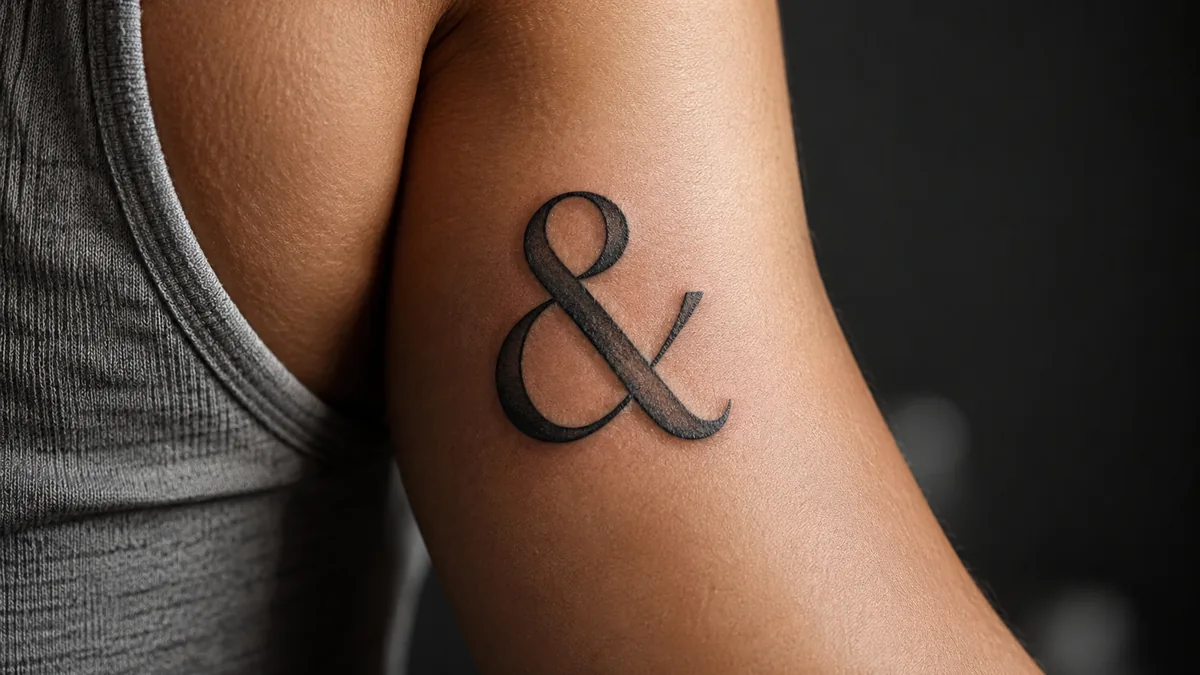
The ampersand is one of those tattoos that looks simple but carries real weight. the & symbol means “and”, continuation, connection, the idea that there’s always something more. People get it to say the story isn’t over, that life keeps adding chapters, that relationships are additive, not finite.
It’s also one of the most versatile pieces in the game. Tiny and fine-line on a wrist, oversized and bold on a forearm, ornate as a standalone centerpiece or paired with other elements. The meaning bends to fit the person wearing it, which is exactly why it’s stayed popular for years without feeling played out.
Core Meaning: Connection and Continuation
The ampersand tattoo is fundamentally about addition. The symbol literally means “and”, it links things together. For most people wearing it, that translates to something personal: love and loss, past and future, me and you. It signals that nothing stands alone, that life is a series of things joined together rather than isolated moments.
A big chunk of people get it as a reminder that there’s always more to come. Whatever chapter just ended, the ampersand says another one follows. It’s quiet hope without being cheesy about it. That’s the appeal. It doesn’t shout. It just sits there on your skin and means something.
The History Behind the Symbol
One symbol, two lives, and everything that happens between them.
The ampersand has real documented history. It started as a ligature, a merged letterform combining the Latin letters E and T, which together spell “et”, the Latin word for “and.” Early scribes wrote the two letters so fast they fused into one shape. By the 19th century it was common in English typesetting and had fully evolved into the & we recognize today.
The word “ampersand” itself comes from the phrase “and per se and,” meaning the symbol & by itself means and. Schoolchildren used to recite the alphabet ending with &. That origin story resonates with tattoo collectors who want something that looks minimal but has genuine linguistic and typographic roots. It’s not a made-up symbol. It has a legitimate paper trail.
What People Actually Mean When They Get One
Partnership is probably the most common personal meaning. Couples get matching ampersands. Best friends get them. Siblings. The symbol says: you and me, ongoing. It’s a cleaner option than initials or portraits when you want something that acknowledges a bond without being literal about it. Tasteful and low-key.
Others use it as a mental health or resilience marker. The reading here is: this hard thing happened, and I’m still here, and more life is coming. Some people specifically pair it with a semicolon tattoo for that reason, though they’re distinct symbols with different histories. The ampersand alone carries the continuation meaning without needing additional context.
Design Variations and Popular Styles
Fine line is where ampersands thrive. A clean, thin & in a classic serif or script font reads beautifully at small scale. Copperplate, Garamond-style, and hand-lettered scripts are all popular. The curves of the symbol work naturally with a calligraphic approach. You can get one the size of a quarter on your wrist and it still reads from across the room if the linework is crisp.
On the bolder end, some clients go for a thick blackwork ampersand, high contrast, maybe with geometric fills or negative space. Watercolor washes behind it are common but age soft over time. Floral wrapping around the letterform is a frequent request, usually roses or botanical line work. Whatever style you pick, make sure the artist works clean at your chosen size. A muddy & is just a blob.
Color vs. Black and Grey
Black and grey is the workhorse here and it ages the best by far. A solid black ampersand with clean edges will look good a decade out, especially on low-wear zones. Black ink holds contrast as your skin changes. Fine line in black grey is the most requested version in most shops, and for good reason. It’s classic, it doesn’t date itself, and it photographs well.
Color ampersands show up, usually in watercolor or illustrative styles. Saturated inks can look beautiful fresh but need solid black linework underneath to maintain structure as they fade. A color piece with no black anchor tends to blur and lose definition over time. If you want color, plan for a touch-up session down the road. Ask your artist to lock the edges in black so the shape holds even as the color softens.
Placement and How It Ages by Zone
Wrists and inner forearms are the most popular spots, which makes sense. The ampersand is a conversational tattoo. People want to see it. Inner wrist placement is meaningful but spicy on the pain scale since the skin is thin over bone. Outer forearm is more forgiving and gives a flatter canvas. Both zones are moderate wear, meaning they see some sun and friction but heal reliably with good aftercare.
High-wear zones like fingers and the side of the hand are risky for a symbol this detail-dependent. Fine line ampersands on fingers blow out fast, especially between the knuckles. The ink spreads and the crisp letterform turns fuzzy within a year or two. If you’re set on hands, go bold and simple, thicker strokes only. Ribs and the back of the neck are lower wear, heal nice, and keep detail longer. The back of the arm near the tricep is underrated for this piece.
Who Gets This Tattoo and How to Make It Yours
Writers, readers, and people with a strong relationship to language tend to love the ampersand because they already know its typographic history. Couples and close friends get matching sets constantly. People in recovery or navigating hard chapters use it as a personal marker. It crosses age groups and styles pretty fluidly, which is unusual for a text-based tattoo.
To make it personal, think about font choice first. A hand-lettered ampersand drawn by your artist is always going to feel more custom than pulling a font off the internet. Add something small that means something to you, a date worked into the negative space, a botanical element that connects to a person or place, a small word tucked beneath it. Keep it tight though. The ampersand is strong on its own. You don’t need to overload it to make it meaningful.









