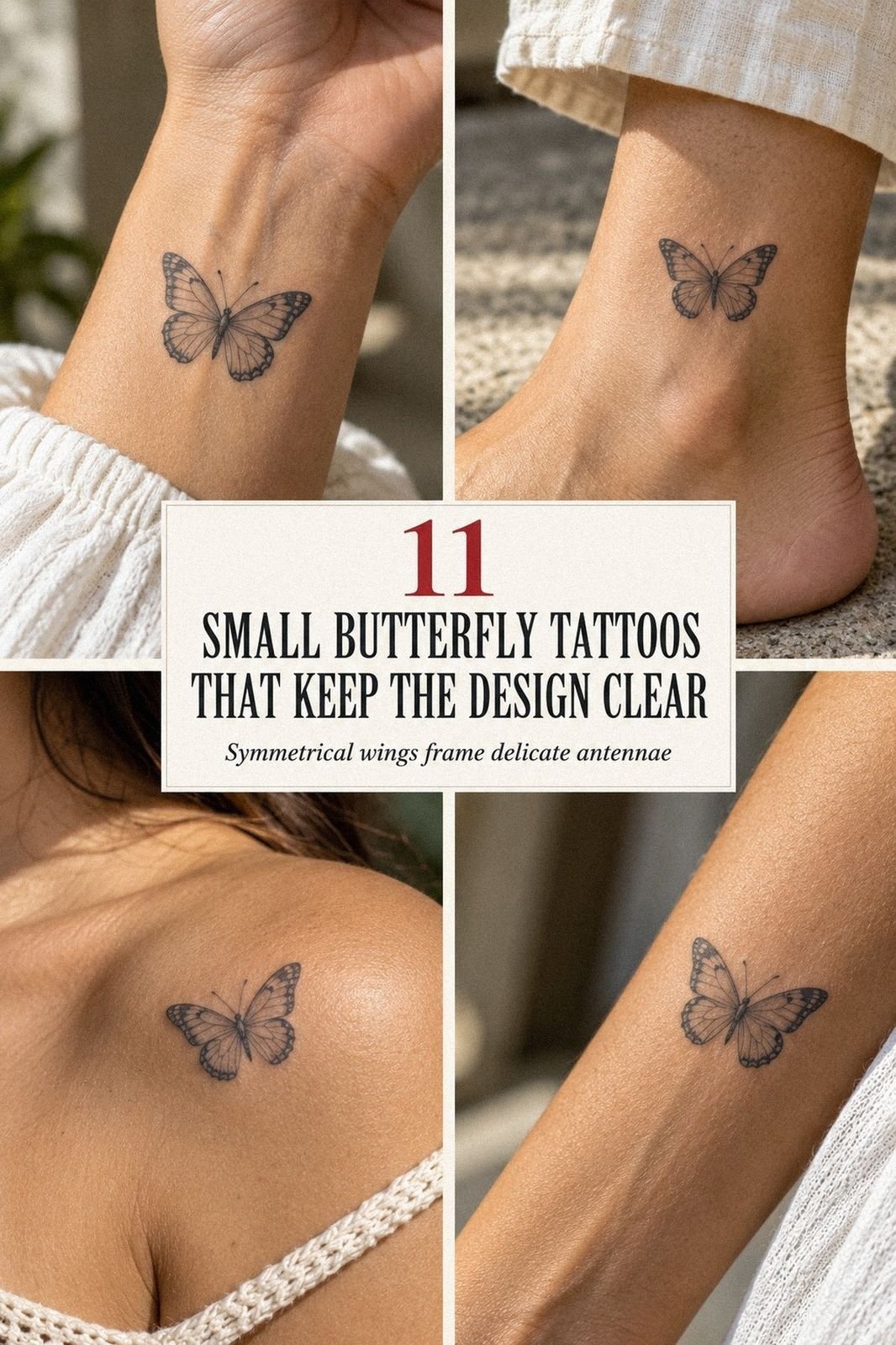
Small butterfly tattoo designs can stay readable for years when line weight, placement, and scale work together. I learned that after choosing a piece that was too tiny and too busy. These ideas keep the shape crisp, personal, and striking without making you commit to a cover-up later.
Editor’s note: If you’re setting a budget, spend it on the stencil consultation, the artist’s healed portfolio, and the right scale. Those choices usually matter more than adding one extra vein or decorative mark. Start with structure, then add style!
Start With a Minimalist Small Butterfly Tattoo
A single-needle linework butterfly on the upper back gives you a minimal starting point. The open wings, even symmetry, and fair cool-pink skin can keep the design clear without making it vague. You’ll want the wings to breathe, especially if your design is about 1 to 2 inches wide.
I’d skip several tiny interior marks because they can merge as the tattoo settles.
The upper-back placement is practical if you’re nervous about visibility. Your clothing can cover it, but you can still show it with a low-back top when you want to.
The skin there usually gives an artist enough area for a crisp outline, and the placement feels personal without being overly dramatic. It’s a graceful option for a first piece.
Ask your artist to leave deliberate negative space between the wing veins. That separation keeps the butterfly legible instead of turning it into a dark speck.
A short consultation matters here, because you’ll learn whether your chosen scale suits your anatomy and preferred line weight. I made the mistake of shrinking a design before asking how it would age.
If you’re comparing quiet motifs, browse these small butterfly tattoo ideas for women and notice how open shapes read from a distance. Your best reference won’t be the smallest image.
It’ll be the one with enough breathing room to remain crisp and meaningful. Bring an open-wing reference that shows the scale honestly.
Behind the Ear: Private but Edgy
Behind the ear works beautifully for a dainty butterfly with open wings, especially when the design follows the curve behind your medium warm ivory skin. The location feels intimate and slightly edgy, but your hair can cover it whenever you need a more understated look. I’d keep the silhouette simple and avoid crowded dots near the ear fold.
A fine-line butterfly here should have a clear head, two upper wings, and a small lower-wing shape. You don’t need heavy shading to make it expressive. Your artist can use a few clean veins and restrained skin breaks, which will keep the result sleek instead of muddy.
And if you wear glasses or earbuds, tell your artist before settling on the exact point.
Behind the ear can be more sensitive than the upper back because the skin is thin and the area sits close to bone. The session may feel sharp, but the design itself is usually compact. Bring your own healing plan, and don’t schedule it right before a day of tight headphones or constant rubbing.
That small detail can protect your healing skin.
For more placement ideas, compare this with small wrist tattoo ideas. Your choice depends on whether you want the butterfly to disappear into your hair or remain visible during ordinary gestures. I’d choose behind the ear when privacy matters more than daily visibility, and that can make the placement worth it.
Add Color Without Losing Clarity
A color butterfly across the collarbone can look playful without becoming childish. Build the design around a clear outline and a restrained wash of color rather than filling every section. I’d choose one main shade with a small secondary accent instead of asking for five competing pigments.
A muted plum watercolor wash can keep the wings vibrant while preserving the fine-line structure underneath. Your artist should leave some skin visible between color areas, because uninterrupted pigment can overpower a small design.
The result can feel romantic and delicate while still reading as a butterfly from several feet away. That restraint makes a difference!
Color changes the conversation about aging and cost. You’ll want to ask how the chosen pigments behave on your skin tone and whether the artist’s portfolio includes healed examples. I’d skip a pale yellow-only design because it may lose contrast faster than a deeper blue, red, or black accent.
Your tattoo doesn’t need to be loud to be memorable.
If you like this direction, compare it with small watercolor tattoo. Bring your artist a reference that shows the color density you want, not just the mood. A thin color layer can look gentle and polished, while a saturated fill may make a tiny butterfly feel heavier than you intended.
Three Butterflies, One Flight Path
Three butterflies across the sternum create a flowing flight path, and the sternum spacing will do most of the visual work. On golden tan skin, black linework can create strong contrast, but each butterfly still needs enough separation. I’d arrange them from smallest to largest so your eye moves naturally across the sternum.
The three-point flight path is a concept I use when a group needs direction. Keep the first butterfly slightly lower, the center one as the visual anchor, and the last one angled just enough to suggest movement.
Don’t place them in a rigid row. Your design should feel expressive, not stamped three times.
The sternum is a bony area, so you may find it more sensitive than the thigh or upper arm. Your artist can make the session easier by keeping each butterfly crisp and avoiding unnecessary shading.
And if you’re unsure about the arrangement, ask for a stencil preview while standing naturally. Your posture changes the spacing more than you’d expect.
For symbolic ideas, read this guide to strength butterfly tattoo meaning. The three forms can represent stages, people, or a personal shift, but you don’t need to explain that meaning to anyone. I value the flight path most when the symbolism stays personal.
Test a Small Butterfly Tattoo on the Wrist
The wrist displays a tattoo often, so I’d pick one crisp shape rather than a crowded collage. Start by comparing silhouettes and checking how the design behaves when your hand bends, grips, types, or lifts something. That constant wrist movement deserves attention before you choose the final size.
A black flash design gives you a classic foundation. Look for open wings, a readable body, and vein marks that aren’t packed against the outline.
The wrist moves constantly, and your skin bends during ordinary tasks. A simple butterfly will keep its identity better than an ornate miniature with too many fragile details.
You’ll also want to consider which side of the wrist faces up during your normal day. The inner wrist feels personal and softer, while the outer wrist reads more immediately.
I’d skip placing the lowest wing directly across a wrist crease because repeated movement can make the design feel visually interrupted. Your artist can shift it slightly without losing the placement.
If you like flash-inspired work, compare small traditional tattoo ideas. A solid black accent can give your wrist butterfly enough contrast without turning it into a heavy traditional piece. And because a flash-inspired design is easy to compare, you can protect your budget by choosing the one shape that feels most personal.
Build an Ornate Butterfly With Dotwork
An ornate butterfly made with dotwork on deep ebony skin can feel powerful and elegant, but the pattern needs clear spacing. I’d choose dot clusters that support the wings rather than covering every inch with texture. A few deliberate skin breaks can make the difference.
A dotwork gradient can move from denser marks near the body to lighter points toward the wing edges. That creates depth without relying on gray wash.
Your artist should show you healed dotwork examples, because fresh dots can look sharper and darker than they’ll look later. The goal is an intricate shape that still reads quickly.
The thigh offers more skin area and is generally more tolerable than a bony placement. You can also keep the tattoo protected from constant public exposure during healing.
I’d avoid making the butterfly so ornate that the outer contour disappears. Your silhouette is still the part people recognize first, and it should remain clear.
For another texture-led direction, look through small dotwork tattoo. Your artist might combine black dot shading with untouched skin around the veins, which keeps the result refined rather than crowded. This is the right choice when you want a delicate subject with a darker, more dramatic edge, and it can be worth the cost if the technique is central to your idea.
Pair a Butterfly With Floral Details
A wildflower sprig beside the butterfly creates a graceful pairing on the thigh. Keep the floral detail flowing around the butterfly instead of competing with it. I’d use one single sprig, not a full bouquet, because the small scale needs visual separation.
The fine botanical stem can lead the eye toward the wings and give the composition a natural direction. Your artist might place the flowers slightly below the butterfly, allowing the open wings to remain the focal point.
Avoid heavy leaf clusters. They can make the design look busy, especially if your skin moves when you walk or sit.
This idea works well when you want something symbolic but not obvious. The butterfly can represent change, while the flower adds a personal memory, initial, or season without requiring text.
I’d choose an understated stem if your butterfly is already ornate. Your tattoo should have one clear lead character, and that usually gives you better value than adding several competing motifs.
If you want to compare related motifs, look at small dragonfly tattoo. A wildflower sprig can also be adjusted to suit your proportions, so ask for a stencil that follows the thigh instead of sitting like a sticker. And if you prefer a more feminine result, keep the stems narrow and the wing outline firm.
Mark New Beginnings With a Symbolic Butterfly
A wrist butterfly for new beginnings can be meaningful without using words. Keep the body centered and let the symbolism come from one small detail, such as a star, initial, or open vein pattern. If your budget is limited, simplify the personal symbol before shrinking the butterfly itself.
The open-wing symbol reads as movement, possibility, and personal change. Your artist can make the shape bold enough to survive daily viewing while keeping the detail restrained. I’d skip adding a long quote beneath it.
Text competes with a small butterfly quickly, and your original meaning may feel stronger when it stays visual.
Because the wrist is visible, you’ll see this tattoo during ordinary moments. That can be reassuring, but it also means you should choose a design you won’t outgrow after one emotional week. Ask yourself whether you’d still want it on a boring Tuesday.
If yes, you’re probably close to the right concept. It can become a daily reminder without becoming a public explanation.
You can explore more symbolism through strength butterfly tattoo meaning. Your artist might use crisp black ink with a single unfilled center, giving the butterfly an empowering but understated quality. It’s a personal mark, not a public explanation.
Follow the Collarbone’s Natural Line
A collarbone butterfly can follow the body line naturally. The placement feels sleek and feminine when the design sits just below the bone instead of crossing it at an awkward angle. I’d ask your artist to test the angle while you stand, breathe, and relax your shoulders.
The collarbone placement has a graceful visual rhythm because the butterfly can sit slightly off-center. Your artist might angle the body toward the shoulder, but don’t force movement if you want a more classic emblem. I’d choose a clean outline over soft gray haze here, since the bone already gives the design a strong structural line.
This area can feel more sensitive than the thigh or outer arm, particularly when the needle passes near the bone. Your skin may also experience strap friction or fitted clothing during healing.
Plan loose layers, gentle washing, and protection from direct sun. Thinking about the healing period before booking can prevent an avoidable cost.
For related inspiration, browse small tattoo ideas for women. Your best reference should show the butterfly at a real collarbone angle, not only from one fixed view. And if you’re choosing between centered and offset placement, I’d pick offset alignment because it follows your anatomy instead of fighting it.
Black Ink, Bold Silhouette
A fresh tattoo won’t be the final appearance. A bold black ink butterfly can hold its shape well when the outline is clear and the placement gives it enough skin area.
I’d use the healed side of an artist’s portfolio as your decision point. Your artist should be willing to show healed work, not only bright appointment-day examples.
Black ink can soften, and very fine lines may widen over time. You’ll want the outer contour to remain stronger than the interior veins so the butterfly still reads after the initial sharpness fades.
This is where the healed-contrast rule helps: the smallest details should support the silhouette, not carry the entire design. I’d skip a design that looks impressive only when enlarged. Your tattoo needs to work at normal viewing distance, especially if you’re placing it on the wrist, hand, or collarbone.
For a comparison with more traditional weight, see small trad tattoo ideas. Your artist can combine a crisp outline with controlled interior marks, giving you a timeless result.
That is worth protecting! If you’re worried about a future cover-up, leave enough separation between details now.
Match Small Butterfly Tattoos for Sisters
Matching butterflies for sisters can be identical, mirrored, or related without being carbon copies. The design should be tested on each person’s anatomy and skin tone. I’d choose the same outer silhouette with one personal variation per sister.
A paired butterfly design can stay meaningful while allowing different placements. One of you might choose the thigh, while the other chooses the wrist or shoulder.
Your tattoos don’t need to sit in the same location to feel connected. I’d avoid forcing identical scale if one body area needs more breathing room.
You can vary one detail, such as a tiny dot cluster, a different wing opening, or a subtle flower. That makes the tattoos personal without weakening the connection.
And if you’re planning the appointment together, agree on the artist’s linework style first. A matching idea can feel awkward when each tattoo uses a different visual language.
One personal variation is usually enough.
For more small butterfly references, compare small butterfly tattoos females. Your strongest choice will be a shared butterfly outline with enough contrast for both skin tones. I’d pick a classic shape over a trend-heavy one because sisters should still recognize the connection years from now.
The Three-Anchor Rule I Trust
After looking at these eleven designs, I’d judge every small butterfly tattoo by three anchors: silhouette, placement, and future readability. Your silhouette should be recognizable without explanation. Your placement should suit how visible and sensitive you want the tattoo to be.
Your details should support the shape instead of making it depend on microscopic lines. That is the future readability test.
I’ve seen people choose a reference because it looked iconic on a screen, then discover that the same design needed a different scale on their body. I made that mistake once. The stencil looked fine while I was standing still, but the placement felt cramped when I moved naturally.
Your artist’s stencil consultation is where you catch that problem.
The most reliable decision is rarely the most elaborate one. A two-scale test can help: ask to see the design at the intended size and slightly larger.
If the smaller version loses the wing structure, choose the larger one or simplify the interior. You’ll protect the tattoo’s future clarity by making that call before the needle starts.
I’d also ask about healed work, aftercare, sun exposure, and how your chosen area tends to age. Surface healing usually takes about 2 to 3 weeks, while complete healing can take about 2 to 3 months.
Keep the skin clean, moisturized, and away from pools and strong sun while it settles. That healed aftercare patience is part of the design.
Test a Butterfly on the Shoulder
The shoulder gives a butterfly enough skin area to remain readable while still letting you control visibility. You can place it toward the front, over the shoulder cap, or slightly behind the arm. I’d choose the shoulder position by watching the wings move with your body rather than deciding from a flat sketch alone.
A shoulder-cap silhouette works especially well when the wings are balanced and the body follows the curve of the muscle. Keep the lower wings slightly smaller if you want the design to feel dainty instead of heavy. The placement can stay feminine, masculine, or neutral depending on the outline and your preferred details.
Shoulder skin can experience friction from straps and sun exposure, so think about your regular routine before booking. If you swim, train, or spend long hours outside, ask your artist how to protect the area during early healing.
A clear aftercare plan is part of making the choice feel safe. Consider the likely strap exposure first.
If you want the butterfly to remain easy to cover, test its visibility under a short sleeve and a tank top. That simple visibility check can tell you more than a social media reference. I’d choose the shoulder when you want a personal tattoo that can still make a bold appearance when you decide to show it.
Gothic Wings, Sharp and Focused
A gothic butterfly can use pointed wings, black fills, or a small crescent without becoming unreadable. The key is keeping one dominant shape and letting the darker details support it. I’d avoid stacking a skull, moon, roses, and lettering into a design that was meant to stay small.
A sharp-wing outline gives the butterfly an edgy identity immediately. You can soften the effect with open skin breaks, or make it more dramatic with controlled black sections near the body. The design should still read as a butterfly before someone notices the gothic details.
This direction suits someone who wants a haunting or daring mark rather than a sweet motif. Ask your artist how the black fill will heal on your skin tone and whether the wing points need extra separation. Tiny points placed too close together can blur into one dark edge.
For a darker result, I prefer a strong outer shape with one symbolic accent. A small star, thorn, or crescent can carry more meaning than several decorative additions. Your tattoo will feel more timeless when the concept remains focused.
One symbolic accent can be enough.
Choose Clean Geometry for Men
A small butterfly tattoo can look masculine, feminine, or entirely personal. The strongest choice depends on the geometry, placement, and details you actually like, not on a rigid category. I’d start with the wing structure and let the final character develop from there.
The best result stays outside a fixed personal category.
A geometric wing structure can use straight segments, mirrored angles, or restrained dotwork. Keep the body centered and make the two sides related without demanding perfect mathematical symmetry. Natural anatomy will always affect the final result.
For a sharper look, consider the forearm, upper arm, chest, or calf. These placement options can support a slightly larger silhouette without forcing the design into microscopic detail. If you prefer something quieter, the upper back or inner arm can keep the mark more private.
You can also choose one small feature that makes the butterfly yours: a broken wing, a dark center, a birth-flower stem, or a single unusual vein. That detail can feel expressive without making the tattoo ornate. The best design is the one you would still recognize as yours years later.
What Makes A Small Butterfly Tattoo Worth It?
A small butterfly tattoo feels worth it when the design remains readable, the placement fits your routine, and the symbolism still feels honest after the excitement fades. A low price doesn’t create value if the shape is too small to age well. A larger quote can still be worthwhile when the artist’s healed work supports the decision.
That is the real design value.
I look for three signs of value: a clear stencil, realistic scale, and an artist who explains trade-offs. You should know what happens if you add color, remove interior veins, or move the butterfly away from a crease. That conversation can prevent an expensive correction later.
Your budget should also include aftercare supplies and a possible touch-up. Don’t book based only on the lowest number you see online. Ask about the shop minimum, estimated duration, and whether the quote changes for color or dotwork.
A meaningful tattoo doesn’t need to be complicated. If one open-wing silhouette says everything you want, adding extra details may weaken the idea. Your future self will notice!
How Much Detail Is Too Much?
Detail becomes too much when the butterfly stops reading at normal distance or when the smallest marks sit almost on top of one another. I use the outline test first: cover the interior with your hand and ask whether the outer shape still looks unmistakably like a butterfly.
A detail-density check can reveal problems before the appointment. Look at the design at its intended size, then view it from several feet away. If the body, wing divisions, and overall direction disappear, simplify the interior instead of shrinking the outline.
Fine veins can be beautiful, but they need breathing room. Dotwork, color, and lettering all compete for the same limited skin area. Choose one supporting technique and let the silhouette lead.
Your artist may suggest removing a few marks, enlarging the design, or changing the placement. Listen carefully. A slightly simpler design can age more clearly than an intricate one that only looks impressive on a phone screen.
Carry One Personal Symbol With a Single Butterfly
One butterfly with one personal symbol can carry more meaning than a crowded collection of motifs. Consider a tiny star for guidance, a small flower for someone you love, or a single open wing for change. I’d keep the personal symbol close enough to feel connected but far enough away to remain legible.
A personal-symbol detail works best when it has a clear visual role. The star can sit between the wings, the flower can follow one lower wing, or the initial can be hidden in the body shape. Avoid placing several unrelated symbols around the butterfly.
Think about whether you want the meaning to be obvious to other people. An understated mark can stay private, while a bold symbol may invite questions.
Neither choice is more meaningful; they simply create different daily experiences. That private meaning can feel quietly empowering.
Before booking, write one sentence explaining why you want the tattoo. If the sentence needs a long explanation, the design may need simplifying.
If the sentence is clear, your artist can translate it into a crisp and personal shape. Keep that booking note short.
What People Always Want to Know
How much does a Small Butterfly Tattoo usually cost?
A small butterfly tattoo in the United States typically costs about $100 to $300, depending on the artist, region, size, placement, and detail. Some shops have a minimum of roughly $50 to $100, while hourly rates often fall around $100 to $250.
Your final quote may be higher for color, dotwork, or a highly ornate design. I’d ask for the final quote and estimated session length before booking, so you’re not guessing at checkout.
Are Small Butterfly Tattoo a good idea for a first tattoo?
Yes, a small butterfly tattoo can be a strong first choice because you can select a tolerable placement and keep the design personal. A clear black outline usually gives you an easy reference point while you learn how your skin responds.
Your wrist, upper back, thigh, or shoulder may feel more manageable than the sternum, ribs, feet, or hands. I’d choose a design with readable lines rather than an ultra-tiny symbol that depends on fragile detail. That makes the first-tattoo placement easier to evaluate.
How do I choose a tattoo artist for Small Butterfly Tattoo?
Choose an artist whose portfolio shows healed fine-line work, clean symmetry, and the style you want. Your artist should also work in a hygienic studio and answer questions about placement, aftercare, and how the design may change over time.
Look for several healed photographs, not only fresh tattoos. And if you want dotwork or color, make sure that style appears repeatedly in the artist’s portfolio rather than in one isolated example. A consistent portfolio pattern matters.
How much do Small Butterfly Tattoo hurt?
Pain depends on your personal sensitivity and the placement. Areas over bone, including the ribs, feet, hands, and sternum, are often more painful, while the forearm, thigh, and shoulder are commonly more tolerable. Your personal pain range may be different from someone else’s.
Your session may feel sharp, hot, or scratchy rather than uniformly painful. I’d eat beforehand, hydrate, and choose a sensitive placement that lets you stay relaxed. A calm body usually makes the experience easier.
How long does a Small Butterfly Tattoo take to heal?
The surface usually heals in about 2 to 3 weeks, while complete healing can take about 2 to 3 months. Your skin may peel, feel dry, or look slightly dull during the process.
Wash gently, moisturize as directed, and avoid pools, strong sun, and picking at the area. You’ll protect the final result by following your artist’s aftercare instructions instead of judging the tattoo during its flaky stage.
What’s the best placement for Small Butterfly Tattoo?
The upper back, thigh, shoulder, and forearm are practical choices when you want more tolerable placement and a better chance of preserving fine detail. The wrist, collarbone, sternum, hands, and feet can be more visible but may feel more sensitive.
Your best placement depends on visibility, daily friction, and the design’s scale. I’d choose the area that supports the butterfly’s outline rather than forcing your favorite reference into an unsuitable space. Consider that daily friction before booking.
Where I’d Start First
If I had to pick one, I’d start with the minimalist upper-back butterfly. Its open silhouette leaves enough skin between the veins, so you’re less likely to need a cover-up when fine details soften.
Pin the idea for later and compare it with this small butterfly tattoo guide before booking. A thoughtful stencil, realistic scale, and a little patience can protect you from cover-up risk later.