The hammerhead shark tattoo carries real weight. It’s not just a cool ocean piece. People choose this specific shark for a reason, and that reason usually has everything to do with power, awareness, and the ability to navigate life from multiple angles. The hammerhead’s signature wide-set eyes give it near 360-degree vision, and that detail translates directly into meaning.
Most clients come in knowing exactly what they want to say with this piece. They want something that reads strong from across the room but carries a layer of personal significance underneath. This shark delivers both. Here’s what it actually means and how to wear it right.
Core Meaning: Strength and Adaptability
The hammerhead shark symbolizes raw strength first. It’s an apex predator that’s thrived for hundreds of millions of years. That kind of longevity reads as resilience. People who’ve pushed through serious hardship, addiction, illness, loss, often land on this design because it says: I’m still here, I’m still moving forward, and nothing in the water scares me anymore.
The adaptability angle is just as strong. Hammerheads are uniquely built, their cephalofoil head is a genuine evolutionary advantage, not just a weird quirk. That translates to being different by design, built for your environment in a way others aren’t. It’s a solid symbol for people who’ve had to carve their own path rather than follow the standard one.
Vision and Awareness
The hammerhead doesn't hunt blind, and neither do you.
That wide, flat head exists for a reason. Hammerheads have their eyes mounted on the sides of the cephalofoil, which gives them close to 360-degree visual coverage. They literally see everything around them simultaneously. As a tattoo, this reads as heightened awareness, sharp perception, and the ability to anticipate threats before they arrive.
Some clients tie this to intuition or emotional intelligence. They see themselves as people who read a room fast, who pick up on what others miss. Others interpret it more literally as vigilance, staying alert, never getting caught off guard. Both readings are legitimate. It’s one of those meanings that’s flexible enough to fit a wide range of personal stories without feeling generic.
Cultural and Maritime Background
In Polynesian tattoo tradition, shark imagery has been sacred for centuries. Sharks represent protection, guidance through dangerous waters, and ancestral power. The hammerhead specifically appears in some Hawaiian and Maori-influenced designs as a guardian spirit, something that clears the path ahead. These aren’t borrowed aesthetics, they’re genuine cultural symbols, though non-Polynesian clients should approach heavily traditional styles with some awareness.
In American and Western sailor tattoo history, shark pieces in general signal fearlessness at sea and survival instinct. The hammerhead, with its unmistakable silhouette, became popular in maritime communities as a mark of strength and respect for the ocean. That sailor tradition feeds directly into modern Western tattoo culture, which is why the hammerhead reads as both tough and classic in American shops.
Popular Design Styles
Traditional American style is a natural home for the hammerhead. Bold outlines, flat saturated color, limited shading. The thick lines hold up over time and the silhouette is already iconic enough that it reads clean even at smaller scales. Neo-traditional adds dimension with more elaborate shading and decorative elements while keeping that bold-will-hold structure. Both styles suit the hammerhead’s strong profile well.
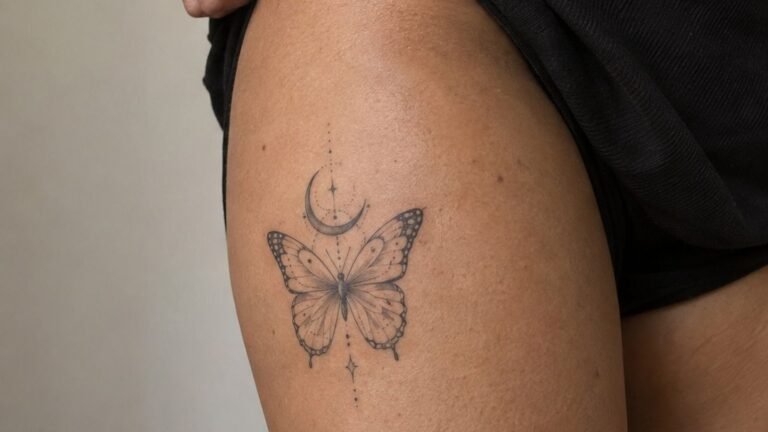
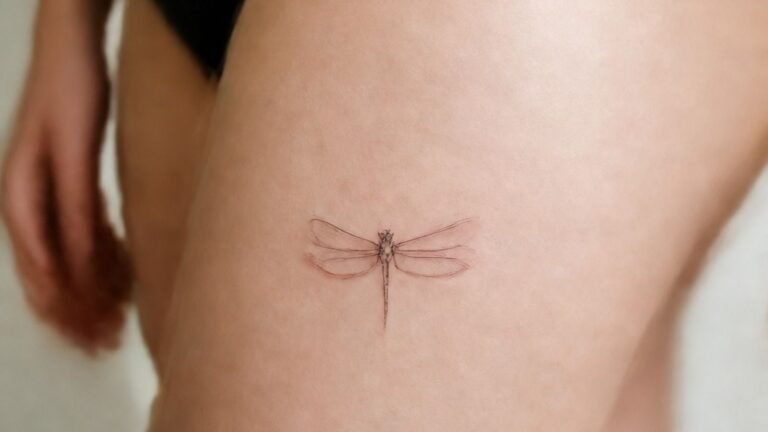
Blackwork and geometric approaches have become increasingly popular. Dotwork filling the body, geometric linework building the cephalofoil, mandala elements integrated into the form. Fine line realism is another direction entirely: detailed texture, skin patterning, realistic eye work. That approach demands an experienced artist and a placement with low movement and minimal sun exposure to keep the detail crisp as it heals and ages.
Color Versus Black and Grey
Color hammerheads hit hard. Deep oceanic blues, grey-greens, and blue-grey tones make the piece feel alive. A saturated piece with a solid background, open water, or stylized waves behind it reads from across the room. The key is commitment: partial color on a big piece often looks muddy five years in. If you go color, go all the way and use a saturated, experienced artist.
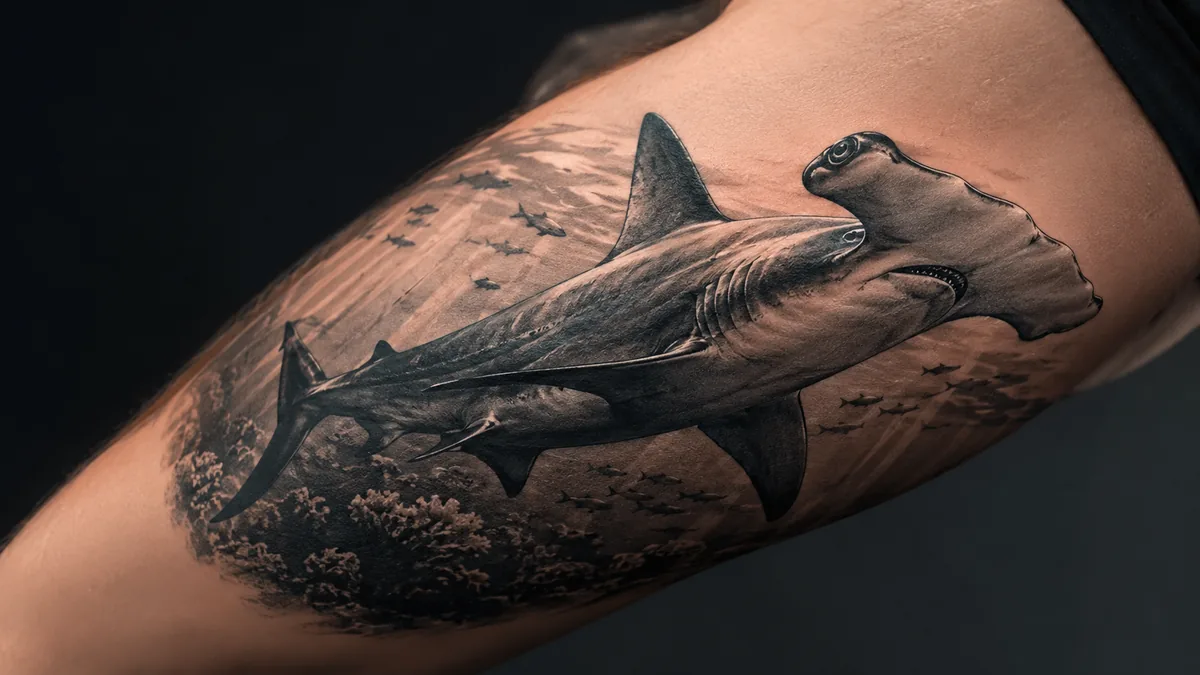
Black and grey is arguably the stronger long-term choice for a hammerhead. The natural coloring of the shark is already minimal, grey skin, white belly, dark fins, so black and grey translation is visually accurate and ages beautifully. Whip shading on the body creates realistic movement. A solid black silhouette version is even simpler and stays crispy for decades. For fine line realism in black and grey, placement on low-wear skin is non-negotiable.
Placement and How It Ages
The hammerhead’s horizontal silhouette makes it a natural fit for the forearm, thigh, shin, and upper back. These are low-wear zones with relatively stable skin that hold detail over time. The elongated body and wide head wrap well around the calf or upper arm. The sternum and ribs work for a vertical orientation with the shark diving downward, though those spots are spicy and the skin moves more with age.
Avoid placing fine line or high-detail versions on hands, fingers, feet, or inner wrists if you want them to last. High-wear zones blow out fine lines fast and require frequent touch-ups. Bold traditional or blackwork versions tolerate those placements better since there’s less fine detail to lose. Whatever placement you choose, sunscreen after healing is not optional if you want that piece to look solid five years from now.
Who Gets This Tattoo and How to Make It Personal
Surfers, divers, and people with deep ties to the ocean are obvious clients. But the hammerhead draws a broader crowd than you’d expect. Veterans who connect with the predator’s precision and focus. People in recovery who identify with relentless forward motion. Athletes who see themselves as built different. Parents who want a protection symbol that isn’t cliche. The design is versatile enough to carry all of those stories.
To make it personal, think about what specific meaning you’re locking in. Add elements that mean something to your story: a specific ocean location, a date worked into the negative space, a geometric pattern that references your culture or family. Talk to your artist about orientation. A hammerhead swimming toward the viewer reads differently than one gliding sideways through open water. Get that conversation right before the needle touches skin.