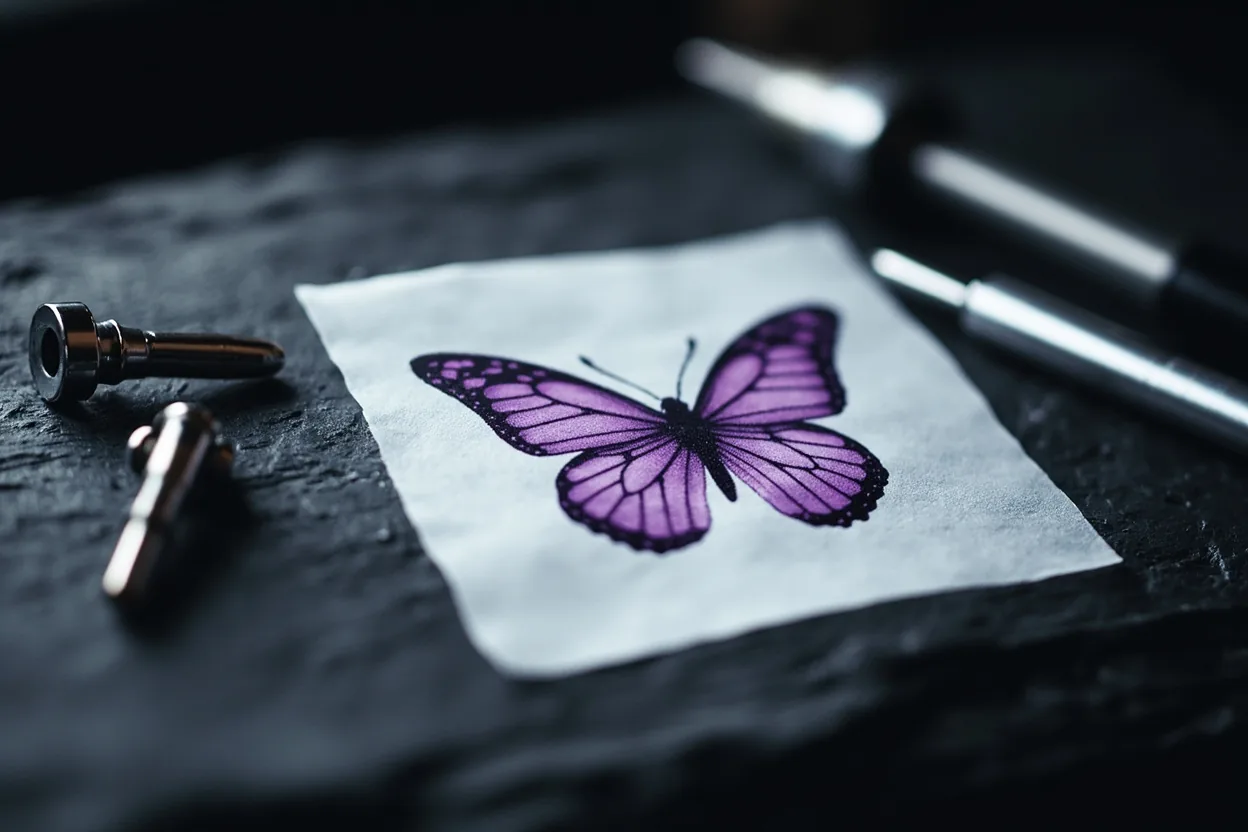
A minimalist butterfly looks like the easy choice: small, clean, a few thin lines. But the fine line look is the least forgiving style there is. Get the size or the line weight wrong and the wings blur into a smudge within a couple of years. Done right, it stays delicate and readable for a long time.
Quick answer: A strong minimalist butterfly uses a clear wing silhouette, very little interior detail, and enough size for the shape to read. Single continuous line and tiny black butterflies work best at roughly 2 cm or wider, with fine-but-not-hairline lines, on stable placements like the inner forearm, behind the ear, collarbone, or ankle. Expect a possible touch-up.
What “minimalist” actually means in fine line work
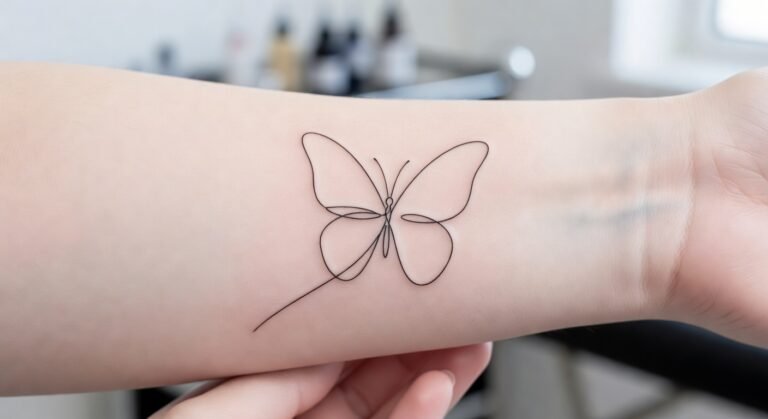
Fine line tattoos are done with a single needle or very small round liner groupings, which is what gives that delicate, hand-drawn look. A true one-line butterfly is just clean linework with no shading, a single continuous stroke that forms the body and wings. The whole effect depends on consistent line weight and smooth curves, because there is nothing else on the design to hide a shaky line once it heals.
That simplicity is the appeal and the risk. With no fill and no shading, every millimeter of the outline is doing the work. A confident single stroke reads as intentional; a wobbly one reads as a mistake. This is why the artist matters more here than in almost any other style, and why you should check their healed photos, not just fresh ink, before booking.
Size: why “tiny” can backfire
A fine line butterfly is only as permanent as the artist's restraint with the needle.
Minimalist butterflies are usually small, but there is a floor below which they stop working. Lines inevitably expand a little as a tattoo ages, and on a very small butterfly that spread merges the wings and body into one shape. Micro-realism artists generally recommend at least around 1.5 to 2.5 cm for simple small designs to stay readable long-term.
- Aim for at least ~2 cm width if you want a clear butterfly shape years from now.
- Below ~1.5 cm, the wings tend to merge visually as lines thicken with age.
- Use fine, not hairline, lines. Ultra-thin single-hair lines fade or blow out faster than slightly heavier fine lines.
- Skip heavy interior texture. Fine internal lines can merge and make the wings look muddy.
Going slightly larger is the single easiest way to protect a minimalist butterfly. It feels counterintuitive when the whole point is “small and discreet,” but a 2 to 3 cm butterfly is still subtle and ages far better than a 1 cm one.
Why thin lines blow out or fade
Tattoos live best in the dermis, the middle skin layer. If the needle goes too shallow and stays in the epidermis, fine lines can fade or fall out within months. If it goes too deep into the looser tissue underneath, the ink spreads and creates a blowout, that fuzzy halo around a line. Thin lines are more vulnerable to both, because they carry less ink mass and any small error in depth is proportionally a bigger problem.
Placement makes this worse or better. Thin, mobile skin like the inner wrist and fingers is more prone to line thickening and blowout, while flatter, more stable areas give the artist more control. That is the real reason placement choice is not just about visibility.
Best discreet placements for a minimalist butterfly
The goal is a spot that is easy to hide but also stable enough to keep the lines crisp. These hold up best:
- Behind the ear: a classic small-butterfly spot, very discreet under hair, and not in constant friction. Usually kept to roughly 3 to 5 cm.
- Collarbone: sits nicely at 3 to 5 cm, hides under most tops, and the skin is relatively stable for clean wings.
- Inner forearm: visible when you want it, stable skin, and enough flat surface for symmetrical wings.
- Inner wrist: very visible and easy to cover with a bracelet, but the thin, moving skin makes thickening and blowout a little more likely.
- Ankle: popular and discreet, though shoes and socks can wear extremely fine lines down faster.
The one to think twice about is the finger. It is trendy, but constant friction, washing, and sun mean fine lines there either fade out quickly or blur into thicker marks. If you love the look elsewhere on the hand, the side of the wrist or the inner forearm is a far safer bet. For more small-tattoo placement ideas that stay readable, see our guide to tiny tattoos with meaning.
Symmetry is the hidden difficulty
Butterfly wings are symmetrical, and on a tiny one-line design even a half-millimeter difference between the two sides becomes obvious once healed. The artist also has to account for body curvature, so the wings still look balanced when your wrist rolls or your ankle bone shifts. A flat placement like the collarbone or inner forearm gives them far more control than the side of a finger.
If symmetry matters to you, ask the artist to draw the stencil directly on your skin and view it from several angles before they start. Check how it sits when you stand normally and when you move, not just when your arm is laid flat on the armrest.
Questions to ask before you sit down
A short conversation up front saves a blurry tattoo later:
- Will the wings stay balanced when my arm or wrist moves?
- What detail can be removed so it heals cleaner?
- Does the stencil still read as a butterfly from two feet away?
- Can I see healed photos of your small butterfly tattoos?
Touch-ups and longevity
Be realistic: ultra-fine line tattoos tend to need touch-ups sooner than bold-line work. Faint or falling-out lines can show up within the first one to three years, especially on high-motion or high-friction areas like the wrist, ankle, or fingers. Plan for at least one touch-up in the tattoo’s early life if you go truly delicate.
You can stretch that interval a lot with two habits: choose a slightly heavier fine line rather than hairline, and protect it from the sun. Sunscreen on exposed placements does more for longevity than almost anything else. A minimalist butterfly is not a “set it and forget it” tattoo, but with the right size, placement, and aftercare it stays clean for years.
Where to take the idea next
If you want to layer in meaning rather than just the look, the butterfly already carries a strong one, transformation, freedom, grief, and survival, which we cover in the butterfly tattoo meaning guide. And if you like the minimalist approach but want to pair the butterfly with a small bloom, our minimalist flower tattoos guide covers floral shapes that stay clear at small sizes.