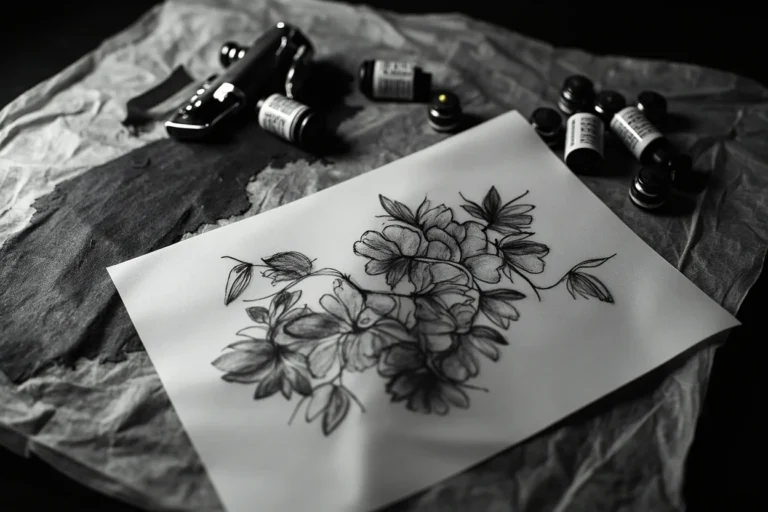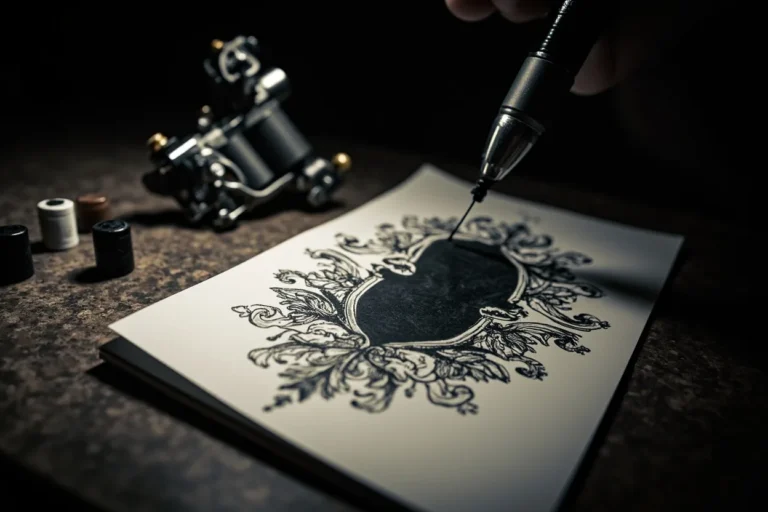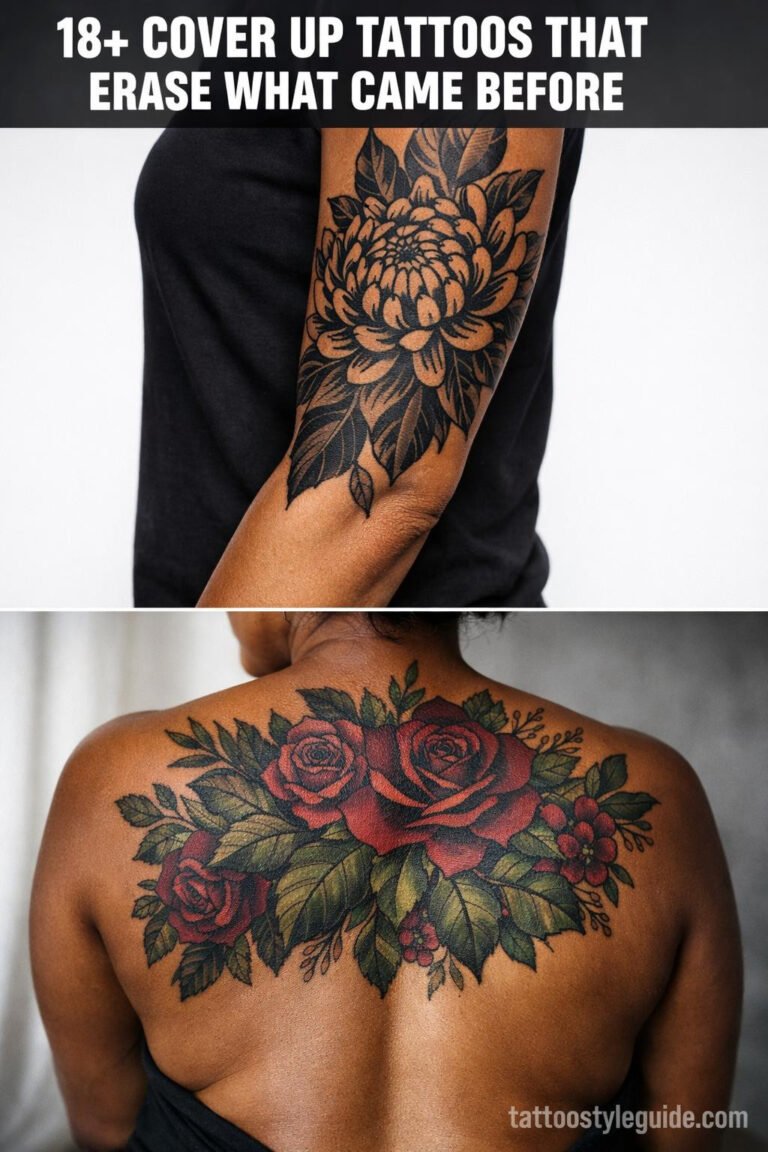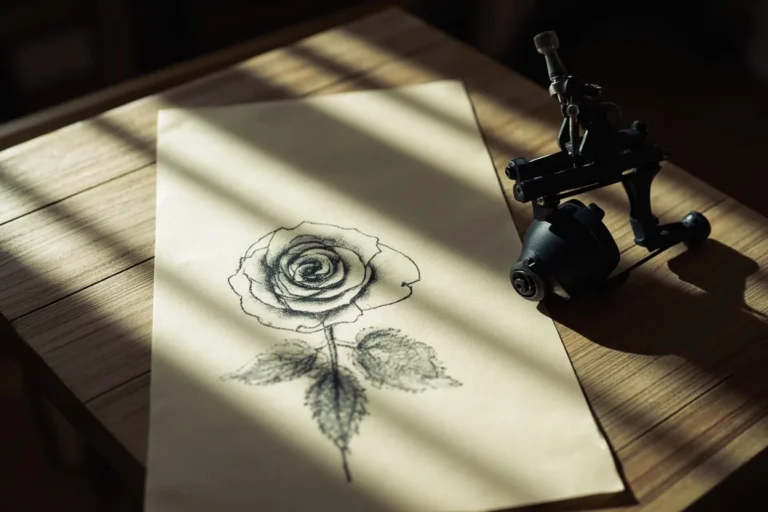
A tattoo portfolio is not proof that an artist can take good photos. It is the only evidence you have, before you commit your skin, of whether their lines hold, their blacks stay solid, and their work survives healing. Learning to read one properly is the difference between booking on a feeling and booking on the facts.
Quick answer: Read a tattoo portfolio by prioritizing healed photos over fresh ones, judging line consistency and solid black saturation, confirming the artist genuinely specializes in your style, checking for placements similar to yours, and reverse-image-searching anything that looks too good for the rest of the work. Depth in one style beats a scattered “I do everything” portfolio every time.
Fresh versus healed photos
This is the distinction most people miss, and it is the most important one. Fresh tattoos look darker, shinier, and more contrasty because of swelling, plasma on the skin, and blacks that have not yet softened. Almost anything looks good fresh. A healed tattoo, photographed weeks or months later, shows the real result: lines softened but still crisp, blacks settled but not patchy, and small details still legible.
A strong portfolio shows a mix of fresh and clearly labeled healed work, with captions like “6 months healed” or “1 year healed.” An artist who only ever posts fresh work, and never a single healed piece, is a yellow flag. In healed shots, look for lines that are still defined rather than fuzzy grey halos, blacks that stayed solid, and tiny details such as eyes or text that remain readable.
Linework and black saturation
The portfolio doesn't show you the best they've done, it shows you what they do consistently.
For any style with lines, which is most of them, line quality is non-negotiable. Lines should flow smoothly with no visible wobble, shaking, or scratchy re-tracing. Thickness should stay consistent unless the variation is clearly intentional, like the thick-to-thin of a calligraphic style. Where lines cross, the joints should be clean, without blown-out corners or messy overlaps.
Solid black areas tell you almost as much. In blackwork and traditional especially, black should be evenly saturated, with no lighter patches or streaks, sometimes called holidays. Shading should transition smoothly from dark to light without harsh, unintentional steps. Be wary of portfolios where dark areas look crushed into a single flat black with no range, or where healed blacks look washed out. Both point to issues with needle depth or packing.
| Signal | What good looks like | What to question |
|---|---|---|
| Healed photos | Labeled, crisp, still readable | Only fresh work, never healed |
| Linework | Smooth, consistent, clean joints | Wobble, re-tracing, blown corners |
| Black saturation | Even, solid, no holidays | Patchy or washed-out blacks |
| Style focus | 10 to 15 strong pieces in one lane | Every piece looks like a different artist |
| Placement range | Work near your chosen area | Only flat, forgiving spots shown |
Recognizing real style specialization
A serious artist usually has depth in one main style, or a small cluster, not a little of everything. Fine line work shows many delicate, minimal pieces with thin crisp outlines and plenty of negative space. Traditional shows bold outlines, a punchy limited palette, and strong saturation. Realism shows accurate light and shadow and believable textures, especially in faces and eyes. Blackwork shows confident use of pure black with real command of composition and negative space.
To gauge genuine specialization, look for at least 10 to 15 examples in the exact style you want, with consistent quality and a recognizable handwriting. If every piece looks like it could be a different artist, with skill levels that lurch up and down, they may be padding the portfolio or copying references. The right artist for fine line is rarely the right artist for dense color realism, and a portfolio makes that obvious if you read it honestly.
Spotting stolen or over-edited images
Some portfolios, especially on social media, use stolen or heavily filtered images. You want to filter those out before you trust your skin to them. The clearest signal is inconsistency: a world-class realism portrait sitting next to very mediocre linework suggests the strong piece is not theirs. No healed photos, no in-progress or stencil shots, no shop environment, and a very new account with few posts all stack the doubt.
The fix is simple. Save the image that looks too good and run it through a reverse image search. If the same tattoo appears under other artists or old pins, that portfolio image is likely stolen. Do this for any piece that stands out from the rest. Separately, watch for heavy editing: skin that looks plastic, neon-bright saturation that does not match the surrounding tone, or extreme highlights and shadows that can hide wobbly lines and patchy fill. Authentic artists tend to show multiple angles and consistent, neutral lighting. These same instincts overlap with the broader tattoo red flags worth knowing before you book.
What makes this work on real skin
A strong portfolio should make the artist’s strengths obvious and point you toward the right match for your specific tattoo. Two filters matter most. First, style-to-idea fit: define your intention in one line, whether that is a bold graphic piece, a subtle personal symbol, or a photo-real portrait, and confirm the artist’s main lane aligns with it.
Second, placement and anatomy. Different body areas age and heal differently. Demanding spots like fingers, the sides of hands, feet, and high-fold areas are hard on fine detail, and micro-detail there often blurs. More forgiving areas like outer arms, outer thighs, and the upper back hold detail and color better. Look in the portfolio for tattoos placed exactly or close to where you want yours, and check how they flow with muscles and joints. A great forearm tattoo does not automatically prove good finger work.
Before you book or apply it
- Find healed examples and judge those, not the fresh glamour shots.
- Confirm the same style appears across many strong pieces.
- Look for placements similar to yours on real bodies.
- Reverse-search anything that looks too good for the rest of the work.
Mistakes to avoid
Do not judge an artist by follower count or lighting style. A polished feed is a marketing skill, not a tattooing one. Do not ask an artist to work far outside the style their portfolio actually proves, since that is how you become someone’s first attempt at a style they do not own. And do not skip the readability test: if you cannot tell what a tattoo is from a meter or two away in their own photos, it will age worse on you.
Reading a portfolio well is really a way of choosing the right person before any needle is involved. Pair this with the guide to choosing a tattoo artist, plan the bigger picture with the tattoo planning guide, and once you have a shortlist, the custom tattoo design process shows what happens next.
Reader questions before you book
Why are healed photos more important than fresh ones?
Fresh tattoos look their best because of swelling and contrast that fade within weeks. Healed photos show the true result: how the lines, blacks, and details actually settled into the skin, which is what you will live with.
How many portfolio pieces should an artist have in my style?
Aim for at least 10 to 15 strong, consistent examples in the exact style you want. A handful of one-off pieces in that style, surrounded by unrelated work, is not the same as genuine specialization.
How do I check if a portfolio image is stolen?
Save the image and run a reverse image search. If the same tattoo appears under other artists or older posts, the image is likely not theirs. Inconsistent skill across pieces is the usual warning sign.