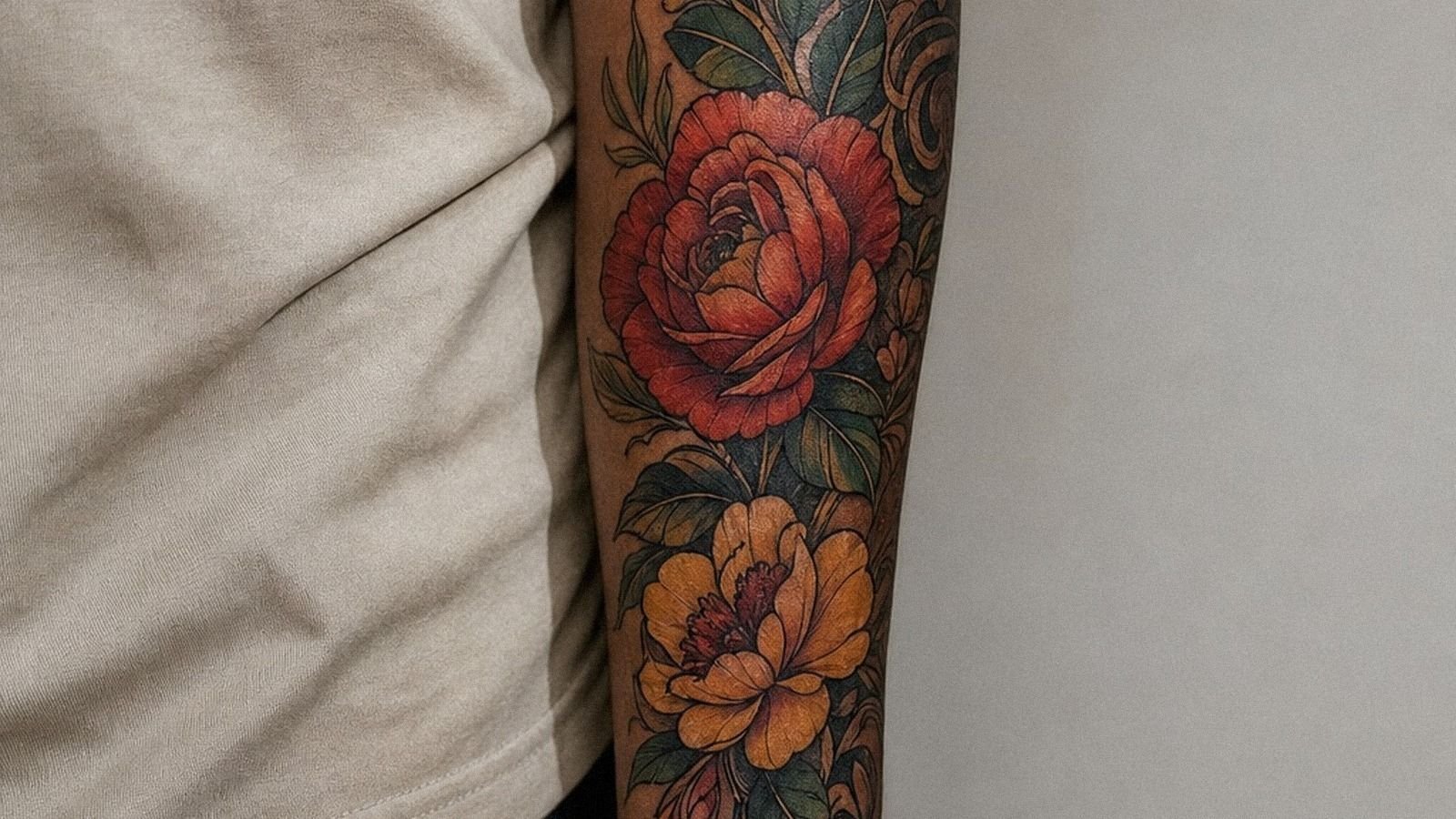
Neo traditional tattoo clicked for me when I stopped treating it like a louder version of old school and started reading it as structure, contrast, and skin flow. I booked this piece the week I turned 30. Five hours later, my arm finally made sense.
Here’s what it looked like before:
Before this piece, I had an outer forearm panel from elbow to wrist that I’d been saving for the right idea. I kept passing on good drawings because they felt either too soft, too tiny, or too busy to hold up. You know that stall-out point where you want new ink, but nothing feels right for the skin yet?
What finally pushed me was seeing healed work, not fresh work. Fresh tattoos can lie to you. Healed black and grey tells the truth about contrast, edge, and whether the design still reads clearly after the shine drops.
- Save Neo Traditional References First
- Pick An Artist Who Really Owns Neo Trad
- Panther Over Ornament? Pick The Shape That Holds
- Peonies Against Teeth Keeps The Piece Balanced
- Test The Design On Upper Arm Skin
- Build A Half Sleeve, Not A Sticker
- Keep The Palette Tight So The Value Stays High
- Let Bold Linework Carry The Whole Read
- Japanese Clouds Gave The Panther Real Motion
- Does The Stencil Still Work When Your Arm Turns?
- Approve Heavy Black Shading Before Color
- Saturated Red Ink Is Gorgeous, But Budget For The Bite
- Watch The Colors Settle Before You Judge The Value
- Protect The Tattoo Through Peeling
- Book The Tiny Touchup, Save The Whole Piece
- Healed Neo Traditional Sleeve, Not Fresh Hype
1Save Neo Traditional References First
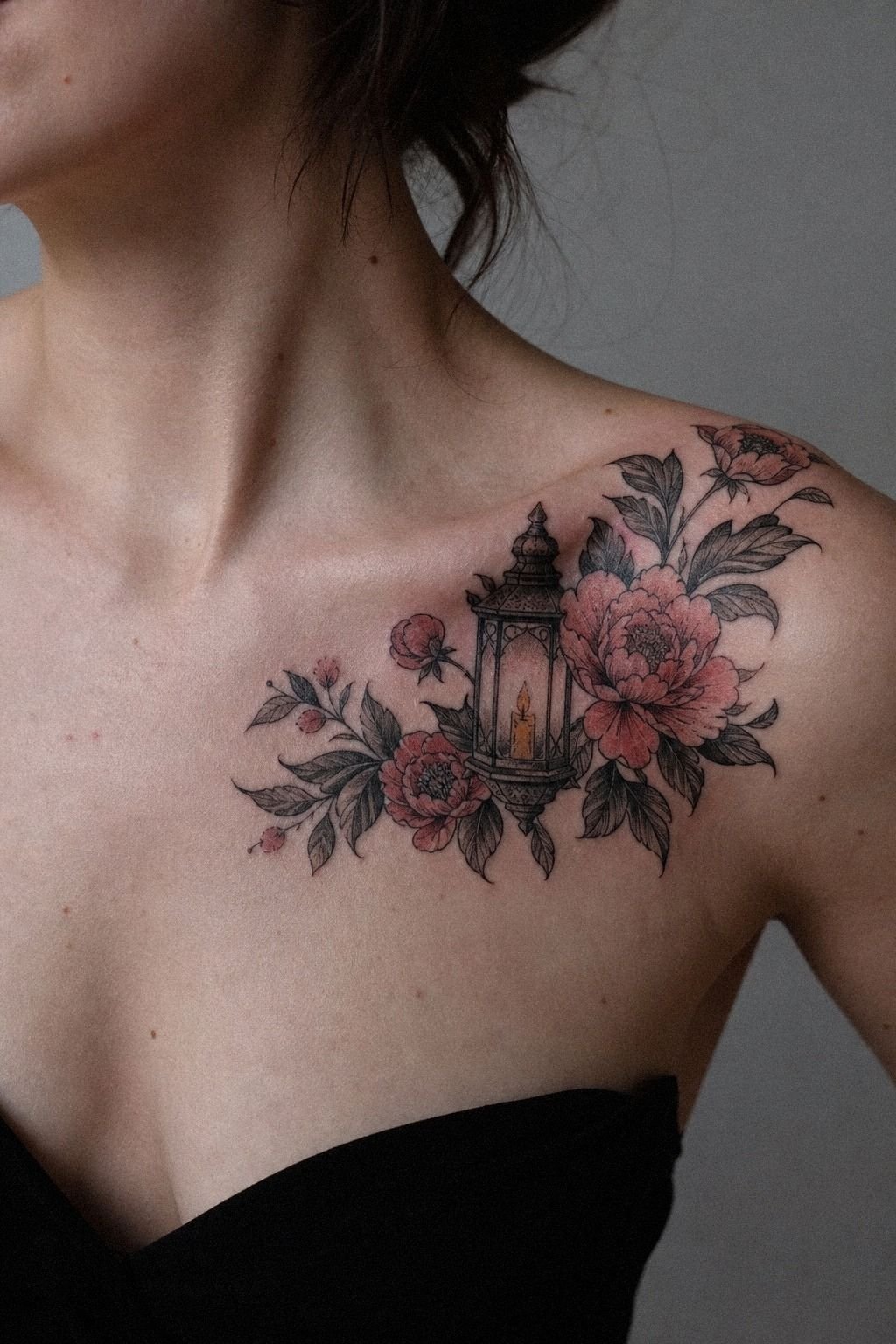
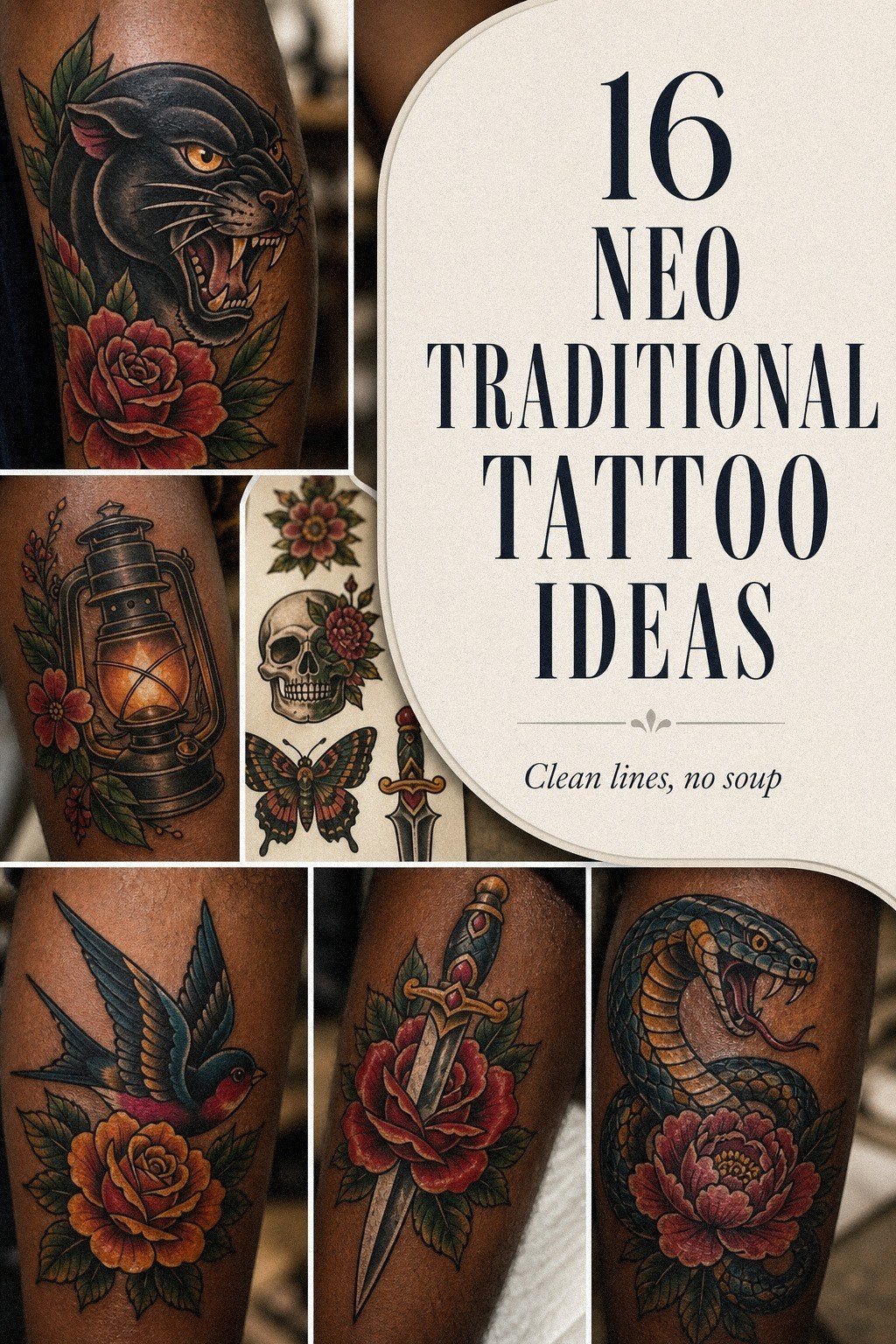
I started with screenshots, not appointments. If you want a neo traditional tattoo that ages nice on you, your reference folder needs more than pretty fresh photos. I saved collarbone pieces with neo-traditional linework that had strong outer shapes, open skin breaks, and color blocks that still read at a glance.
Reference folders can lie if they only chase mood. I saved healed examples, close crops, and one or two full body shots so I could see scale.
That kept me from asking for soup on a high-visibility placement. If you’re still sorting visual direction, my neo traditional tattoo ideas guide helps you separate good references from Pinterest noise.
And yes, collarbone placement looks sharp, but it’s a spicy place to learn on. I knew right away that if I kept the piece there, I had to keep the shape simple and the line pulls clean.
2Pick An Artist Who Really Owns Neo Trad
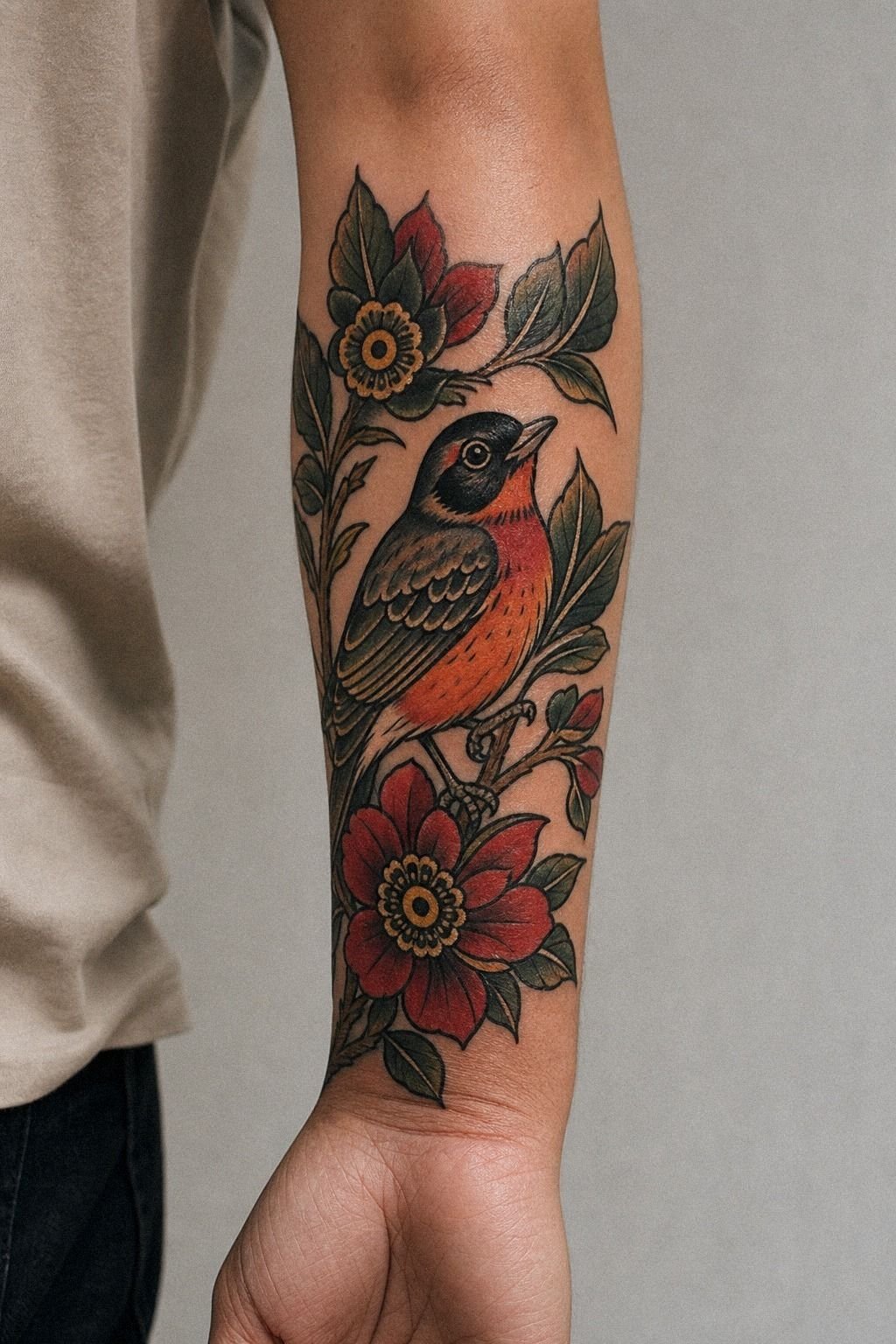
This was the real turning point. A neo traditional tattoo lives or dies on artist fit, so I stopped looking for someone who did everything and narrowed down to artists whose portfolios already showed healed neo trad tattoos on forearms, sternums, and upper backs.
You want crispy linework, not ten fuzzy passes trying to find the edge. I looked for solid black packing, smooth red saturation, and photos taken in clean daylight instead of heavy filters.
That mattered more than follower count, and it gave me a clearer booking read. My neo traditional tattoo artists guide is the same checklist I use when a client asks who really owns this style.
But I also checked whether the artist could draw panthers and florals and filler that belonged in the same family. One good dagger doesn’t prove they can build a sleeve.
3Panther Over Ornament? Pick The Shape That Holds
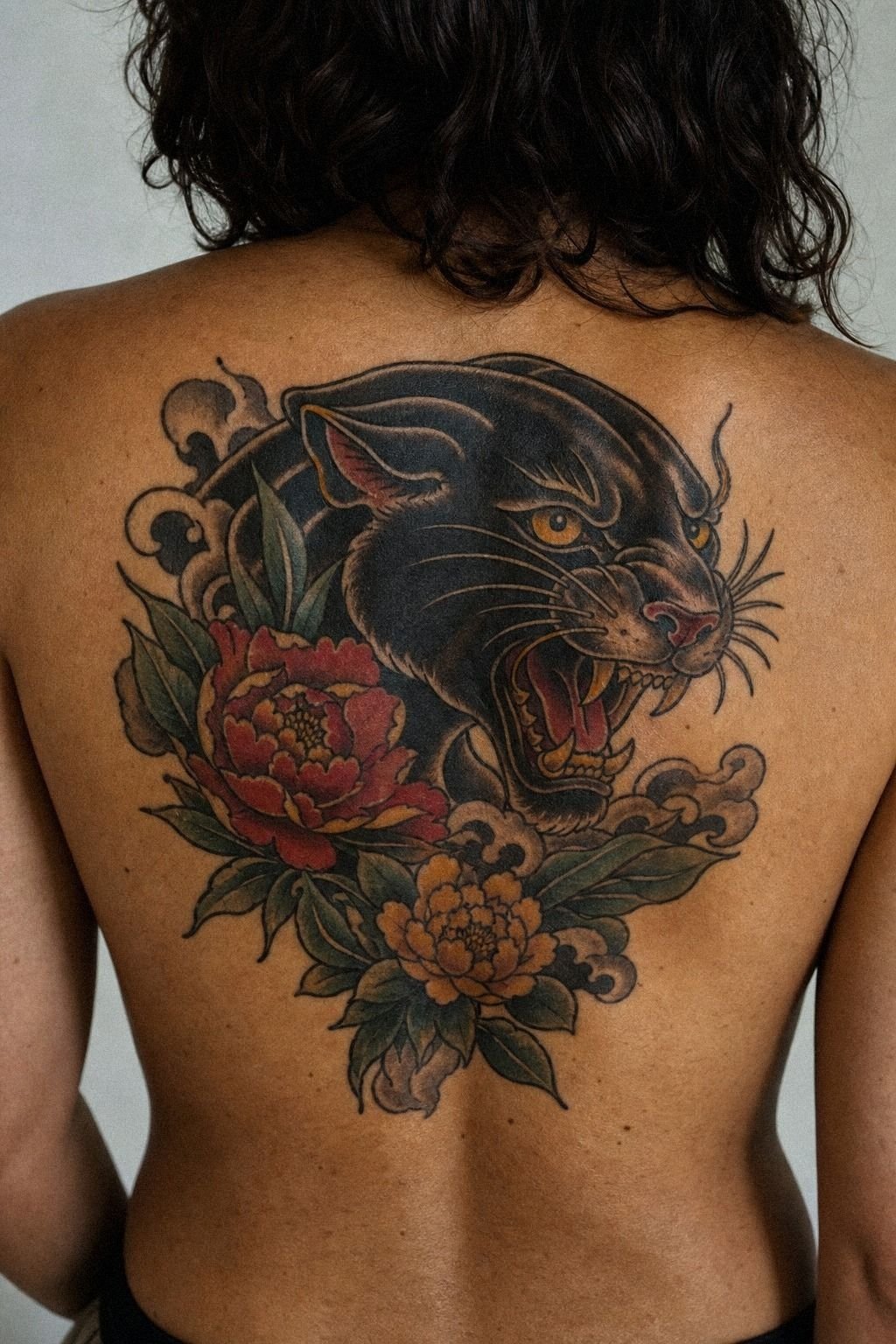
The panther was the piece that made everything click. Neo traditional needs a subject with bite, and a black panther motif gives you exactly that: heavy head shape, clean teeth, clear eyes, and enough body movement to wrap skin without looking stiff.
I chose it for the upper back sketch first because that placement lets you see how the silhouette behaves on a broader plane. If your motif falls apart on a flatter placement, it usually gets worse once it wraps an arm or ribs. A panther also makes a better long-term choice than ultra-fine ornamental ideas because the black mass stays readable.
If you want more old-school crossover references before you commit, the traditional tattoo artwork guide helps you see which classic shapes still hold when you push them into a modern traditional tattoo direction.
4Peonies Against Teeth Keeps The Piece Balanced
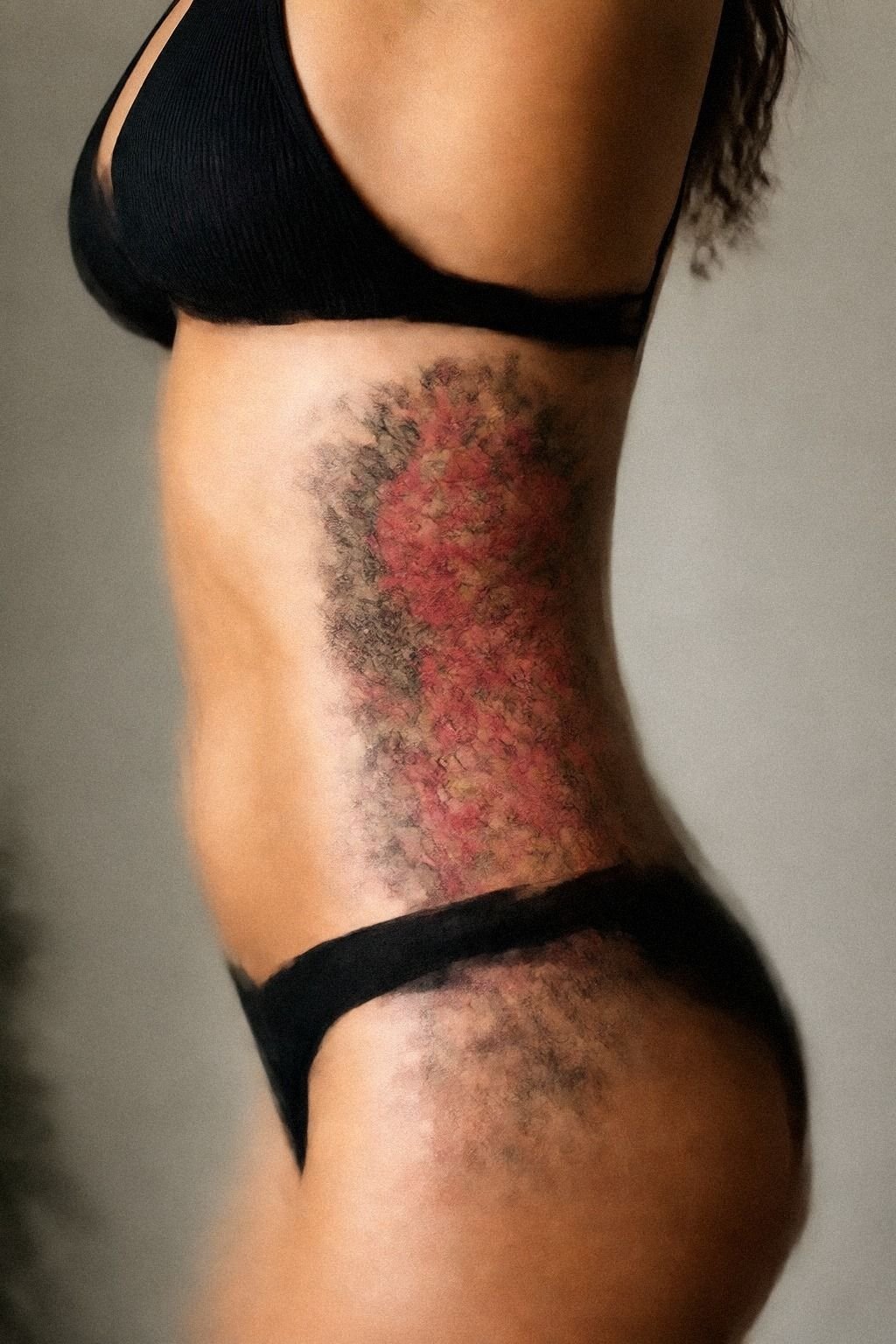
Once the panther was locked, I needed contrast in meaning and in shape. Peonies gave me both. A peony cluster softens the aggression of the cat without making the whole piece sweet, and the layered petals give you bigger color pockets that heal cleaner than tiny supporting filler.
On rib placement, everything is amplified. Lines feel sharper there, shading turns into a dull burn, and color packing is the spiciest part, so I wanted the flowers to ride the natural curve instead of fighting it.
You can see right away when floral work is just pasted on. The petals should open with the body, not buckle at the bend.
I also like peonies because they let you play symbolism without getting corny. Strength plus softness, done clean, will always beat random filler. If you’re comparing motifs, the traditional tattoo stars guide is useful for seeing how accent elements can support a main subject without stealing the read.
5Test The Design On Upper Arm Skin
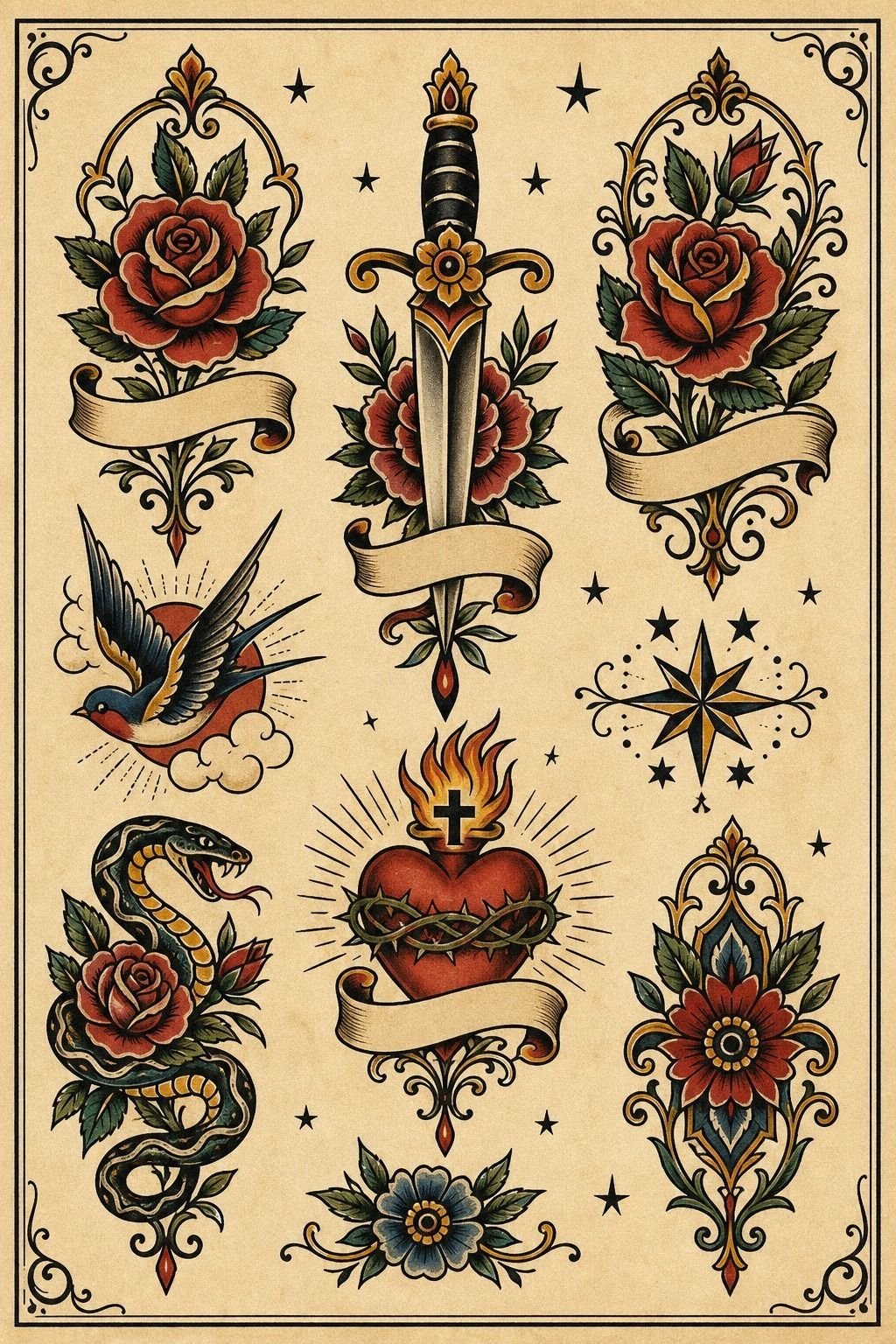
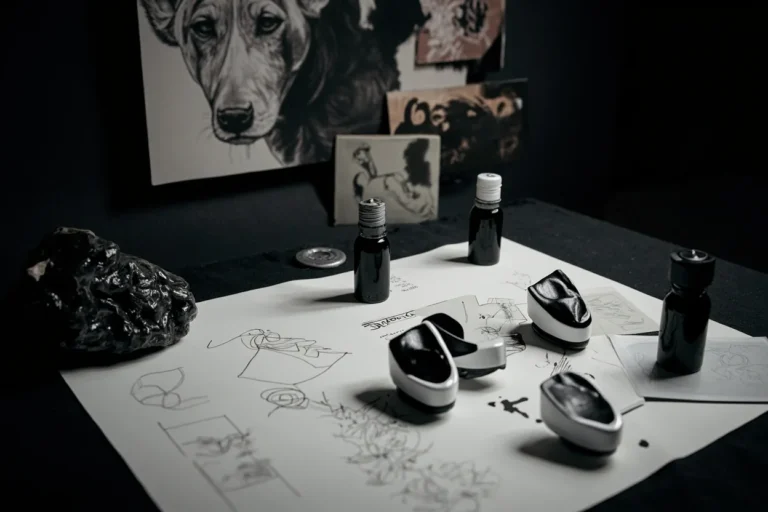
Before I approved scale, I tested the drawing the boring way, on paper first. The flash sheet stage matters because a flash drawing shows whether the design still has discipline when all you can judge is shape, line weight, and negative skin.
Then I mocked that same size on upper arm measurements, roughly 5 to 6 inches tall, because upper arm skin gives you enough width for the head, leaves clearance for petals, and heals more forgivingly than a wrist. That size is usually safer for first-time collectors than trying to cram a panther into 2 inches of skin.
Why upper arm placement first? Because if the design breathes there, you can usually adapt it to outer forearm or calf later. My traditional tattoo stencils guide explains how I judge whether a drawing has enough open skin before it ever touches a printer.
6Build A Half Sleeve, Not A Sticker
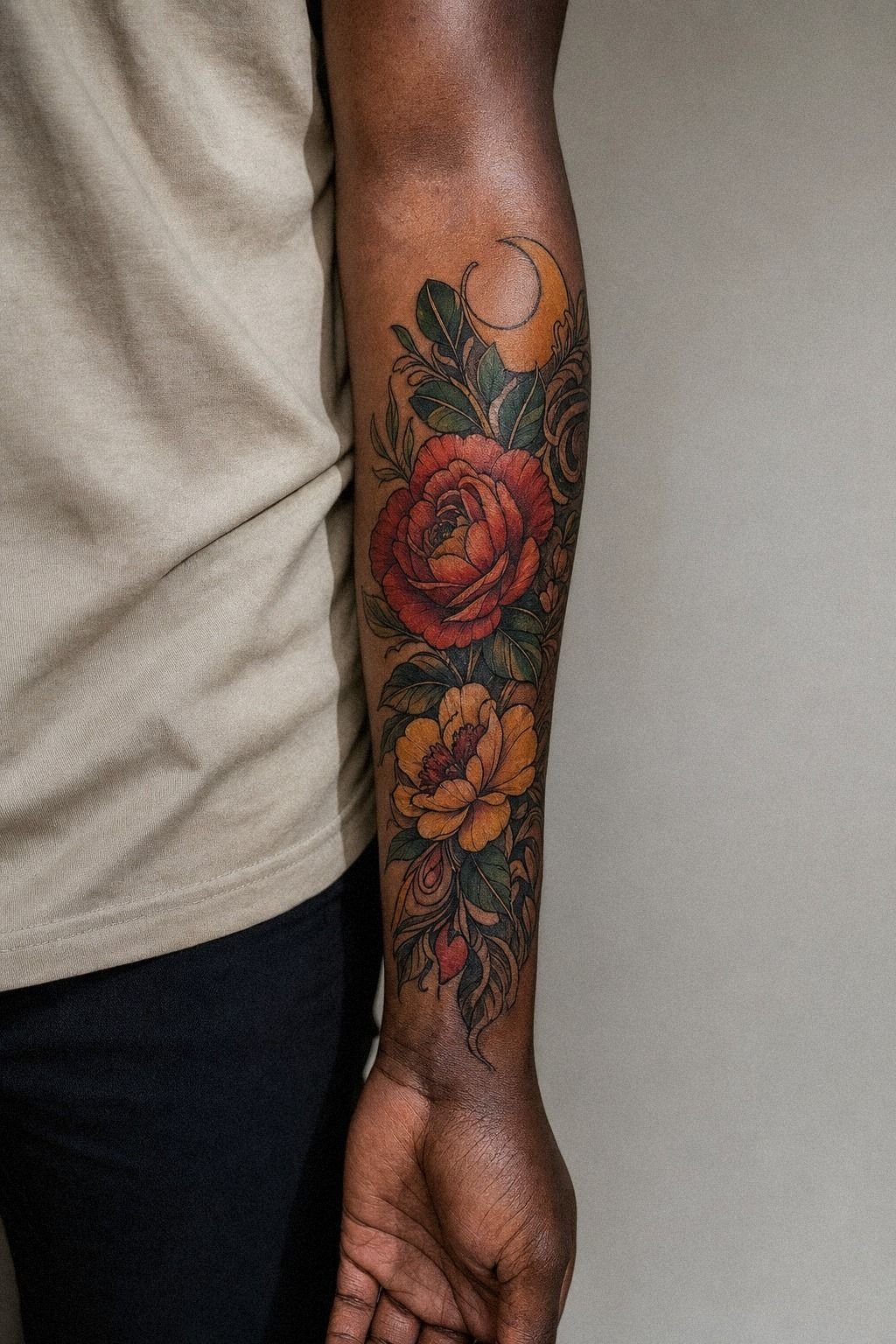
Once I saw the forearm mockup, I knew I didn’t want a single sticker. I wanted a sleeve plan. A neo traditional half sleeve works best when the anchor piece is chosen first, then everything else supports the flow from elbow ditch to wrist instead of crowding it.
I marked three zones: panther head as anchor, peonies as movement, and cloud filler to connect the bends. That kept the design from getting chewed up where the forearm rotates. On deep ebony skin especially, I wanted the black shapes big and deliberate so the whole piece would still read clearly after healing.
If you’re mapping a bigger project, sleeve planning matters early, and slowing down before you spend the deposit pays off. Look at neo traditional tattoo ideas first, then compare that with the traditional tattoo outline guide. You need the vibe, sure, but you also need structure.
7Keep The Palette Tight So The Value Stays High
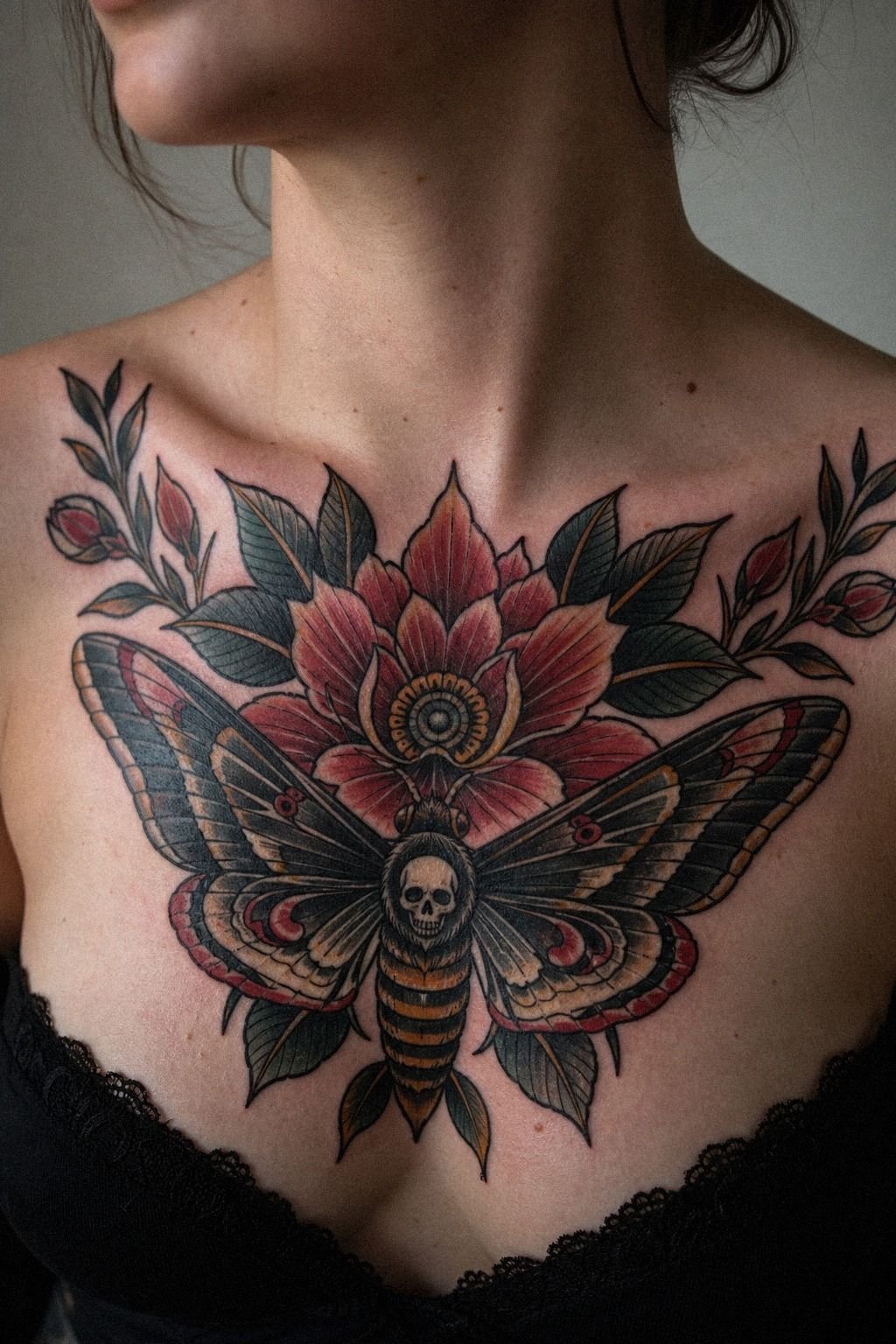
Color was where I nearly overcomplicated it. Modern traditional tattoos can go muddy fast when every petal, leaf, and cloud wants its own moment. I cut the palette down to oxide red, muted cream, olive green, and strong black.
That kind of restraint matters on sternum and forearm work because those placements already give you movement. Too many hues and the design loses authority. I wanted saturated red to hit, but I didn’t want candy-bright color that would fight the black outline two years from now.
But healed examples save you again here. Fresh red always looks hotter than it settles. If you want to study palette discipline, my neo traditional tattoo artists guide and traditional tattoo numbers guide both show how fewer colors can still feel rich without dragging the session longer for no reason.
8Let Bold Linework Carry The Whole Read
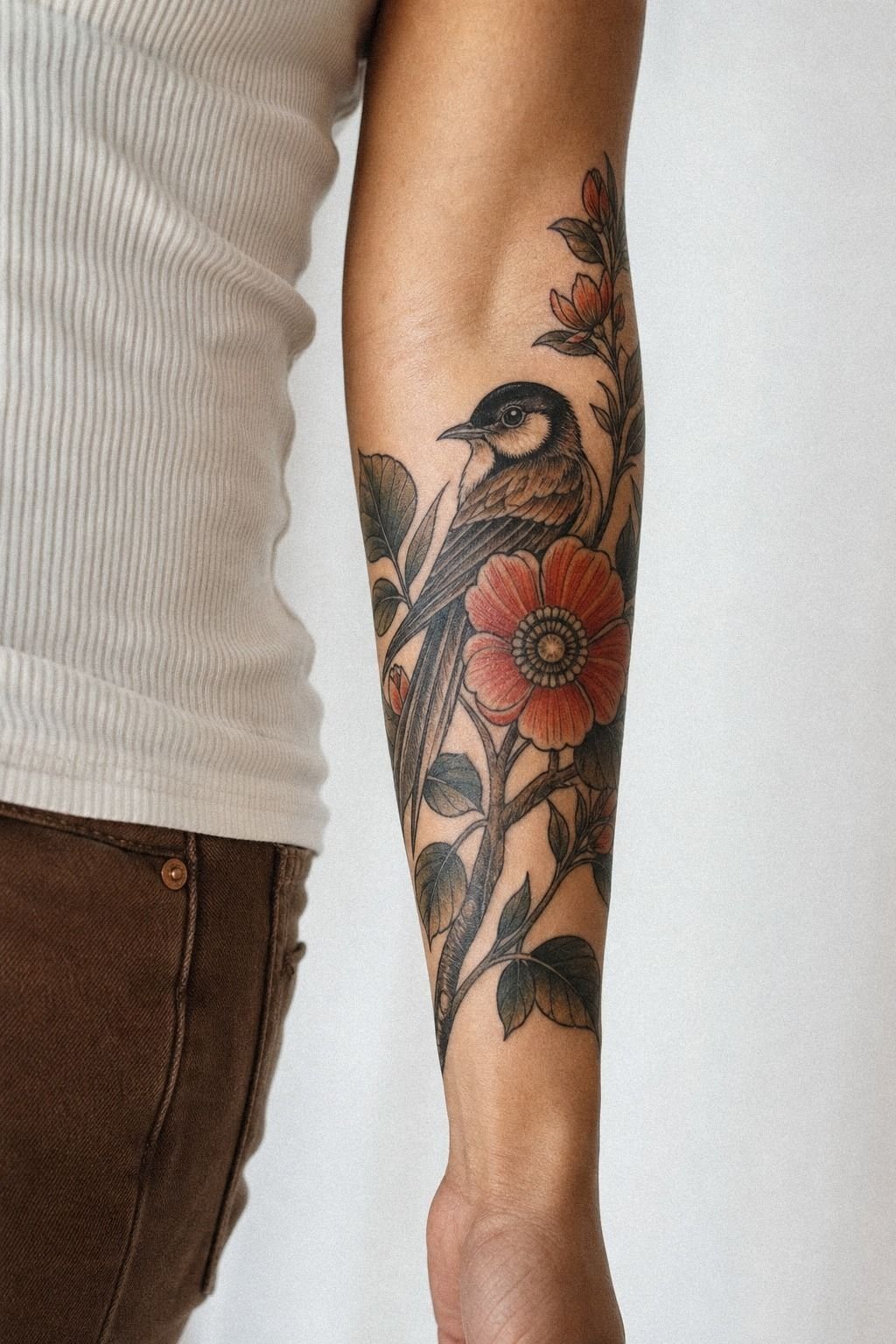
This was my non-negotiable. Neo trad falls apart fast when the lines get timid. I asked for bold outer linework with enough weight difference inside the design to separate whiskers, petals, and cloud curls without making the center too busy.
One clean pull, not ten fuzzy ones. That’s still the standard.
On a healed forearm piece, you can spot scratchy work from a few feet away because the edge looks restless, not intentional. You don’t need every tiny texture mark if the main silhouette is already doing the job.
If line confidence is the part you’re still learning to judge, the traditional tattoo outline guide breaks down exactly why some outlines hold and some spread into mush.
9Japanese Clouds Gave The Panther Real Motion
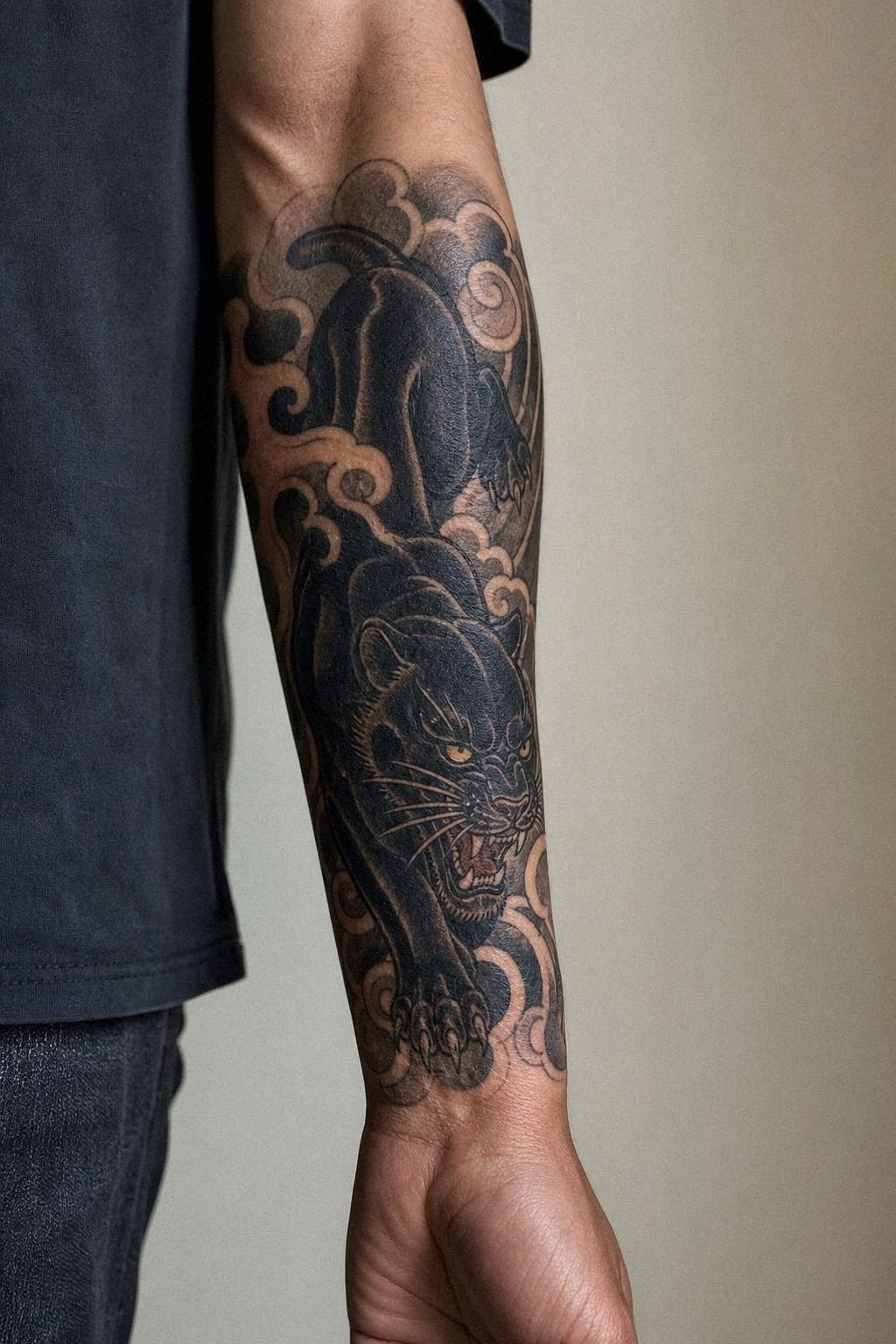
This is where Marco brain fully won. I didn’t want random filler, and I definitely didn’t want dots just because there was extra skin. Japanese cloud filler gave the panther movement, rhythm, and a bridge into traditional Japanese tattoos without turning the whole thing into straight irezumi.
Cloud filler works because it guides the eye around the forearm and gives the black shapes somewhere to land. On medium olive skin, that contrast can look clean and rich if the curls stay open. If you pack the filler too tight, you lose the airy breaks that keep neo trad readable.
And that blend of Western anchor plus Japanese motion is what made the sleeve feel grown up. If that crossover speaks to you, the traditional tattoo banner guide and traditional tattoo artwork guide are solid for studying how filler should support, not clutter.
10Does The Stencil Still Work When Your Arm Turns?
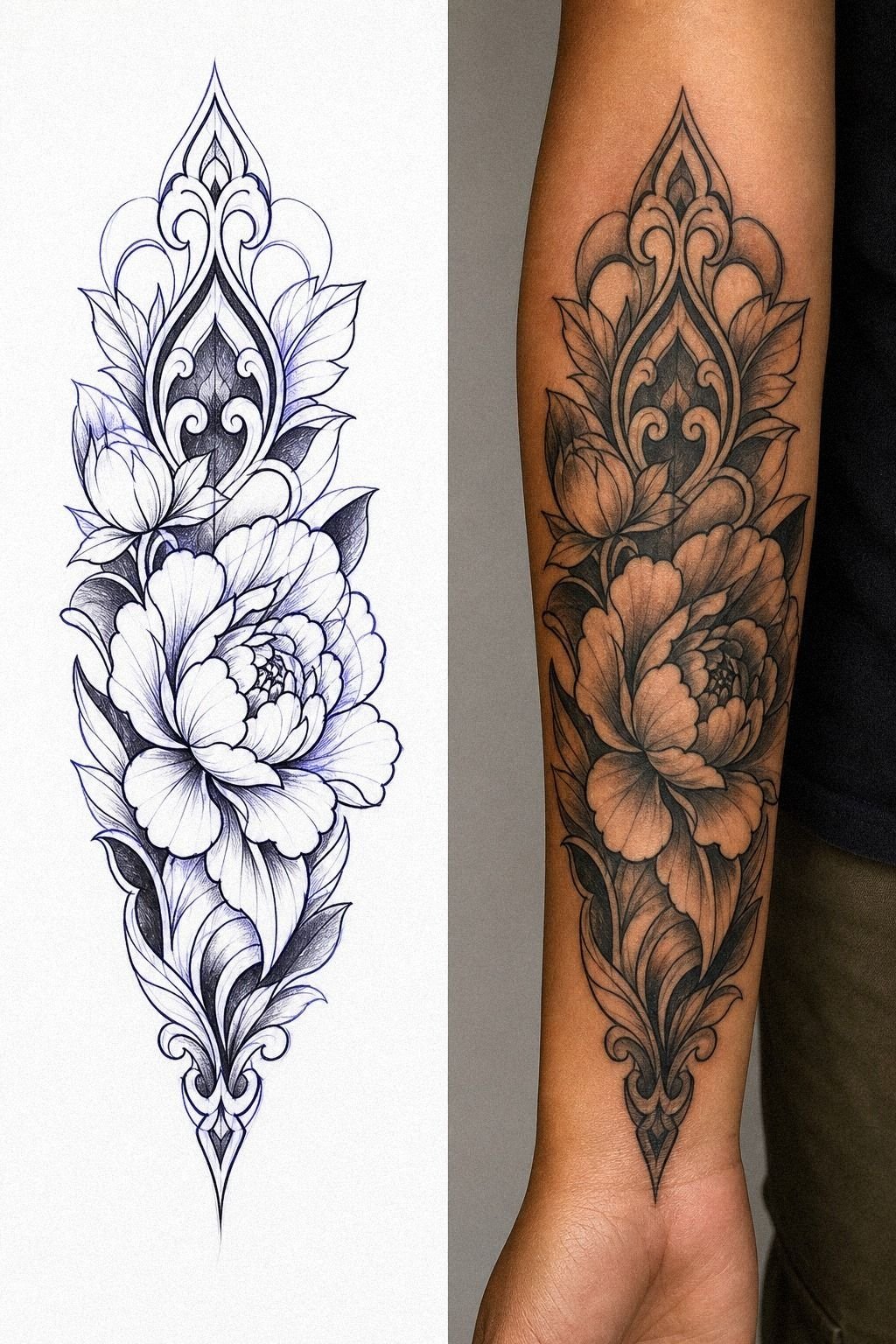
Stencil day tells the truth. A design can look perfect on paper and still die on skin if the wrap is off. I checked the thermal stencil from front, side, and slight rotation because forearms don’t read from one flat angle.
The big thing I watched was whether the panther face sat on the money panel and whether the secondary shapes tucked around the arm instead of splitting the focal point. You should be able to bend your elbow without chopping the face in half. If the eye or nose falls into a hard crease, I’d move it.
This is also when I measured session commitment. A forearm wrap at this scale can take 4 to 6 hours depending on linework and color density, so I built that into my budget before stencil day. The traditional tattoo stencils guide covers the same wrap logic if you’re trying to understand why some stencil placements look awkward even before the first line goes in.
11Approve Heavy Black Shading Before Color
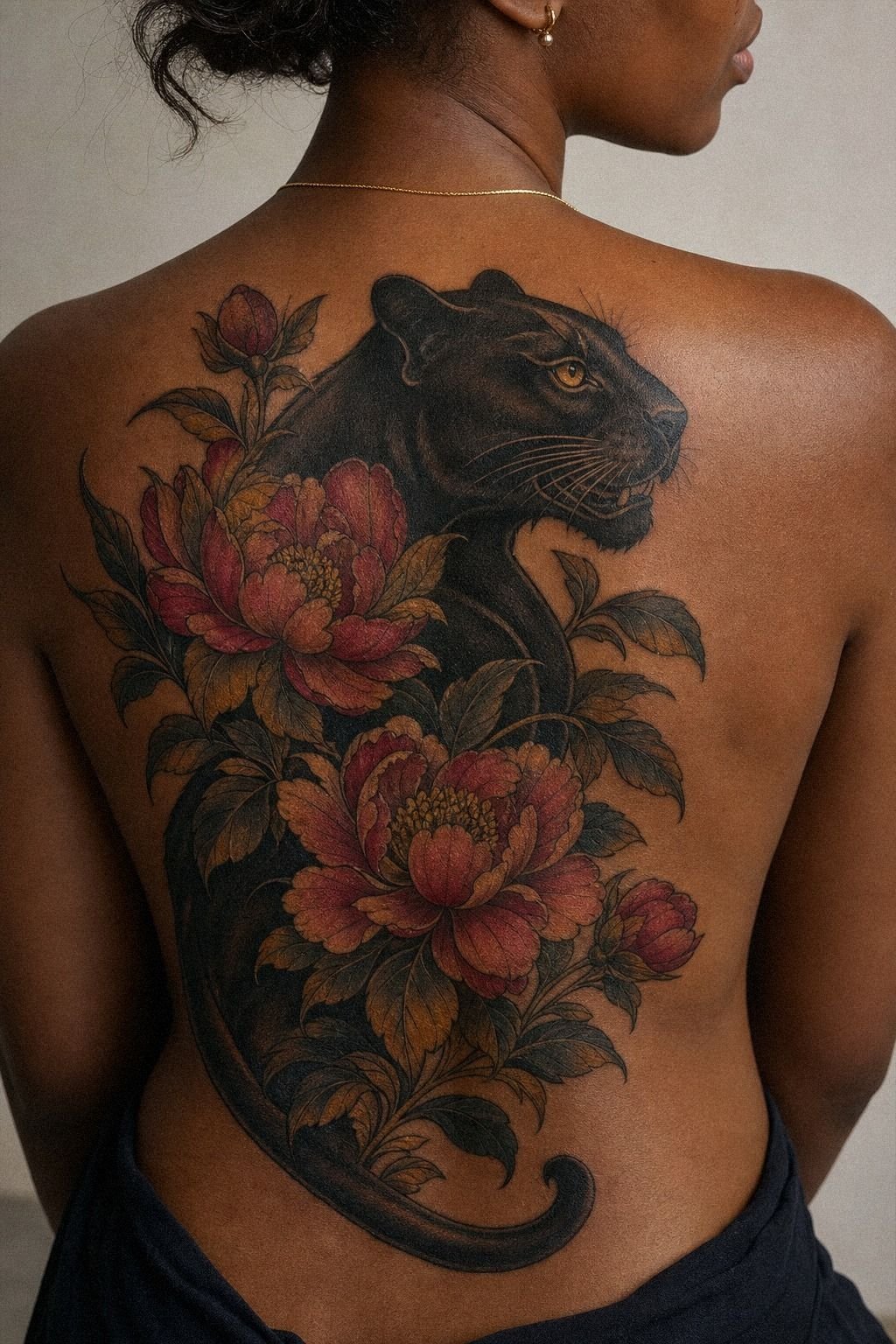
I signed off on the black first because black is your best friend for longevity. In neo traditional work, heavy black shading builds the skeleton.
Color is spice. If the black values are weak, the piece heals flat no matter how expensive the booking was.
On upper back compositions and broader sleeve zones, I like whip shade and packed black working together. Soft where the form turns, solid where the silhouette needs weight.
That keeps the piece velvety instead of patchy. It also helps darker skin keep that strong read without relying on pale highlights that may not stay visible.
But I would’ve skipped trendy grey fog for this design. The panther needed punch, not haze. My traditional tattoo outline guide explains why contrast is usually a better long-term bet than over-rendering.
12Saturated Red Ink Is Gorgeous, But Budget For The Bite
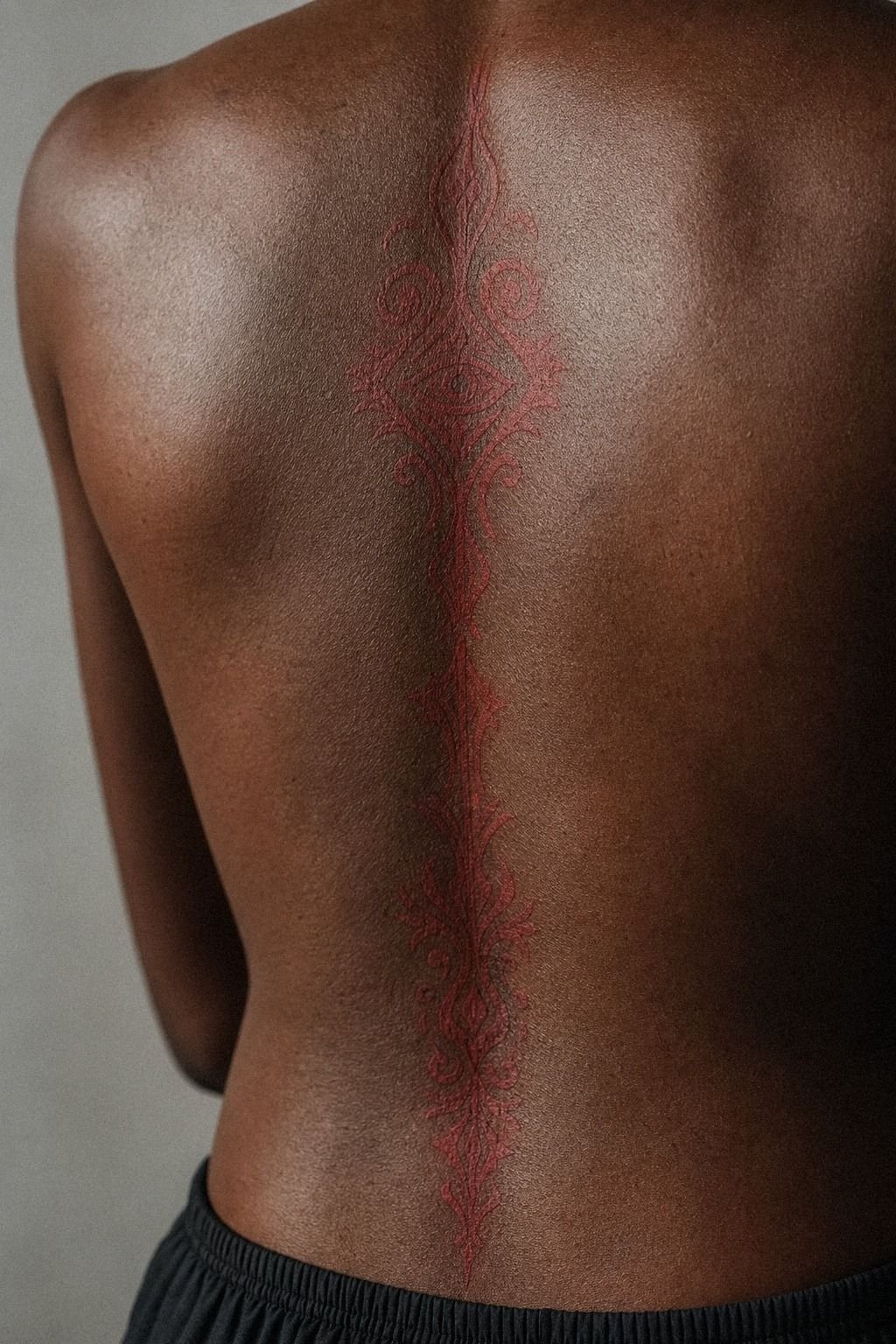
Red was the final push, and honestly, it was the spiciest part of the session. Saturated color over tender skin always has more bite, especially along the spine or any bony lane. I saved saturated red ink for last so the clean black structure was already finished even if I needed a breather.
Red packing should look solid, not scratched in. Big mags, smooth passes, no overworking. On deep ebony skin, I wanted the red used with discipline, mostly in petals and select accents, so it stayed rich next to the black instead of disappearing into visual noise.
If your artist can’t show healed red on multiple skin tones, ask harder questions. That’s not being difficult, that’s being smart. The neo traditional tattoo artists guide is built for that exact conversation, and it’s worth checking before you add color cost to your quote.
13Watch The Colors Settle Before You Judge The Value
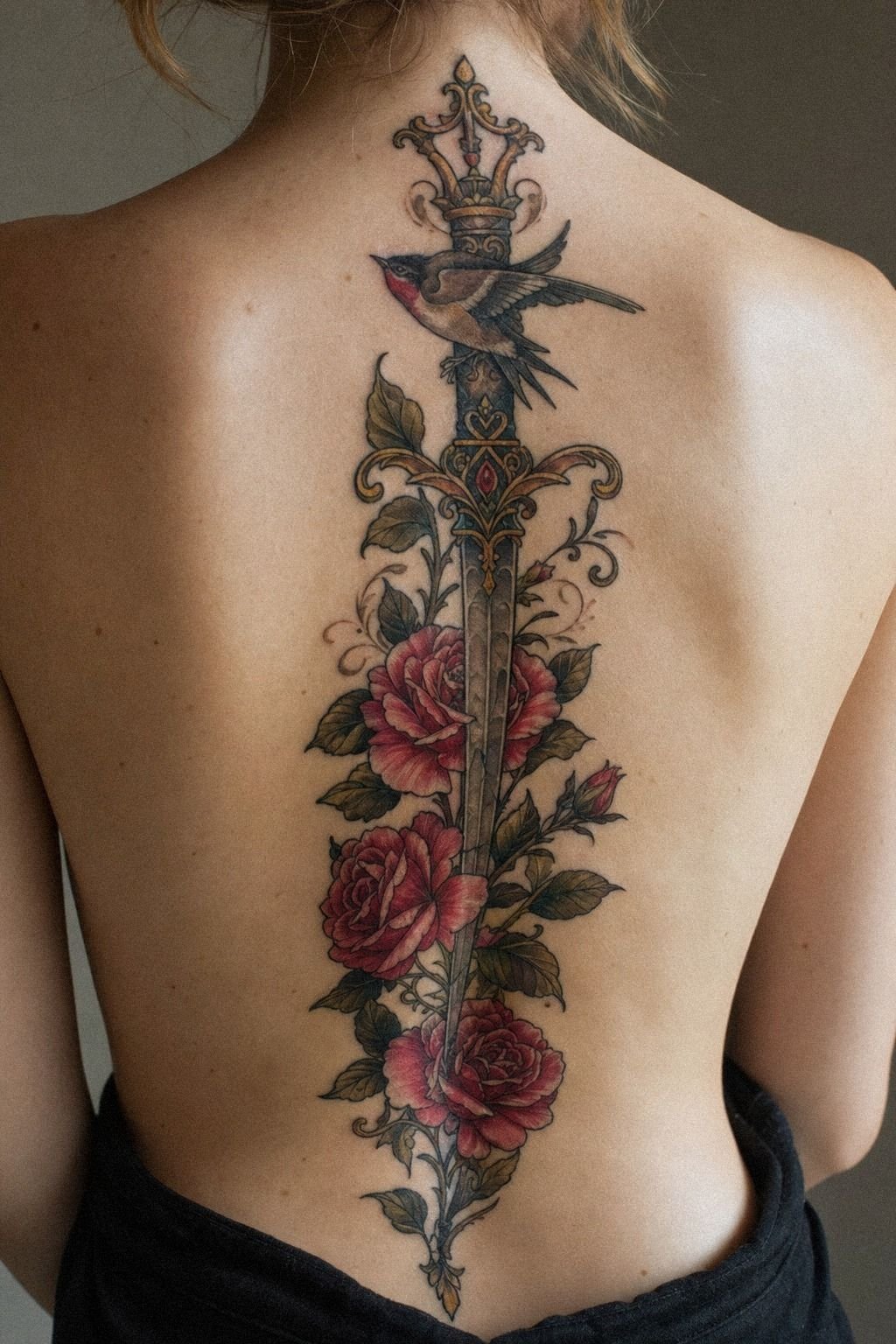
Fresh color isn’t the final look. Not even close. I watched the piece through peel, silver skin, and that weird shiny stage because a healed neo trad palette always settles softer than day one.
By week two to three, the surface was mostly closed. By month two, the true balance showed up.
The black stayed crisp, the red dropped into a deeper brick tone, and the cream highlights stopped yelling. That’s why I tell people not to judge color work on day three photos.
You’re looking at trauma, ointment, and swelling, not the final tattoo.
And this is also when you see whether the design was built to age or just built to impress fresh. If you want more examples of healed balance, start with neo traditional tattoo ideas and compare the freshest pieces against healed ones.
14Protect The Tattoo Through Peeling
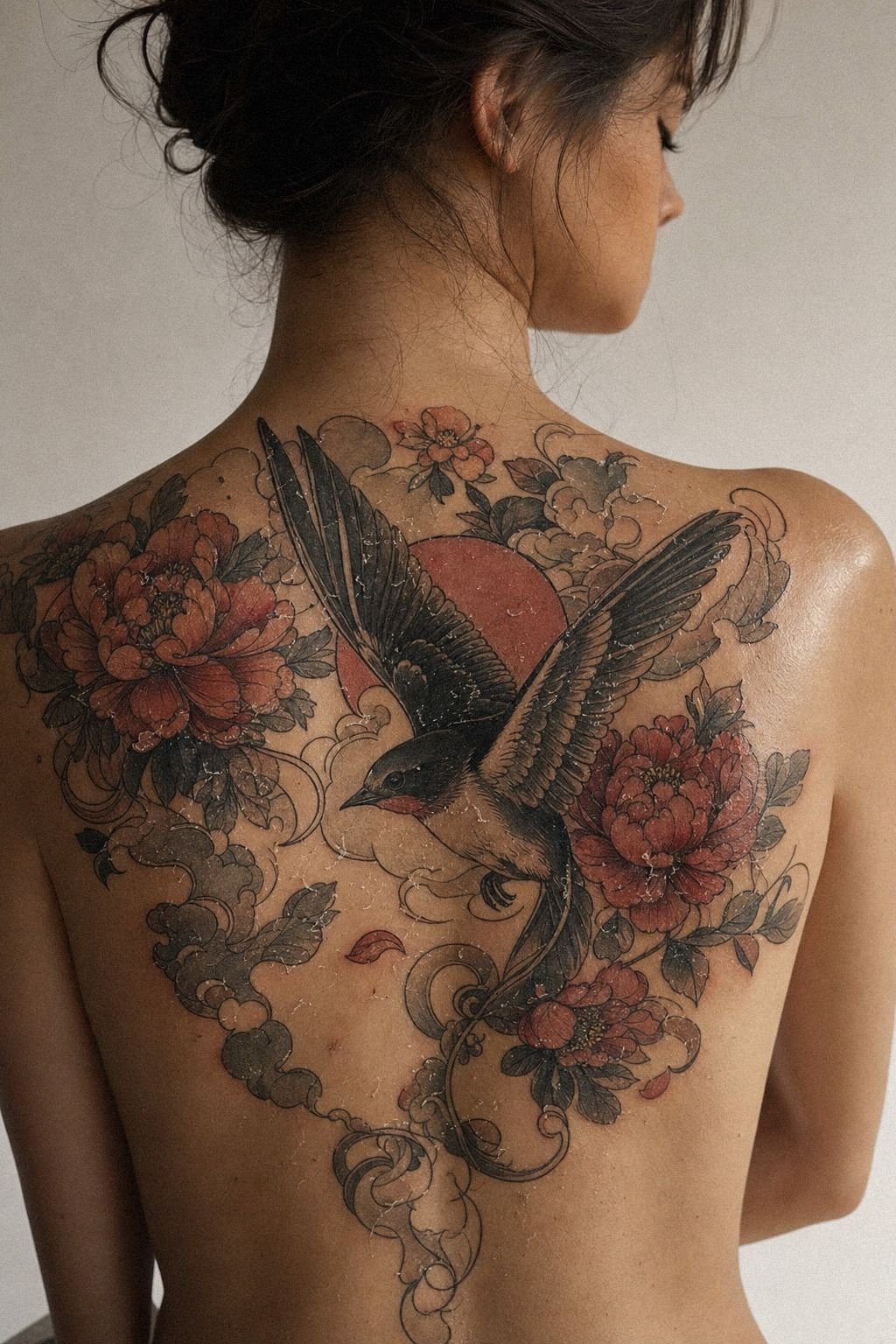
The first few days, it’s an open wound, treat it like that. I washed with gentle unscented soap, patted dry, then used a thin layer of fragrance-free ointment so the skin stayed calm without getting suffocated.
Peeling started like a light sunburn, exactly on schedule. I didn’t pick, I didn’t scrub, and I didn’t test it in the gym just because the lines looked closed.
Pools, hard sun, and friction are what kill a nice heal. Surface healing is usually around 2 to 3 weeks.
Full settling can take 2 to 3 months depending on placement and how hard you are on your skin.
If aftercare is the part you’re nervous about, keep it boring. Clean.
Thin product. Loose shirt. That’s it!
And if you need more outline-specific healing context, the traditional tattoo outline guide is a good extra read.
15Book The Tiny Touchup, Save The Whole Piece
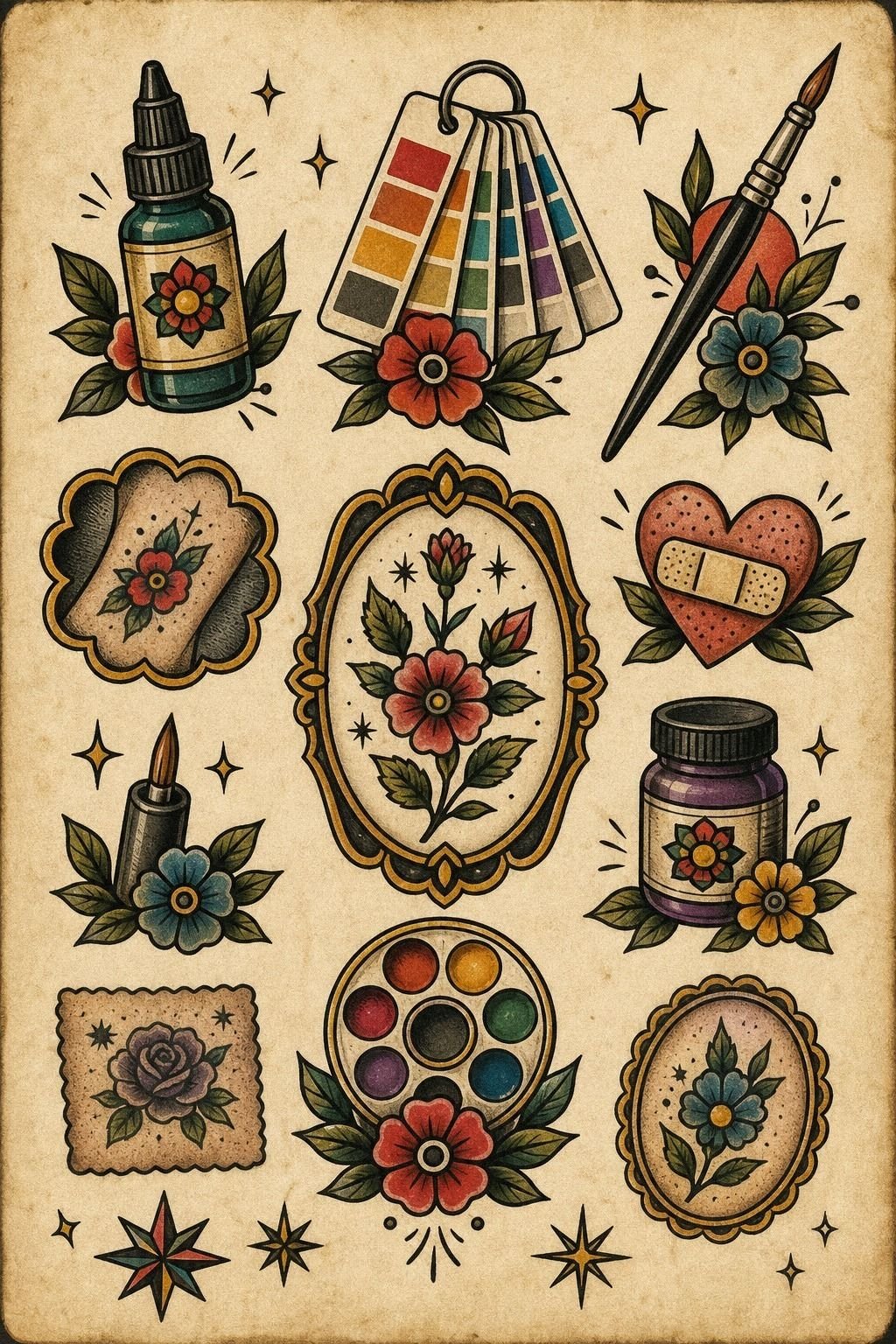
I didn’t need a full rework, just a tidy pass.
16Healed Neo Traditional Sleeve, Not Fresh Hype
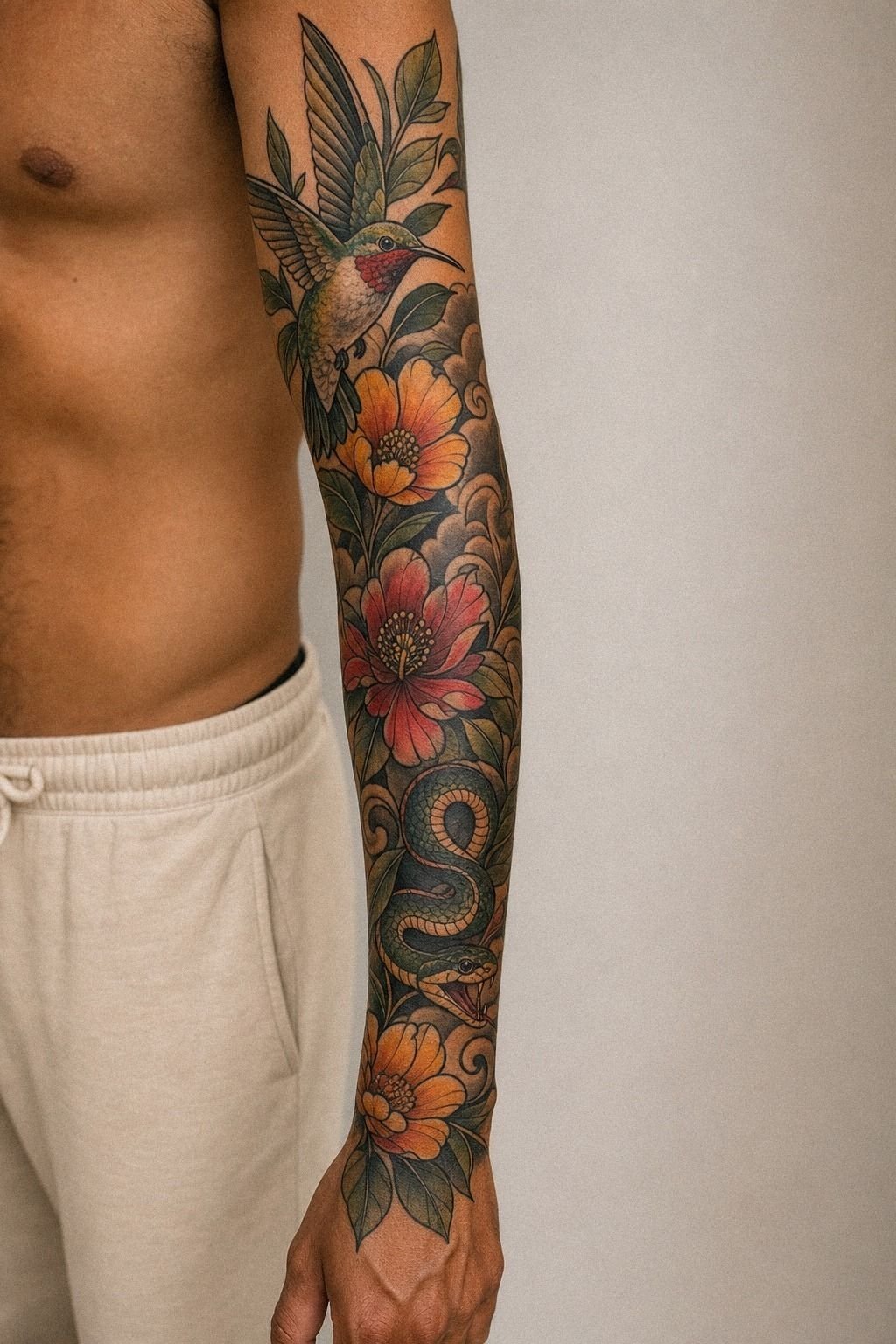
The healed sleeve photo mattered more to me than the fresh one. Fresh tattoos get likes. Healed tattoos earn trust!
A healed neo traditional sleeve shows whether the design still flows when the redness is gone and your skin looks like your skin again.
Mine held because the design bones were right from the start, bold linework, big black shapes, disciplined red, and enough open skin to keep every section readable. On golden tan skin, that balance can look rich without turning muddy, which is exactly what I wanted.
Would I do anything differently? Reference discipline would come sooner.
I’d place the first reference folder together sooner and stop chasing ultra-detailed inspiration that was never going to age cute on me. If you’re planning your own version, start with neo traditional tattoo ideas and my neo traditional tattoo artists guide before you ever send the deposit.
The Hold-First Rule That Made Neo Traditional Finally Click
Neo traditional finally made sense to me when I stopped judging it by fresh color and started judging it by hold. That’s the rule I wish more people used.
Does the tattoo still read when the shine is gone, the redness is gone, and you’re looking at healed skin in plain daylight instead of studio gloss? If the answer is yes, then the style is doing what it should.
I think people get tripped up because neo trad sits in the middle of two temptations. One side pulls too old school, heavy but a little stiff. The other side pulls too illustrative, full of tiny details that look fancy fresh and turn to soup later.
The sweet spot is structure first. Big silhouette.
Intentional black. Color that supports, not performs.
That’s where the style stops looking trendy and starts looking built.
In my chair, I see the same portfolio mistake over and over. A client brings ten screenshots with the same vibe but no shared construction.
One panther has tiny whisker filigree, one has soft watercolor petals, one has a Japanese wave field, and one is basically realism with thicker lines. You can’t weld all that together and expect it to heal nice.
The artist has to choose a language and keep speaking it. That’s why I kept coming back to the same questions: does the outline hold, do the filler shapes belong, and will you still like this once it stops looking brand new?
The best neo traditional tattoos don’t scream for attention. They sit right on the body, move with it, and still read clearly at a glance after a couple of years. That’s the click.
Not louder. Not busier. Just cleaner, smarter, and more honest about what skin can carry.
What Makes A Neo Traditional Tattoo Worth It?
Here was the honest booking math I used before I committed. In the US, shop minimums usually start around $50 to $100, and most strong neo traditional artists land around $100 to $250 per hour depending on region, demand, and how custom the drawing is.
My plan landed at about $900 for the main session before tip, based on 5 hours at $180 an hour. That felt fair for custom drawing, bold linework, black shading, and red packing in one focused sitting.
If your artist quotes more, that doesn’t mean it’s overpriced. It means you should check whether the portfolio backs it up, whether the design is truly custom, and whether the result feels worth it to you.
The Three-Check Rule Before You Book
Before you book neo trad, run three checks. First, does the healed work still have clean edge and readable black? Second, does the placement match the size, or are you forcing too much detail into too little skin?
Third, do you like the drawing because it is yours, or because you saw it go viral for a week?
That quick filter saves money, skin, and regret. And yes, it saves time too!
The Questions Worth Answering First
How much does a neo traditional tattoo usually cost?
Usually, a neo traditional tattoo costs about $100 to $250 an hour in the US, with many shops keeping a $50 to $100 minimum. Size, placement, and artist demand move the number. Bigger panthers, sleeves, and heavy color usually cost more because they take longer.
Are neo traditional tattoo a good idea for a first tattoo?
Yes, they can be a great first tattoo because bold linework ages well and the designs usually read cleaner than tiny trendy tattoos. Better starter placements, outer arm, thigh, calf.
Harder starters, ribs, sternum, hands. Keep the size honest and you’ll get a cleaner result out of the whole session.
How do I choose a tattoo artist for neo traditional tattoo?
Look for healed portfolio photos, not just fresh posts. Clean outlines.
Solid black. Saturated color.
A studio that feels clean and calm. And if the artist already tattoos neo trad well, that matters more than a general portfolio with one lucky piece.
How much do neo traditional tattoo hurt?
Pain depends on placement. Outer forearm, shoulder, and thigh are usually more tolerable.
Ribs, sternum, hands, feet, and spine get spicy fast. Lines feel sharper.
Shading is a dull burn. Color packing is often the part people remember most.
How long does a neo traditional tattoo take to heal?
Surface healing is usually 2 to 3 weeks, while full settling often takes 2 to 3 months. Wash with gentle unscented soap.
Thin ointment. No picking.
No pool. No hard sun.
Boring aftercare heals nice, and that’s the goal.
What’s the best placement for neo traditional tattoo?
For most people, outer forearm and upper arm are the safest bets because the lines have clearance to breathe and the placement shows the design well. They also tend to age better than tiny wrist or finger versions, which need more maintenance and more touchups.
Where I’d Start First
If I had to pick one, I’d start with the artist portfolio. A strong neo trad artist fixes weak references, but weak hands can ruin a perfect idea.
Save that first. Then book.